

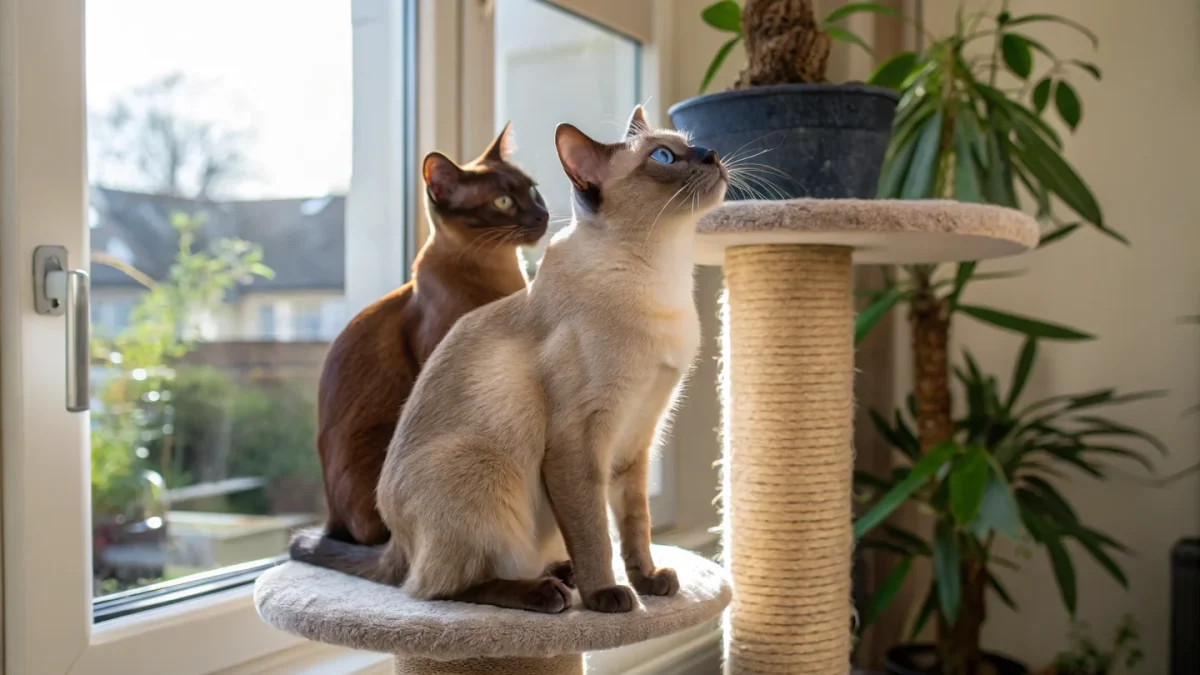
The Siamese is the class president: opinionated, vocal, constantly running the agenda. The Burmese is the class favorite: warm, affectionate, pleased to be wherever the people are. The Tonkinese is the student who somehow got the best qualities from both without the exhausting parts of either.
That's not a guarantee — individual cats vary, and no breed is a formula. But as characterizations go, it holds up better than most breed temperament descriptions. The Tonkinese genuinely occupies a middle ground between its parent breeds that isn't an average so much as a synthesis.
For the history of how that synthesis was deliberately created, the Tonkinese breed guide covers the origin story and genetic background.
The Siamese Inheritance: What Stayed
The Siamese is one of the most cognitively complex domestic cat breeds — curious, problem-solving, highly communicative, and deeply invested in human activity. These qualities don't disappear in the Tonkinese; they modulate.
Curiosity: Tonkinese cats investigate. A new object in the house will be inspected immediately and thoroughly. A new person will be approached with interest rather than wariness. Change in the environment is something to figure out, not something to hide from.
Intelligence: The Tonkinese learns quickly and retains what it learns. This shows up in training receptiveness — clicker training, recall, learning names — but also in less welcome ways, like figuring out how latches work or reading owner routines with enough accuracy to anticipate the 6am food window and begin lobbying at 5:45.
Social assertion: Tonkinese want to be involved. They don't wait to be invited into activity — they insert themselves. If you're working, there will be a cat on the desk. If you're reading, there will be a cat on the book. This is the Siamese's persistent social engagement, moderated rather than eliminated.
The Burmese Inheritance: The Counterbalance
The Burmese brings warmth and a settled quality that the Siamese lacks. Where a Siamese can feel like a cat with demands and a sense of entitlement, the Burmese — and the Tonkinese — has more of a sense of contentment. It wants to be with you; it's not requiring you to perform on cue.
Affection without agenda: Tonkinese are physically affectionate in a way that feels genuine rather than transactional. They seek laps, lean into hands, and purr reliably during contact. The Siamese can be affectionate too, but it has more conditions. The Tonkinese is simply glad to be with you.
Adaptability: Burmese cats adapt readily to household changes, new people, and shifting schedules. The Tonkinese inherits this. Where a pure Siamese may express unhappiness about a change in routine loudly and repeatedly, the Tonkinese typically adjusts with good grace.
Steadiness: Tonkinese are not easily startled or reactive. They process new stimuli with curiosity rather than alarm. This makes them more straightforward to live with in busy, varied households than breeds with more nervous temperaments.
The Voice: Present but Not Piercing
Tonkinese are communicative cats. They have opinions, and they express them — but the register is conversational rather than demanding. The classic Siamese yowl — persistent, operatic, impossible to ignore — isn't part of the Tonkinese toolkit. The Tonkinese chirps, trills, and makes its soft-voiced commentary at a level that most owners describe as charming rather than wearing.
This does mean they're not silent. Tonkinese will tell you when they're hungry, when they'd like the door opened, when the play session they've been anticipating since 4pm hasn't materialized. They simply do it with a softness that doesn't commandeer the room.
Play and Mental Engagement
Tonkinese need play and mental engagement as a genuine requirement, not an optional enrichment. A Tonkinese without sufficient stimulation becomes an invention machine — and cats are better at finding interesting things to do in a home than owners typically anticipate.
The good news is that the engagement bar isn't unreachable. Daily interactive play sessions of 15–20 minutes, puzzle feeders, and a reasonable assortment of toys they can interact with independently covers the need for most cats. The Tonkinese isn't as extreme in its activity requirements as an Abyssinian or a Bengal; it's interactive, not relentlessly athletic.
What they need most is time with their people. The toys and puzzles are supplements — the primary enrichment is you.
With Children
Tonkinese are genuinely good with children who know how to interact with animals. The breed's confidence means it doesn't hide from energetic household members, and its playfulness makes it an enthusiastic participant in games and activity. A Tonkinese will often seek out children who play rather than avoid them.
With very young children, the usual supervision applies. Tonkinese are not aggressive, but they are interactive enough that an unpredictable toddler and a curious cat can generate situations worth managing.
Multi-Pet Dynamics
The Tonkinese's social nature extends to other animals with less complication than with many breeds. They typically accept other cats readily, especially if introduced properly. With dogs, outcome depends more on the dog than the cat — the Tonkinese will generally approach with curiosity rather than immediate retreat.
Pairing two Tonkinese is often described as ideal: they entertain each other, maintain their social nature with fewer demands on the owner, and form the kind of mutual bond that clearly enriches both cats' lives.
The Tonkinese vs. Pure Siamese: The Critical Difference
People who have owned traditional Siamese — and the Siamese temperament that defines one half of this breed's character is genuinely distinctive — sometimes describe the Tonkinese as "everything I loved about the Siamese without the parts that drove me crazy." That's a generous framing, but it identifies something real.
The pure Siamese, particularly the traditional type, can be vocally demanding to a degree that becomes genuinely stressful for owners who didn't anticipate it. The intelligence that makes Siamese fascinating also makes them persistent in ways that wear on people. The Tonkinese has the engagement and intelligence without the relentlessness.
If the Siamese is the cat that runs the household and expects acknowledgment of that fact, the Tonkinese is the cat that considers itself a full member of the household and acts accordingly — engaged, affectionate, present — without the power struggle.
What Kind of Household Suits a Tonkinese
The Tonkinese thrives in active, social households — families with children, people who work from home, households with other social pets. They do well in multi-cat setups. They adapt to apartment life if given sufficient enrichment and play.
They are not ideal for people who are frequently away for extended stretches without another animal present. The social need is genuine, and a consistently lonely Tonkinese doesn't thrive.
They are not high-maintenance in terms of care — grooming is simple, health is generally robust — but they are high-maintenance in terms of time. They want interaction, and providing it is what the relationship is built on. Give them that, and a Tonkinese is one of the most rewarding domestic cats available.