

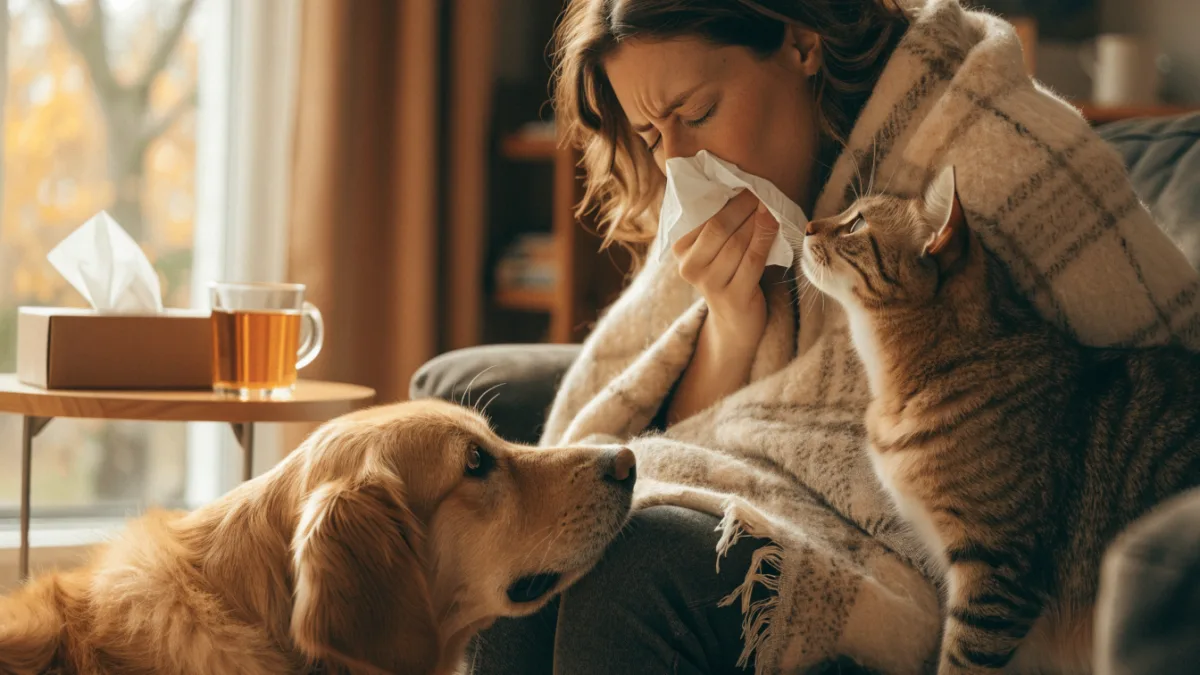
Last winter, a client named Maria brought her 4-year-old domestic shorthair cat, Whiskers, into the clinic. Whiskers had been sneezing, lethargic, and refusing to eat for two days. Maria looked exhausted herself — she’d been battling a nasty bout of the flu for nearly a week. “I know this sounds crazy,” she said, “but did I do this to her?” My answer surprised her: maybe, yes. We ran tests, and it turned out Whiskers had picked up a respiratory infection that was almost certainly linked to Maria’s illness. It’s a scenario more common than most pet owners realize, and it’s called reverse zoonosis.
What Is Reverse Zoonosis, Exactly?
Most of us are familiar with the concept of,[1] — diseases that jump from animals to humans. Rabies, Lyme disease, and cat-scratch fever are classic examples. But the traffic on this particular road doesn’t just flow one way. Reverse zoonosis, also called anthroponosis, is when humans pass pathogens to animals. And according to a [2] it happens far more frequently than the veterinary community once believed.
I’ll be honest — when I first learned about reverse zoonosis in veterinary school, it was treated almost as a curiosity. Something that technically existed but rarely mattered in clinical practice. I’ve changed my mind on this over the past decade. The evidence has become increasingly difficult to dismiss, particularly when it comes to influenza viruses and coronaviruses making the leap from humans to companion animals.
The Common Cold Myth Versus Reality
Here’s where I need to clear up a very common misunderstanding. When clients ask me, “Can I give my dog my cold?” the answer depends entirely on what we mean by “a cold.”
Rhinoviruses: The Good News
The rhinovirus — the virus responsible for the majority of human common colds — is remarkably well-adapted to human hosts. It has evolved over millennia to latch onto specific receptors in human nasal passages. Dogs and cats don’t have the same cellular receptors, which means the standard rhinovirus essentially bounces off their cells like a key that doesn’t fit the lock. So if you’re sniffling from a garden-variety cold caused by rhinovirus, your pet is almost certainly safe.
Influenza and Coronaviruses: The Complicated News
Influenza and coronaviruses, however, are a different story. These viral families are responsible for the majority of confirmed reverse zoonosis cases in companion animals. Unlike rhinoviruses, influenza viruses are notorious for their ability to reassort — essentially shuffling their genetic material when they encounter a new host species. And coronaviruses, as we all learned rather dramatically during the COVID-19 pandemic, have shown an unsettling willingness to jump between species.
I remember reading early reports in 2020 about cats and dogs testing positive for SARS-CoV-2 after close contact with infected owners. At the time, some colleagues dismissed these as isolated incidents. But the pattern has become clearer: when a human sheds certain viral particles around a pet, particularly a cat, transmission is biologically possible.
Should You Snuggle Your Pet When You’re Sick?
This is the question I get asked most often during cold and flu season. A client named David once called me, panicked, because he’d been cuddling his elderly Golden Retriever, Biscuit, for three days straight while recovering from the flu. He was convinced he was poisoning his best friend.
Here’s my balanced take: routine colds and standard seasonal flu generally do not pose a significant threat to healthy dogs and cats. The infectious disease specialists are largely correct when they say that everyday respiratory viruses don’t easily cross the species barrier. If you have a routine cold, you don’t need to quarantine yourself from your pet.
However — and this is where I part ways with the overly simplistic reassurance — the scientific literature clearly shows that reverse zoonosis does occur, particularly with influenza strains and coronaviruses. So while you don’t need to treat your pet like a leper when you’re under the weather, a little common-sense hygiene goes a long way.
Practical Guidelines When You’re Ill
The [2] emphasizes that cats are particularly susceptible to picking up human pathogens through contaminated bodily secretions. With that in mind, here’s what I recommend to my clients:
- Keep your sneezes and coughs covered. This seems obvious, but many people let their guard down at home. A tissue or your elbow works — just don’t sneeze directly on your cat.
- Avoid face-to-face contact when symptomatic. I know it’s tempting to let your cat nuzzle your face when you’re feeling miserable, but this is exactly how respiratory droplets transfer. A gentle stroke on the back works just fine.
- Wash your hands before handling food bowls, toys, or bedding. Viral particles on your hands can contaminate surfaces your pet interacts with closely.
- Keep nasal discharges away from pets. Used tissues should go straight into a closed trash bin, not on the nightstand where a curious cat might investigate.
- Be extra cautious with very young, elderly, or immunocompromised pets. Just as with humans, the very old, the very young, and those with weakened immune systems are at higher risk for complications.
Why Virologists Worry About Species Jumping
There’s a deeper concern here that goes beyond whether your individual pet catches your sniffles. Every time a virus successfully jumps from a human to an animal, it enters a new host environment — and that’s where things can get unpredictable.
When a virus replicates in a new species, it has the opportunity to mutate. Most mutations are biologically meaningless. But occasionally, a mutation produces a variant that could be more transmissible, more severe, or capable of jumping back to humans in a modified form. This is exactly how virologists believe some concerning influenza variants have emerged over the years — through intermediate animal hosts.
I don’t say this to alarm anyone. These events are relatively rare. But the post-pandemic surge in research on human-to-animal viral transmission has made one thing clear: the interface between human and animal health is far more porous than we once thought.
Cats: The Especially Vulnerable Companions
The Umar study and several others have highlighted something that feline practitioners have suspected for a while: cats appear to be more susceptible to reverse zoonosis than dogs. Their cellular receptors seem to accommodate certain human respiratory viruses more readily, and their close physical proximity to owners — sleeping on beds, grooming themselves after contact with human skin — creates multiple transmission opportunities.
This doesn’t mean cat owners should live in fear. But if you have multiple cats, or a senior cat with feline asthma or other respiratory vulnerabilities, it’s worth being a bit more careful during cold and flu season.
I think about Maria and Whiskers often. Whiskers recovered fully with supportive care — fluids, appetite stimulants, and time. But Maria left the clinic with a new awareness of how interconnected their health really was. She still cuddles Whiskers when she’s sick, but she keeps her face turned away, washes her hands more often, and disposes of tissues immediately. Small changes, meaningful protection.
What About Wildlife?
While cats and dogs are the focus of most pet owners’ concern, the broader implications of reverse zoonosis extend far beyond our living rooms. Humans passing respiratory viruses to wildlife populations represents one of the most significant conservation challenges of our time. Mountain gorilla tourism in Rwanda and Uganda has been transformed by the realization that human respiratory viruses can devastate already-fragile ape populations. Ecotourism operators now require masks, distance minimums, and health screenings — not to protect the tourists, but to protect the animals from us.
The same principle applies closer to home. If you’re sick, it’s not just your pets who might be at risk — it’s the wild birds at your feeder, the neighborhood stray cats, and any wildlife that encounters your contaminated tissues or unwashed hands.
We tend to think of ourselves as separate from the animal world, protected by our species boundaries. But viruses don’t respect those boundaries. They never have. The health of our pets, our wildlife, and ourselves is deeply interconnected — and recognizing that connection is the first step toward protecting all of us, one species at a time.
Sources
- zoonosis — epi.ufl.edu
- 2024 study published by S. Umar in PubMed Central — pmc.ncbi.nlm.nih.gov