

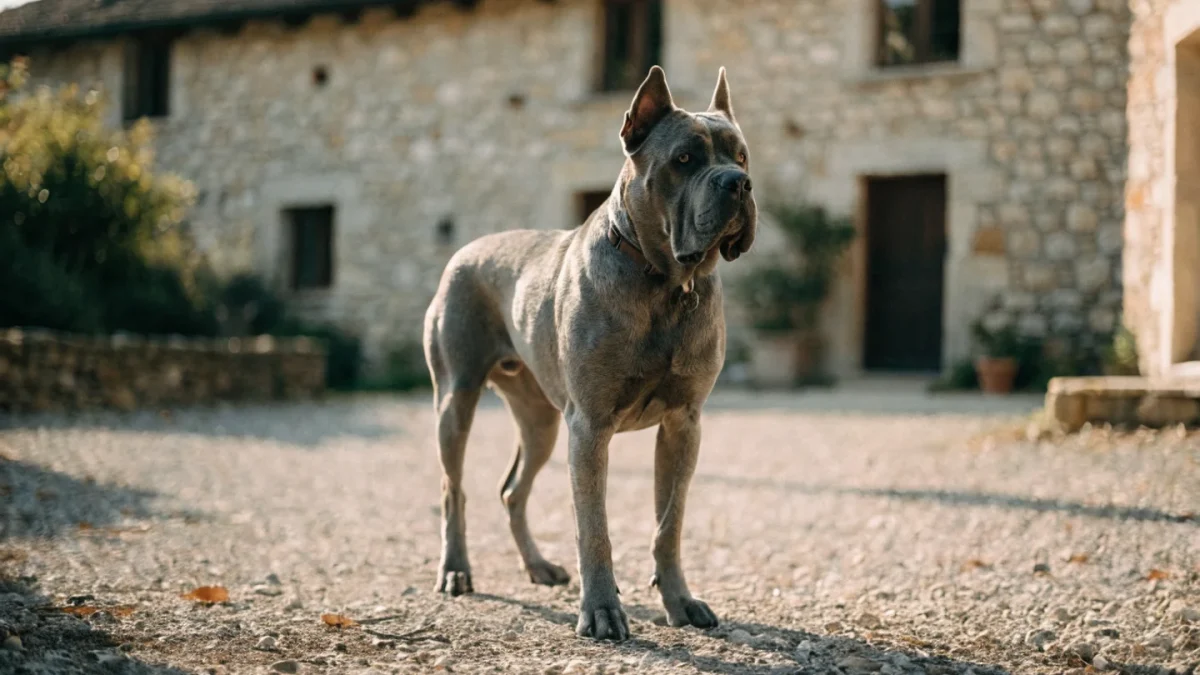
Every registered Cane Corso alive today traces back to a handful of dogs recovered from rural southern Italy between 1973 and the mid-1980s. That founding group was small — not "modest-sized," not "limited" — small. The FCI granted the breed full recognition in 2007, by which point the entire modern population had already descended from that narrow base. The breed has been gaining popularity at a rapid clip ever since, which means you have an increasing number of dogs deriving from a gene pool that never had much margin to begin with.
That bottleneck matters for more than academic reasons. Closed stud books mean no new genetic material enters the population. Each generation narrows the variation available for selection. And when popular sires get used heavily — which happens in any breed that spikes in popularity — the effective population size collapses even faster than the total numbers suggest. Understanding Cane Corso genetics means understanding what happens downstream from that founding moment: what the breed's coat colors tell us about individual genotypes, what health conditions travel through the population because of high homozygosity, and where screening can actually help.
Coat Color Genetics
Three loci play the primary roles in Cane Corso coat color.
The K Locus. The dominant K^B allele produces solid black (or gray, if dilution is present). The recessive k^y allele allows A-locus expression — fawn and brindle. A dog that is K^B/K^B or K^B/k^y will be solid-colored. A k^y/k^y dog expresses the A locus pattern.
The A Locus. In k^y/k^y dogs, the A locus determines fawn (A^y) or brindle (k^br modifying the A^y base). Brindle intensity varies from sparse stripes to near-solid dark brindling.
The D Locus. Two copies of the recessive d allele dilute black to gray (blue) and fawn to formentino. Color dilution alopecia (CDA) — hair thinning, dry skin, and follicular inflammation — has been reported in dilute Corsos. The Cane Corso is listed among affected breeds in veterinary dermatology literature, but breed-specific prevalence data comparable to what exists for Dobermans (where CDA affects roughly 50 to 90% of dilute individuals) has not been published for the Cane Corso. The risk appears breed-dependent — not all dilute dogs develop CDA, as demonstrated by Weimaraners, which are entirely dilute yet rarely affected.
The standard recognizes black, grays (lead, slate, light), fawns (light, dark, stag red), and brindle variants. Fawn and brindle dogs carry a black or gray mask. Small white patches on chest, toes, and nasal bridge are permissible. Chocolate, tan points, merle, and large white markings fall outside the standard.
The color premium problem. Market demand for blue, formentino, and heavy brindle has created pricing tiers unrelated to genetic quality. A blue Corso requires two copies of a common recessive allele — it is not genuinely rare. Breeding driven by color demand rather than soundness degrades the breed.
The Gene Pool Problem
The breed's recovery from near-extinction drew from limited founding stock. Closed stud books mean no new genetic material enters the population. Each generation within a closed pool increases homozygosity, exposing recessive disease alleles and reducing immune diversity.
The Corso hasn't reached the extreme inbreeding coefficients of some older closed-registry breeds, but the trajectory is concerning — particularly as popular sire syndrome concentrates breeding around a few heavily used males, rapidly narrowing effective population size even as total numbers grow. Responsible breeders track inbreeding coefficients and select pairings that maintain genetic diversity.
Hip Dysplasia Genetics
Hip dysplasia is polygenic — multiple genes interacting with environmental factors (growth rate, nutrition, body weight, developmental exercise). Heritability estimates for canine hip dysplasia range from 0.1 to 0.68 across breeds. Breed-specific heritability data for the Cane Corso is limited, though a French retrospective study of radiographic screening from 1997 to 2017 found the Cane Corso had one of the highest overall hip dysplasia prevalence rates at approximately 52% — notably, the study also documented a significant decrease in prevalence over the screening period, suggesting that systematic screening is improving outcomes.
Screening both parents through standardized radiographic evaluation is the minimum. It reduces population-level prevalence but doesn't guarantee clear offspring — two screened parents can produce a dysplastic puppy, and two marginal parents can produce excellent hips. Consistent screening across generations shifts the population mean.
Cardiac Genetics
DCM in the Cane Corso appears heritable, consistent with patterns in other large breeds. The breed's higher incidence compared to the general dog population supports a genetic component, though the specific genes have not been identified with the precision available for breeds like the Doberman (where PDK4 and chromosome 5 markers are established). Ongoing canine DCM research — including a Hill's Pet Nutrition and Embark Veterinary recruitment study — may eventually identify breed-specific risk loci, but current genetic panels do not include Cane Corso-specific DCM markers. Echocardiographic screening before breeding remains the most practical tool, and annual cardiac evaluation for breeding stock is increasingly recommended.
What DNA Tests Can and Cannot Tell You
Available DNA tests identify coat color genotype, confirm parentage, calculate inbreeding coefficients, and screen for limited single-gene conditions. They cannot predict hip dysplasia, DCM, or temperament — traits governed by many genes interacting with environment.
The most valuable genetic information for a buyer remains health screening documentation (hips, elbows, cardiac, eyes), the pedigree's inbreeding coefficient, and the breeder's transparency about previous litter outcomes. The what to look for when choosing a puppy covers how to request and interpret that documentation. The full health profile and evaluation criteria are covered in the complete breed guide.