

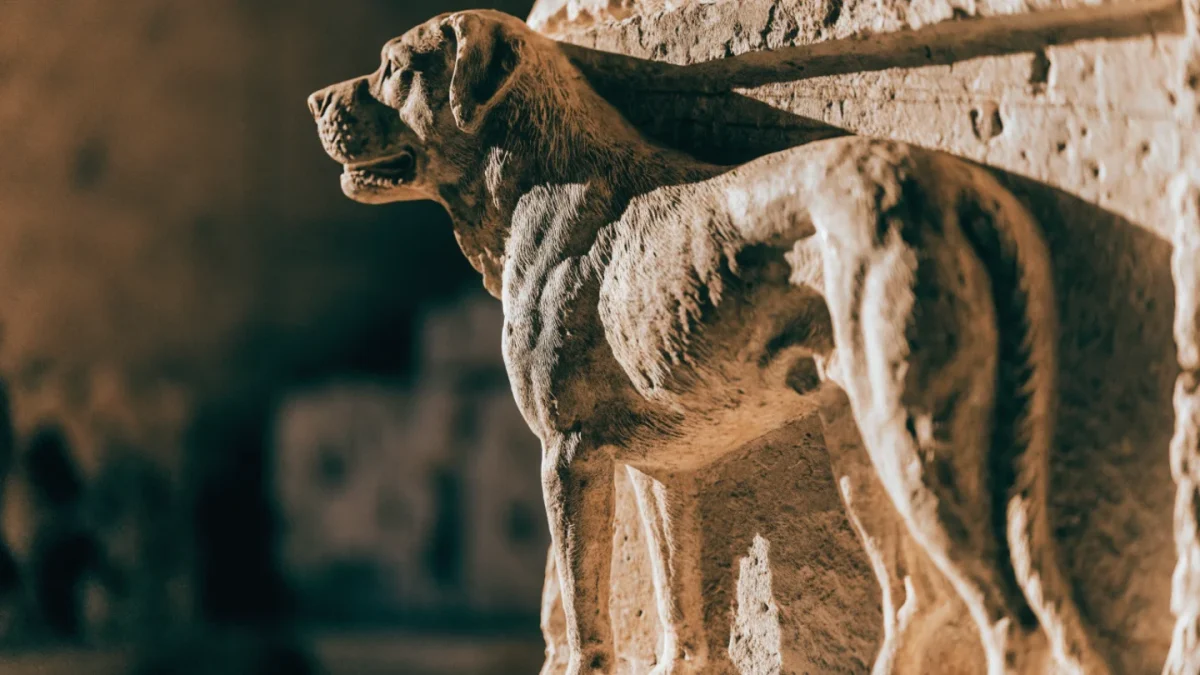
Here's something worth knowing before we get into the actual history: a significant portion of what you'll read about the Cane Corso's ancient lineage is reconstruction, not documentation. The breed nearly went extinct in the 1970s. The recovery effort started in 1973. The Italian Kennel Club granted recognition in 1994. That's recent — within the lifetimes of people reading this. So when marketing copy traces the Corso in an unbroken line back to Roman war dogs, it's doing something specific: lending borrowed prestige to a breed whose modern form was assembled by a small group of Italian enthusiasts within the last fifty years.
None of that makes the history false. The Corso does descend from Roman molosser stock, through a chain of working farm dogs across southern Italy that's reasonably well-evidenced in regional records. But there's a difference between "descended from ancient working dogs" and "an ancient breed that has survived unchanged." The version breeders tend to market is the second. The version the evidence supports is the first.
The actual history is interesting enough on its own terms without needing embellishment — a near-extinction event, a rescue by a handful of dedicated researchers, and a revival that turned a regional farm dog into one of the fastest-growing breeds on the planet. That story is worth telling straight.
The Roman Foundation
The Roman military deployed large molosser-type dogs — collectively designated canis pugnaces — as battlefield assets, supply-line guards, and handlers of livestock that accompanied legions on campaign. These dogs descended from the broader Molossian dog type of ancient Greece and Epirus, bred larger and more formidable through selective pairing with British mastiff types encountered during the conquest of Britannia in the first century AD.
Roman authors documented these dogs with a specificity that historians find useful and dog enthusiasts find irresistible. Columella, writing around 60 AD in De Re Rustica, distinguished between the canis villaticus (estate guard dog) and the canis pastoralis (livestock guardian), describing the ideal guard dog as dark-colored so it would be invisible at night, heavy enough to overpower intruders, and bold enough to confront wolves. Gratius Faliscus, a generation earlier, wrote about the molosser type's courage and its tendency to fight silently — without the prolonged barking that characterizes alert-based guard breeds.
These Roman war dogs were not a single breed in the modern sense. They were a functional type — large, muscular, broad-skulled dogs selected for courage, physical power, and the ability to work under chaotic conditions. The genetics of that type eventually flowed into multiple modern breeds: the Neapolitan Mastiff, the Dogue de Bordeaux, the Boerboel, and the Cane Corso among them. The Corso's distinction from its molosser relatives was not established in Rome. It was shaped in the Italian countryside over the next fifteen hundred years.
From War Dog to Farm Dog
When the Western Roman Empire collapsed in the fifth century, the military infrastructure that maintained and deployed large war dogs collapsed with it. The dogs themselves dispersed with soldiers, settlers, and farmers across the Italian peninsula. In the rural south — Puglia, Basilicata, Calabria, Sicily — they were absorbed into agricultural life and subjected to a new set of selection pressures.
Southern Italian farms needed a multi-purpose working dog. Not a specialist. A dog that guarded the farmstead at night, drove cattle to regional markets (sometimes over distances of 40 to 60 kilometers), hunted wild boar in dense scrub, and protected the landowner's family during travel between properties. The dogs that thrived in this role were necessarily different from the Roman war dog. They were lighter, more athletic, more capable of sustained physical work over rough terrain. The massive, slow-moving mastiff type that could charge a battle line was less useful than a leaner, faster animal that could keep pace with cattle all day and still guard the gate all night.
This selection — practical, unwritten, driven by daily survival rather than breed standards — gradually produced the Cane Corso type. By the late medieval period, the dogs described in southern Italian records are recognizably distinct from the heavier Neapolitan Mastiff type that developed in parallel. The Corso was the working version; the Mastiff was the estate guardian and status symbol. Both descended from the same Roman stock. Function split them apart.
A Thousand Years of Rural Work
From roughly the sixth century through the mid-twentieth century, the Cane Corso existed as a regional working dog known primarily to farmers and landowners in southern Italy. It had no breed club, no written standard, no formal recognition. It survived because it worked. For more, see History of the Rottweiler: Roman Drover Dogs to Modern Guardians.
The name itself evolved through regional dialects. Cane cursus (runner, courser) in the 1137 Monopoli document. Cane e presa (catch dog) in Calabrian dialect, describing its role in hunting large game. Cane da masseria (farm dog) as a general descriptor across the south. The word "Corso" has multiple proposed etymological origins, none with definitive consensus. The most widely cited derivation traces it to the Latin cohors (meaning courtyard, enclosure, or by extension, guardian of an enclosed space). Italian linguist Giovanni Bonatti proposed the Old Provencal corsus, meaning "strong" or "robust." A Greek derivation from kortos (enclosure, courtyard) has also been suggested. All three theories converge on the same functional concept — a powerful dog guarding an enclosed space — which aligns with the breed's documented historical role.
The breed's role in wild boar hunting deserves particular mention because it shaped the Corso's physical and behavioral characteristics in ways that persist today. Hunting boar required a dog that could locate quarry through scent, close distance at speed, and hold the animal at bay — typically by gripping the ears or head — until the hunter arrived. This demanded a combination of courage, prey drive, and the physical capacity to absorb punishment from an animal that could weigh over 100 kg and was armed with razor-sharp tusks. The Corso's powerful jaw, athletic build, and calm determination under pressure are direct products of this function.
Italian farmsteads also used Corsos for night guarding — cane da guardia notturna. The dog patrolled the property perimeter independently, making its own decisions about threats. This autonomous working style shaped the breed's temperament: the Cane Corso doesn't wait for commands when it perceives a genuine threat. It assesses and acts. That independence, a tremendous asset in a farmstead guardian, is also the trait that makes the breed ill-suited for passive or inexperienced handlers.
The Collapse: 1950s–1970s
The forces that nearly destroyed the Cane Corso had nothing to do with the dogs themselves. They were economic and demographic.
Mechanized farming arrived in southern Italy through the 1950s and 1960s. Tractors replaced cattle drives. Trucks replaced the overland transport of livestock that Corsos had accompanied for centuries. Refrigeration and centralized slaughterhouses eliminated the need for market-day cattle escorts. The wild boar population, severely reduced by habitat loss and hunting pressure in the early twentieth century, offered less opportunity for the hunting partnerships that had kept Corsos relevant.
Simultaneously, southern Italy experienced massive rural depopulation. Between 1955 and 1971, millions of people left the agricultural south for industrial jobs in northern Italy, Germany, Switzerland, and beyond. The farms that needed multi-purpose dogs emptied. The old landowners who understood the breed's capabilities died. Their children, settled in Milan or Turin, had no use for a 45 kg farm dog in a city apartment.
By the early 1970s, the Cane Corso survived in isolated pockets — scattered farms in the interior of Puglia, in parts of Calabria and Basilicata, on a handful of estates in Sicily. There was no breeding program, no registry, no organized effort to preserve them. The dogs that remained were the ones still needed: a farmer here with a boar problem, a landowner there whose property was too remote for reliable police response. The breed's survival was accidental, not intentional.
The Recovery: 1973–2007
The Cane Corso's rescue from extinction began with one researcher. In 1973, Dr. Paolo Breber, a biologist and cynologist based in the Puglia region, began systematically searching the southern Italian countryside for surviving Corso-type dogs. Breber was not looking for a show breed. He was documenting a cultural artifact — a working animal type that was vanishing along with the agricultural society that had created it.
Breber published his findings in 1976 in the Italian hunting and rural-culture press, bringing the breed's precarious status to wider attention. The publication attracted a small group of dedicated breeders: Giovanni Bonnetti in Mantova, the brothers Giancarlo and Luciano Malavasi in the north, Vittorio Mazzini, and others who traveled to the south, located surviving dogs, and began structured breeding programs.
The work was painstaking. The founding stock was genetically limited. Many of the surviving dogs were old, some were in poor condition, and not all matched the historical type closely enough to serve as breeding founders. The breeders had to balance genetic diversity — starting from a dangerously narrow base — against type consistency, all without the DNA testing and genomic tools available today.
The Società Amatori Cane Corso (SACC) was established in 1983 to coordinate the recovery. The first breed standard was drafted in 1987 by Dr. Antonio Morsiani, a veterinarian and morphology expert, based on measurements and evaluations of the recovered dogs and historical references. The Cane Corso's temperament profile — that calm, evaluative watchfulness — was documented as a defining breed characteristic, not an incidental trait.
The Italian Kennel Club (ENCI) granted provisional recognition in 1994 and full recognition in 1997. The Fédération Cynologique Internationale followed with full recognition in 2007. Between the first documentation of surviving dogs and international recognition, thirty-four years passed. The breed had been within a generation of disappearing entirely.
International Expansion
Cane Corsos arrived in North America in the late 1980s, brought by Italian immigrants and breed enthusiasts who recognized the dog's potential as a companion and property guardian outside agricultural contexts. The first dedicated breed organization in the United States was established in the early 1990s.
Registration numbers climbed steadily through the 2000s, then accelerated sharply after formal recognition by major registries in 2010. By the early 2020s, the Cane Corso had become one of the fastest-growing breeds in multiple countries. That growth trajectory — predictable in hindsight — mirrors what happened with the Rottweiler in the 1980s and the German Shepherd before that. Rapid popularity brings overbreeding, attracts profit-focused operations, and pushes the breed into households unprepared for what it requires.
The breeders who rescued the Cane Corso from extinction in the 1970s and 1980s did so because they valued the breed's function, its heritage, and its working character. The genetics and coat color discussion matters here — understanding the breed's genetic foundation helps explain why preserving working type against market pressure for exaggerated features remains the central challenge for serious breeders.
What History Demands of Current Owners
The Cane Corso almost disappeared because the world that created it disappeared. It survived because a handful of people recognized what would be lost and did the work to prevent it. The breed's full profile, including health realities and ownership requirements, is covered in the complete breed guide.
That work isn't finished. Every breeding decision, every purchase decision, every socialization effort either preserves or erodes what two thousand years of working history produced. The Cane Corso doesn't need protection from predators anymore. It needs protection from the consequences of its own popularity — from breeders who prioritize head size over temperament, from buyers who want the look without the commitment, and from a market that treats a living piece of Italian agricultural heritage as a product line. The history demands better than that.