

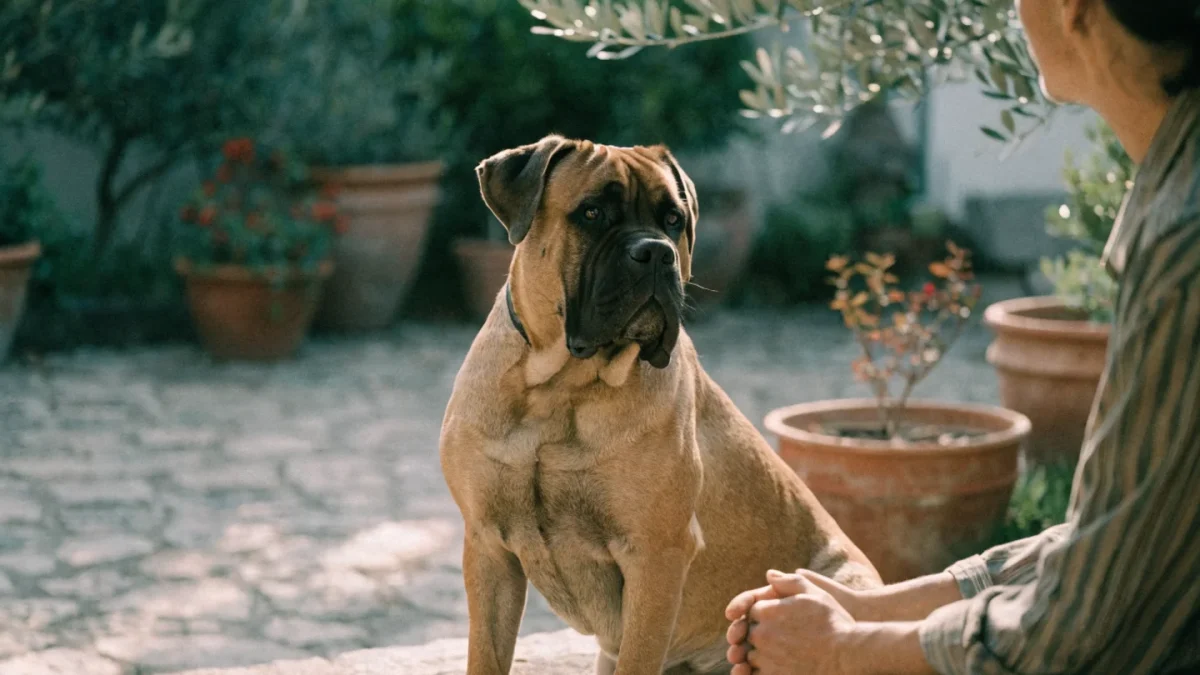
There's a specific quality to sharing space with a well-bred Cane Corso that I didn't fully appreciate until I'd spent time around several of them. It's not menace — people confuse the two constantly, and that confusion causes problems. It's more like a steady, unbroken attentiveness. The dog is tracking everything in the room without appearing to track anything. You notice it when a stranger walks through the door: most dogs react, alert, maybe bark. A properly bred Corso sits up slightly, watches the entrance, and waits. No performance. No noise. Just assessment.
That restraint is the defining feature of the temperament. The Cane Corso breed standard uses the Italian phrase indifferente-reagente — indifferent until there's a reason to react. It's an accurate description of what living with one actually feels like: a dog that maintains a baseline watchfulness, stays calm through most of what daily life brings, and reserves its reactions for situations that actually warrant them. This is not a dog that's suppressing aggression. It's a dog that, through centuries of selection for farm guarding, developed genuine judgment. The difference matters enormously when you're talking about a 50-kilogram dog that can enforce its decisions.
The Watchful Default
A Cane Corso at rest doesn't look relaxed the way a Labrador at rest looks relaxed. The Corso is positioned. It has chosen a spot in the room or yard that gives it sightlines to the main entry points. Its body may be lying down, but the head is up, ears forward, scanning. This isn't anxiety. It's the neutral operating state of a dog whose ancestors guarded livestock from wolves and property from strangers for centuries.
This default watchfulness is the first thing visitors notice and the trait that most frequently gets misinterpreted. People unfamiliar with guardian breeds see a large, still, staring dog and read that as menacing. What they're actually seeing is a dog in information-gathering mode — cataloguing the visitor's scent, body language, vocal tone, and the reaction of the dog's own family to the arrival. Most Corsos complete this assessment in thirty seconds to two minutes. If the family is relaxed, the dog relaxes. If the family is tense, the dog stays alert.
Where the Rottweiler might position itself at the door like a bouncer checking credentials, the Corso tends to observe from a distance. It's the difference between overt and covert security. Both are effective. The Corso's version is quieter, more patient, and often harder for inexperienced owners to read.
Bonding and Attachment
Cane Corsos form deep, singular bonds. Most Corsos clearly identify one person as their primary handler — the person they follow room to room, position themselves near during rest, and look to first during uncertain situations. They're affectionate with the entire household, but the bond hierarchy is usually obvious within the first few months.
This attachment runs deeper than the typical "Velcro dog" label suggests. A Corso doesn't just follow its person out of habit or boredom. It follows because its working heritage demands proximity to the thing it's protecting. Your Corso lying at your feet while you work isn't seeking attention. It's on duty.
The flip side of this intensity is that Corsos tolerate prolonged absence poorly. Dogs left alone for extended periods without gradual conditioning develop separation distress — destructive behavior, vocalization, and sometimes barrier frustration that a 45 kg dog expresses by dismantling door frames. This isn't a breed defect. It's a guardian breed doing what guardian breeds do when separated from their charge. For more, see Rottweiler Temperament: Confidence, Calm, and Fierce Loyalty.
Territorial Instinct in Practice
The territorial drive in a Cane Corso is spatial and contextual. The dog learns the boundaries of its property, the normal patterns of activity within those boundaries, and the difference between routine events and anomalies. A delivery driver who arrives at the same time each day triggers less response over time than an unfamiliar person approaching the fence line at an unusual hour. The Corso is reading patterns, not just reacting to stimuli.
This contextual awareness makes well-socialized Corsos remarkably adaptive. A Corso that has been properly exposed to outdoor cafes, parks, and public spaces understands that those environments have different rules than the home property. The dog is still watchful — it never truly turns off — but the threshold for response adjusts based on learned expectations.
Problems arise when owners either suppress the territorial instinct entirely (producing an anxious, insecure dog) or fail to shape it through socialization (producing a dog that treats every unfamiliar stimulus as a perimeter breach). The middle ground — where the dog understands that the home boundary is its responsibility but the world beyond it is not — requires deliberate, ongoing exposure to novel environments starting in puppyhood.
With Other Dogs
Same-sex aggression between Cane Corsos is well-documented and frequent enough to warrant honest discussion. The breed was never required to cooperate with unfamiliar dogs. Its working context was the family farmstead, where the Corso was often the only dog or worked alongside dogs it had known since puppyhood. The result is a breed that tolerates familiar dogs well but may be confrontational with unfamiliar dogs, particularly those of the same sex.
This trait is not universal — individual temperament, socialization history, and early experiences create significant variation. But prospective owners who assume their Corso will enjoy dog parks or play freely with unknown dogs are setting themselves up for management challenges. Some Corsos are genuinely social with other dogs throughout their lives. Many are not. Planning for the latter while hoping for the former is the realistic approach.
Opposite-sex pairings within the home tend to be more stable. Corsos raised with cats or smaller dogs from puppyhood generally coexist peacefully, though the size differential demands supervision. A Corso that plays gently by its own standards can still injure a small dog through sheer physics.
Emotional Range
People who haven't lived with a Corso are often surprised by the breed's emotional expressiveness. These are not stoic, blank-faced dogs. A Corso's face communicates — the wrinkled forehead when puzzled, the soft eyes and loose lips when content, the tight mouth and raised brow when alert. The breed has a broader range of facial expression than many molosser types, likely because centuries of close working partnership with humans selected for dogs that communicated their internal states visibly.
Corsos also display a sense of humor that catches first-time owners off guard. A Corso that steals a shoe and parades through the house with it, watching to make sure you've noticed, is playing a game. A Corso that deliberately sits on a smaller dog's bed and then looks at you with an expression that can only be described as satisfied is exercising its particular sense of social commentary.
The emotional sensitivity cuts both ways. Corsos are attuned to household tension. Arguments, stress, and erratic energy in the home affect them. Dogs in chaotic households frequently develop anxiety-based behaviors — shadow-chasing, excessive licking, hypervigilance — that are the guardian temperament's response to an environment it can't predict or control.
The Confidence Question
The trait that separates a well-bred, well-raised Corso from a poorly bred or poorly socialized one is confidence. A confident Corso moves through the world with an ease that reads as dignity — unhurried, unflustered, acknowledging novelty without being destabilized by it. It meets strangers with a measured curiosity or polite indifference rather than lunging, cowering, or escalating.
A Corso that lacks confidence is a far more dangerous animal than a confident one. Insecurity in a powerful guardian breed produces defensive reactivity — the dog that snaps at a hand reaching toward it, or that lunges at an approaching stranger, isn't displaying dominance. It's displaying fear. And fear in a dog with the Cane Corso's physical capabilities has serious consequences.
This is why temperament should be the first priority in any breeding decision, ahead of structure, ahead of color, ahead of size. A Cane Corso that looks spectacular but cowers at loud noises or aggresses at normal social contact is a liability. A Corso with solid nerve and calm confidence is a companion that earns the breed's two-thousand-year reputation.
Living With This Temperament
The cane corso temperament personality rewards a specific type of owner: someone who leads through consistency rather than confrontation, who provides structure without rigidity, and who respects the dog's intelligence enough to explain the world rather than simply restricting access to it. If you've read this far and recognize what this breed asks of its handler — and it asks a great deal — the complete Cane Corso breed guide covers the full picture of what ownership demands.
The Cane Corso doesn't want a drill sergeant. It doesn't want a pushover. It wants a person who makes decisions clearly, enforces boundaries fairly, and provides the stability that lets a naturally vigilant animal stand down. When that partnership works — and it takes effort from both ends — the result is a bond that people who've experienced it describe as unlike anything else in dogs. The Corso doesn't give its trust easily. But once given, it doesn't take it back.