

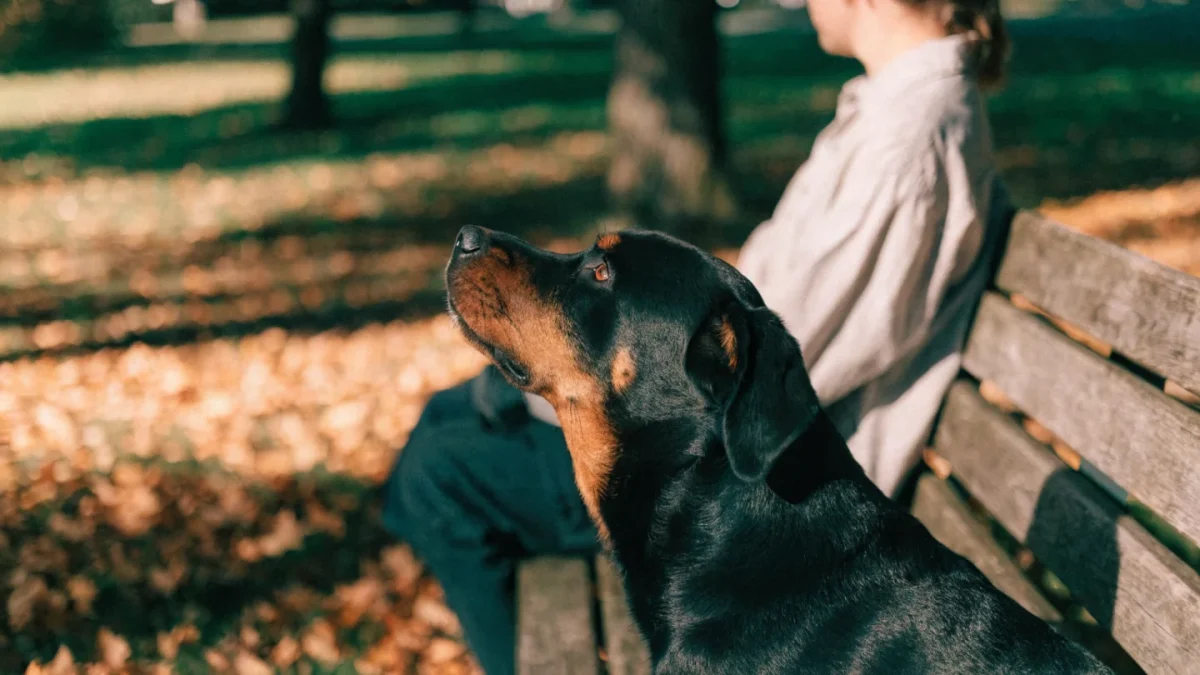
The German word "Gelassenheit" translates roughly to composed serenity — a calmness that isn't passive but deliberate, rooted in self-assurance rather than indifference. I've never found a single English word that captures rottweiler temperament as accurately. This is a breed that watches a room the way a seasoned bartender watches a crowded bar: relaxed, unhurried, and aware of everything.
Understanding rottweiler temperament personality means setting aside two decades of sensationalized headlines and looking at what the breed was actually built to do. These dogs spent centuries driving cattle through medieval German market towns, guarding butchers' earnings on dark roads, and pulling loaded carts — jobs that demanded steadiness under pressure, not explosive aggression. That working temperament didn't vanish when the breed moved into suburban homes. It just found new expressions.
The Calm That Gets Misread
A rottweiler's default state is quiet observation. Where a Labrador bounds into a new situation with its entire body wagging and a Border Collie locks onto every moving object with laser intensity, the rottweiler stands, surveys, and processes. First-time visitors to a rottweiler household often describe the dog as "just staring," and they're not wrong — but they're misinterpreting what they're seeing.
That stillness is active assessment, not menace. The breed evaluates new people, new environments, and new situations before committing to a response. Experienced rottweiler owners recognize the sequence: the dog notices, orients toward the stimulus, holds position for a beat, then either relaxes and approaches or maintains a watchful distance. It's a remarkably consistent pattern across well-socialized individuals.
This deliberate temperament makes rottweilers exceptionally steady housemates. They don't react to every noise. They don't pace when guests arrive. A well-adjusted rottweiler in a familiar environment radiates the kind of calm that actually lowers the stress level in a room — assuming you're not unnerved by a 50-kilogram dog quietly watching you from the doorway.
Loyalty That Runs Deeper Than Most Breeds
Rottweilers attach to their people with an intensity that surprises owners accustomed to more independent breeds. This isn't the bouncy, distribute-affection-everywhere sociability of a Golden Retriever. Rottweiler loyalty is focused, selective, and deeply personal. They distinguish sharply between their household and everyone else — not with hostility toward outsiders, but with a clear gradient of trust.
In practice, this looks like a dog that follows you from room to room, positions itself where it can see the door and you simultaneously, and physically leans against your legs when you're standing still. Rottweilers are contact-seekers. They want to be touching their person, and a 55-kilogram dog leaning its full weight against your thigh while you're trying to cook dinner is one of the breed's most recognizable (and occasionally inconvenient) habits.
The depth of this bond has a practical implication that prospective owners need to understand: rottweilers don't handle prolonged isolation well. A dog this attuned to its household, left alone for ten hours every weekday in a quiet house, will develop behavioral problems. Anxiety, destructiveness, and excessive barking are not personality flaws in a neglected rottweiler — they're predictable responses to an environment that violates the breed's fundamental social wiring.
Protective Instincts: The Part Everyone Fixates On
Yes, rottweilers have genuine guarding instincts. No, this is not the same thing as aggression. The distinction matters enormously, and collapsing the two into a single category is the source of most public misunderstanding about the breed.
A rottweiler with sound temperament and proper socialization responds to perceived threats with graduated escalation: increased alertness, positioning between the family and the stimulus, a deepened posture, and a low warning vocalization. This sequence gives the handler time to assess and respond. It's controlled, readable, and — critically — it stops when the perceived threat resolves. The dog doesn't maintain aggression after the stimulus is gone.
Compare this to fear-based reactivity, where a dog lunges and snaps at anything unfamiliar because it hasn't learned what's safe. That's not guarding. That's a socialization failure, and it happens in every breed. The difference with rottweilers is that their physical power makes poorly managed reactivity more consequential.
The key variable isn't the instinct itself — it's socialization. A rottweiler that has been systematically exposed to varied people, environments, dogs, and situations from eight weeks through two years learns to calibrate its responses. It develops the ability to distinguish between a delivery driver at the door and an actual intruder. Without that exposure, the dog lacks a reference library for "normal," and everything unfamiliar triggers the protective response.
For a complete overview of how this temperament fits within the breed's physical profile, health predispositions, and care requirements, the rottweiler complete breed guide covers the full picture.
Trainability: Intelligent, Not Obedient
Rottweilers consistently rank in the top ten for trainability across standardized canine intelligence assessments. They learn new commands in relatively few repetitions, retain trained behaviors reliably, and can master complex multi-step tasks. Working rottweilers in search-and-rescue, tracking, and carting demonstrate problem-solving abilities that rival the breeds traditionally considered the "smartest."
But here's what most people get wrong about rottweiler intelligence: it doesn't produce the eager compliance that makes breeds like Labrador Retrievers or Poodles easy for novice handlers. A rottweiler understands what you're asking. It then makes a judgment about whether your request makes sense in the current context. Experienced trainers find this trait engaging. First-time owners sometimes find it infuriating.
This is not defiance. It's discernment, and it's the same cognitive process that makes the breed effective in working roles. A search-and-rescue dog that blindly follows every command without reading the situation is less useful than one that can assess conditions and adapt. The trait that makes a rottweiler challenging in your living room is the same trait that makes it exceptional in the field.
Training approaches that rely on repetitive drilling or harsh physical corrections produce poor results with this breed. Rottweilers respond to handlers they respect, and respect in canine terms is built through consistent boundaries, fair consequences, and reward-based motivation — not through intimidation.
With Families, Children, and Other Animals
The rottweiler's family temperament is one of the most misrepresented aspects of the breed. Well-bred, well-socialized rottweilers are frequently gentle, patient, and remarkably tolerant with children in their own household. They develop a protective awareness of the family's youngest members that experienced owners describe as almost parental.
That said, gentleness doesn't eliminate physics. A dog that weighs as much as an adult human can knock a toddler flat with an enthusiastic greeting or an accidental bump during play. Size-related incidents aren't aggression — they're geometry — but they require management. Supervision during interactions with small children is non-negotiable, not because the dog's intentions are bad, but because its mass doesn't come with a dimmer switch.
With other dogs, the picture is more nuanced. Rottweilers can coexist peacefully in multi-dog households, particularly when introduced gradually and managed consistently. Same-sex aggression, especially between intact males, occurs at higher rates in this breed than in many others. Early and ongoing socialization with other dogs reduces conflict, but it doesn't eliminate the breed's tendency toward dog-selectiveness. Some rottweilers are genuinely social with other dogs; others tolerate them; a few will never be reliable in off-leash group settings. Knowing which category your individual dog falls into, and managing accordingly, is part of the job.
The Right Owner for This Temperament
A rottweiler's temperament is an asset in the right hands and a liability in the wrong ones. The calm, the loyalty, the protectiveness, the intelligence — every trait I've described here is a feature when paired with an owner who understands working breeds, commits to socialization as a multi-year project, and provides the consistent leadership this dog needs to thrive.
The mismatch happens when someone acquires a rottweiler for its appearance or reputation without understanding that the temperament requires active management. An unsocialized rottweiler with an absent or inconsistent owner isn't the breed at its best — it's the breed set up to fail.
If the German Shepherd is the colleague who needs a clear chain of command and a defined mission, the rottweiler is the one who works best when it trusts the leadership and understands the reasoning behind the rules. Earn that trust, and you'll have one of the most devoted, stable, and rewarding companions in the entire canine world. Fail to earn it, and you'll spend the next decade managing a powerful dog that never learned who was steering.