

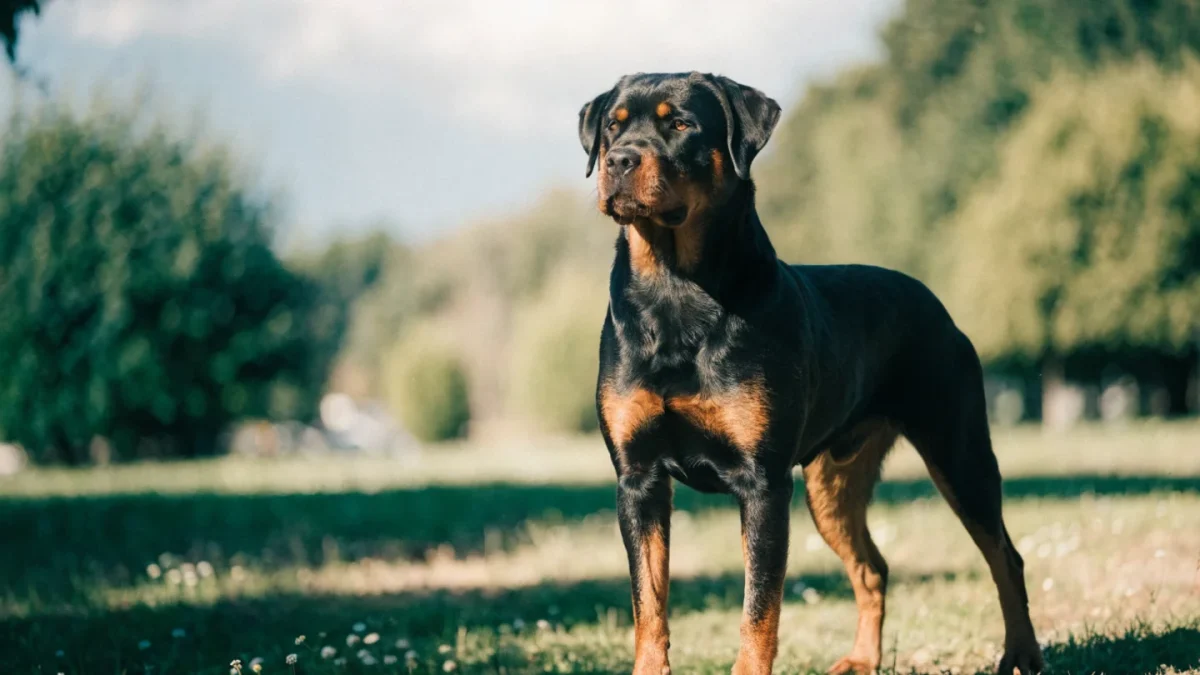
Canine coat color genetics research has confirmed what rottweiler breeders observed for decades: the breed's distinctive black-and-mahogany coat pattern is governed by specific interactions at the Agouti signaling protein (ASIP) locus. Rottweilers are fixed for a black-based tan point pattern — homozygous at/at at the A locus, with E/E at the Extension locus and ky/ky at the K locus — producing one of the most genetically consistent coat phenotypes among purebred dogs. Unlike breeds where coat color variation spans a wide spectrum, the rottweiler's color palette is remarkably narrow — and that narrowness tells a story about the breed's genetic architecture that extends well beyond aesthetics.
Understanding rottweiler genetics health screening means looking at three interconnected domains: the genetic basis of the breed's physical characteristics, the heritable conditions that responsible breeders screen for, and the DNA tests that are now available to complement traditional evaluations.
Coat Color Genetics
The rottweiler's coat pattern — black with tan to mahogany markings in specific locations — is one of the most phenotypically uniform in any breed. The genetic mechanism behind it involves two key loci.
The ASIP (Agouti) locus controls the distribution pattern of eumelanin (black pigment) and phaeomelanin (red/tan pigment). Rottweilers are homozygous for the "at" allele (tan point pattern), which restricts phaeomelanin to specific body regions: above the eyes, on the cheeks, muzzle sides, throat, chest, lower legs, and under the tail.
The MC1R (Extension) locus must carry at least one functional "E" allele for eumelanin to be produced. The presence of this allele allows the black base coat to express. Rottweilers are typically EE or Ee at this locus.
The variation you see between individual rottweilers — richer mahogany versus lighter rust markings, slightly broader or narrower chest patches — reflects quantitative variation in phaeomelanin intensity and pattern extent, modulated by polygenic influences and possibly the pheomelanin-intensity (RALY) gene region. But the fundamental pattern is genetically fixed in the breed.
"Rare color" claims. Occasionally, dogs marketed as "red rottweilers" or "blue rottweilers" appear from unscreened breeding operations. These coat variations result from recessive dilution alleles (dd at the MLPH locus for blue, bb at TYRP1 for liver/red) that are not part of the breed standard and are vanishingly rare in well-maintained breeding lines. Their appearance in a litter typically indicates either crossbreeding in the recent pedigree or selection from atypical genetic backgrounds. Breed registries do not accept these color variants, and "rare color" premium pricing is a marketing tactic, not a reflection of quality.
The Genetics of Size Variation
Rottweiler size varies considerably within the breed standard — a lean working-line female at 38 kilograms and a heavy-boned show male at 58 kilograms are both within normal range, but they represent substantially different genetic expressions of the same breed.
Canine body size is highly polygenic. Research has identified over twenty genomic regions associated with size variation in dogs, with the IGF1 gene being among the most influential. Within a single breed, size variation reflects the interplay of multiple gene variants interacting with environmental factors (nutrition during growth, exercise levels, spay/neuter timing).
The practical relevance for rottweilers: size is heritable, but it isn't a single-gene trait you can select for in isolation. Breeders who select exclusively for maximum size — "XXL" or "king" type marketing — are prioritizing one phenotypic extreme at the expense of the balanced structure the breed standard describes. Large-for-breed rottweilers carry elevated orthopedic stress on joints, ligaments, and the cardiac system, because the skeleton and cardiovascular system scaled for a 50-kilogram dog are being asked to support 65 or 70 kilograms.
The rottweiler's historical development produced a dog optimized for functional athleticism, not maximum mass. Breeding away from that functional range has predictable health consequences.
Heritable Health Conditions
The conditions that responsible rottweiler breeding programs screen for share a common feature: significant genetic components that make parental screening a meaningful predictor of offspring risk.
Hip and elbow dysplasia. Both conditions are polygenic — influenced by many genes rather than one — and also affected by environmental factors (nutrition, exercise, body condition during growth). Published heritability estimates for hip dysplasia in rottweilers support a substantial genetic component. A Finnish study of 2,764 rottweilers reported heritability of 0.58, while Swedish data estimated 0.34 to 0.42, meaning roughly 20% to 60% of the variation in hip joint quality between individuals can be attributed to genetic factors depending on the population and methodology used.
Elbow dysplasia follows a similar polygenic pattern with comparable heritability. Screening both parents via radiographic evaluation and selecting dogs with better joint scores incrementally improves outcomes across generations. It doesn't guarantee healthy offspring — the environmental component is real — but it shifts the probability meaningfully.
Subaortic stenosis (SAS). This cardiac condition — a narrowing below the aortic valve — is inherited in rottweilers, though the exact mode of inheritance is debated. Some studies suggest an autosomal dominant pattern with variable penetrance; others point to a more complex polygenic mechanism. What is clear: the condition runs in families, and echocardiographic screening of breeding stock is essential for identifying affected or carrier animals.
Mild SAS may go undetected without cardiac imaging. Moderate to severe cases cause exercise intolerance and carry a risk of sudden death. Screening by a board-certified veterinary cardiologist using Doppler echocardiography is the standard — auscultation alone misses subclinical cases.
Juvenile laryngeal paralysis and polyneuropathy (JLPP). This fatal neurological condition, identified specifically in rottweilers, is inherited as an autosomal recessive trait. Affected puppies develop progressive paralysis of the larynx and limbs, typically becoming symptomatic by several months of age. A DNA test is available that identifies carriers, and responsible breeding programs test all breeding stock to ensure carrier-to-carrier matings don't occur.
Osteosarcoma. Bone cancer occurs at disproportionately high rates in rottweilers, particularly in large males. The genetic basis of osteosarcoma predisposition is being actively researched — several genomic regions have been associated with increased risk, but no single-gene test exists. Family history remains the most practical risk indicator, and breeders who track cancer incidence in their lines make more informed breeding decisions than those who don't.
The Screening Protocol
A responsible rottweiler breeding program screens for at least the following before any mating:
Hips and elbows: radiographic evaluation scored by a recognized body — OFA, PennHIP, or equivalent national programs. Both parents evaluated, results documented and verifiable.
Cardiac: echocardiography by a board-certified veterinary cardiologist. Annual re-evaluation is recommended, as some cardiac conditions can develop or progress with age.
Eyes: ophthalmoscopic examination by a veterinary ophthalmologist. Annual evaluation.
JLPP: DNA test. Both parents should be tested, and if both are carriers, the mating should not proceed.
Temperament: formal assessment of behavioral stability. ADRK-affiliated programs require a Zuchttauglichkeitsprufung (breed suitability test) that evaluates nerve stability, confidence, and social behavior. Other programs may use breed-specific temperament evaluations or standardized behavioral assessments.
These screenings represent a minimum standard, not an aspirational one. Breeders who perform all of them are doing what the breed's genetic risk profile demands. Those who skip any of them are leaving preventable risk unaddressed.
What Genetic Testing Can and Cannot Tell You
DNA testing has expanded rapidly, and the JLPP screen provides a definitive carrier/clear/affected result for rottweilers. But for polygenic conditions — dysplasia, SAS, osteosarcoma — no single DNA test is predictive. These conditions involve many genes and environmental cofactors that current panels cannot capture.
The practical takeaway: DNA tests supplement but do not replace radiographic, cardiac, and physical screening. A breeder who submits a DNA panel but skips hip radiographs is doing incomplete work. The most reliable picture comes from combining traditional evaluations with available DNA tests and transparent tracking of health outcomes across generations.
The complete breed guide places these genetic considerations in the context of the full breed profile — health predispositions, temperament, and care requirements.