

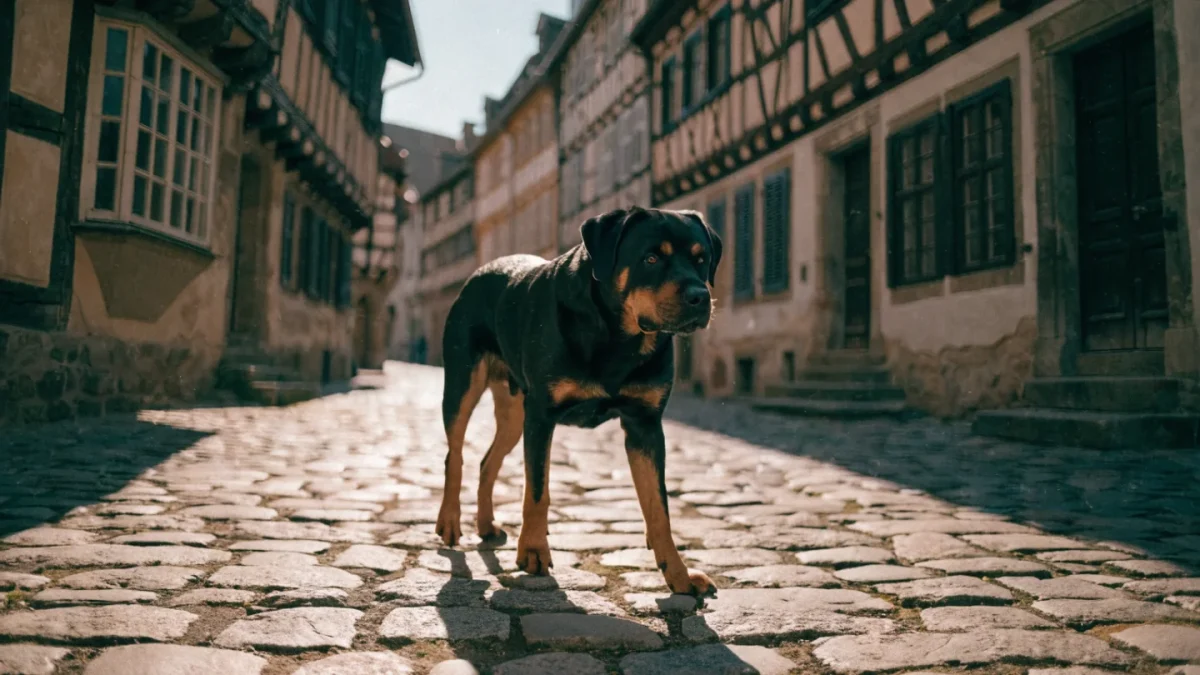
Sometime around 74 CE, Roman engineers built a bathhouse in a small settlement in what is now the Baden-Württemberg region of southern Germany. The structure had distinctive red clay tiles — "rote Wil" in the local dialect — and that detail, mundane as it sounds, eventually gave a town its name: Rottweil. Centuries later, the town would give a dog breed its name. But the dogs were already there, long before anyone thought to name them.
The rottweiler history origins story spans roughly two thousand years, crosses an empire's rise and fall, survives a near-extinction event, and culminates in one of the most recognizable working breeds on earth. It's also a story that most casual accounts oversimplify into "Roman war dogs became German butcher dogs." The real timeline is considerably more interesting than that.
The Roman Chapter
Roman legions didn't travel light. An army on the march needed to feed thousands of soldiers across weeks and months of movement through hostile territory. Live cattle traveled with the columns — a walking food supply that required dogs to drive, manage, and protect the herd.
The dogs the Romans used for this purpose were a mastiff-type: broad-chested, endurance-built, temperamentally steady enough to handle obstinate livestock and alert enough to guard the camp at night. They weren't war dogs in the cinematic sense — there's limited evidence that Romans used dogs in direct combat with any consistency. They were working animals performing critical logistical functions.
When Roman forces crossed the Alps and established settlements through what is now southern Germany and Switzerland during the first century CE, those dogs came with them. And when the Empire's western frontier eventually contracted, the dogs stayed behind with the colonists who remained in established settlements. Rottweil, positioned at a crossroads of trade routes and blessed with fertile surrounding land, became a prosperous market town — and the dogs that had driven Roman cattle adapted to driving medieval cattle.
Butchers, Drovers, and the Metzgerhund
The medieval period gave the rottweiler its most recognizable historical role. Rottweil developed into one of the region's most important cattle trading centers, and the local butchers needed dogs that could do three things: drive cattle from surrounding farms to market, pull carts loaded with dressed meat through town streets, and guard the butchers' purses on the journey home.
This is where the breed's temperament was forged through centuries of practical selection. A dog that couldn't manage a balking bull calf on a narrow road didn't get bred. A dog that panicked at the chaos of a crowded market square didn't get bred. A dog that let a thief approach the butcher's cart at night didn't get bred. But a dog that was needlessly aggressive — one that bit livestock instead of driving it, or attacked trading partners instead of warning off strangers — was equally useless.
The result was a dog the locals called the "Rottweiler Metzgerhund," literally the Rottweil butcher's dog. It was a working title, not a breed name in any formal sense. There were no studbooks, no breed standards, no kennel clubs. There were butchers who needed reliable dogs, and the ones that proved reliable reproduced. The selection pressure was entirely functional.
According to local accounts that have survived in regional histories, some butchers would tie their day's earnings around the dog's neck for the walk home, trusting the animal's guarding instincts more than their own ability to fend off roadside robbers. Whether this happened routinely or is partly folk embellishment is debatable, but the fact that the story persists across multiple independent sources suggests it has at least a foundation in practice.
The Railroad and Near-Extinction
The mid-nineteenth century nearly erased the rottweiler entirely. Railroads expanded across Germany, and cattle that had been driven overland for centuries could now be transported by rail — faster, cheaper, and without dogs. The butchers' cart-pulling work likewise diminished as transportation modernized.
The breed's population collapsed. Dogs that had been essential working animals in every butcher's household became surplus within a generation. By the 1880s, accounts from breed historians describe rottweiler numbers as critically low. A dog show in Heilbronn in 1882 featured what appears to be the first recorded use of the breed name in a show catalog — a single rottweiler entry that O. Hell, a leader of Germany's national Rottweiler Breed Society, later described in 1926 as bearing "little resemblance to our present requirements."
This is a pattern repeated across dozens of working breeds during the industrial revolution: the job disappears, and the dog disappears with it. The breeds that survived this period did so because they found new work — or because dedicated fanciers decided the type was worth preserving.
The Police and Military Revival
The rottweiler survived because it turned out to be exceptionally good at a job that was rapidly expanding in early twentieth-century Germany: police work.
German police forces in the early 1900s were experimenting with dog units, testing various breeds for the specific combination of traits the work demanded — physical power, trainability, stable nerves in chaotic situations, and enough protective drive to be useful without being uncontrollable. The rottweiler checked every box.
The first breed standard was drafted in 1901, reflecting a growing recognition that this was a type worth formalizing. Breed clubs began forming between 1907 and 1921, eventually consolidating into the Allgemeiner Deutscher Rottweiler-Klub (ADRK) in 1921 — the organization that remains the breed's governing club in Germany and one of the most influential breed registries in the world. The ADRK established breeding requirements that included temperament testing, a stipulation that distinguished it from many contemporary breed clubs.
During both World Wars, rottweilers served in military roles — messenger dogs, draft animals, and guard dogs. This wartime utility kept the breed visible and maintained a functional breeding population during periods when civilian dog ownership declined.
For those wanting the full picture of where this history landed — the physical breed, health profile, and modern care requirements — the rottweiler complete breed guide covers the present-day breed in detail.
The Popularity Surge and Its Consequences
Rottweilers arrived in North America in the late 1920s and early 1930s, with early registrations appearing through various kennel clubs by the mid-twentieth century. The breed remained relatively niche — known to working-dog enthusiasts but not a mainstream pet — until the 1980s.
Then came the popularity explosion. Between roughly 1983 and 1998, rottweiler registrations skyrocketed. The breed went from a working-dog insider's choice to one of the most registered breeds in multiple countries. The surge was driven partly by media attention — the rottweiler appeared in films, television, and advertising as the quintessential guardian dog — and partly by the breed's striking physical presence.
What happened next is depressingly predictable for anyone who follows breed history. Demand outstripped the supply of well-bred dogs. Commercial and backyard breeding operations multiplied, prioritizing volume and exaggerated physical traits — massive heads, extreme bulk — over temperament stability and health screening. Dogs from these operations entered households with owners who were unprepared for a powerful working breed, and bite incidents rose in tandem with popularity.
The breed's public reputation, shaped more by these incidents than by the vast majority of rottweilers living uneventfully in responsible homes, darkened considerably during this period. Breed-specific legislation targeting rottweilers followed in multiple jurisdictions.
Two Populations, One Breed Name
The popularity surge's lasting legacy is a breed that effectively split into two populations. On one side: dogs bred by ADRK-affiliated or similarly rigorous programs that maintain temperament testing, health screening, and working evaluations as prerequisites for breeding. These dogs tend toward the original type — athletic rather than massive, with stable, confident temperaments.
On the other side: dogs from unscreened breeding operations selected for imposing appearance with temperament and health as secondary considerations at best. These dogs are often heavier, less structurally sound, and more temperamentally variable.
Both populations carry the same breed name, and this creates a persistent problem for public understanding. Temperament studies, bite statistics, and breed-wide health data aggregate both groups. The rottweiler that a responsible owner acquires from a health-tested, temperament-evaluated litter is a profoundly different animal from one purchased from a parking-lot transaction with no documentation — but they occupy the same statistical category.
Understanding this divide is essential context for anyone evaluating what a rottweiler "is." The breed's history produced a specific temperament profile — confident, loyal, and discerning — but that profile is only reliably expressed in dogs that actually descend from careful breeding programs rather than commercial volume operations.
What the History Actually Tells Us
Two thousand years of rottweiler history distill into a few consistent threads. This has always been a dog bred for function over form. It has always required a handler who earns its cooperation rather than demands its submission. It has survived multiple existential threats — the end of droving, two world wars, the fallout of a popularity boom — and emerged intact each time because its fundamental working temperament remained valuable.
The breed's past is not a warning label. It's a blueprint. Every trait that defines the modern rottweiler — the calm assessment, the powerful build, the deep handler bond, the protective instinct modulated by training — traces directly back to what those dogs needed to do in the streets of a medieval market town. The job changed. The dog, in its essentials, did not.