
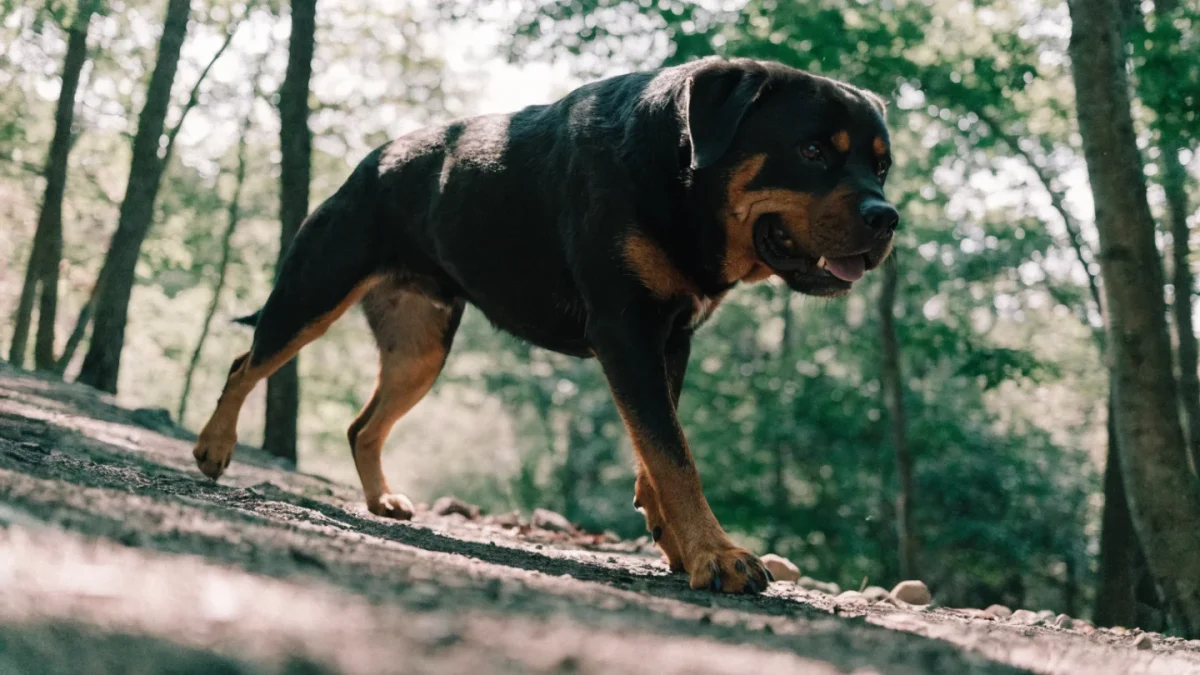
Here's a number that resets expectations about rottweiler exercise needs: a mature rottweiler's resting heart rate sits between roughly 60 and 100 beats per minute — a range comparable to other large working breeds but well below the rates you'd find in purpose-bred endurance athletes like Siberian Huskies or Vizslas. The rottweiler was built for sustained moderate effort, not marathon-level output. Understanding that distinction is the difference between an exercise routine that keeps your dog healthy and one that grinds its joints down before age five.
Rottweilers need daily physical activity. That's non-negotiable. But the common image of a rottweiler as a tireless powerhouse that requires hours of intensive exercise is overstated. These dogs were bred to drive cattle at walking pace, pull loaded carts through town streets, and stand guard — not to run forty kilometers across frozen tundra. Their exercise requirements reflect their actual heritage, not the exaggerated version.
The Adult Baseline
A healthy adult rottweiler at proper weight does well with 60 to 90 minutes of combined physical activity per day. That total should be split across the day rather than delivered in a single long session. Two walks of 30 to 40 minutes each, supplemented by 15 to 20 minutes of structured play or training, covers the baseline for most individuals.
Some rottweilers want more. Working-line dogs with higher drive may benefit from 90 to 120 minutes, particularly if the extra time includes task-based activity — tracking, scent work, carting, or structured obedience — rather than pure physical exertion. Other individuals, especially those on the heavier end of the breed standard or older dogs managing early joint stiffness, thrive on the lower end of that range.
The key metric isn't a timer. It's behavior. A rottweiler getting adequate exercise is calm in the house, settles without pacing, doesn't destroy furniture, and sleeps soundly. A rottweiler running an exercise deficit announces it: restlessness, demand barking, digging, and the kind of inventive destruction that turns a sofa cushion into confetti.
Why Mental Work Matters as Much as Miles
This is the part most owners underestimate. Rottweilers are working dogs with active problem-solving intelligence, and physical exercise alone doesn't satisfy their cognitive needs. A rottweiler that gets a 45-minute walk twice a day but spends the remaining 22 hours in an empty house with nothing to think about will develop behavioral issues — not because it's under-exercised physically, but because its brain has nothing to do.
Mental stimulation options that work well for the breed:
Scent work. Hide treats or scented objects and let the dog find them. Rottweilers have strong noses and genuine tracking instinct. A 15-minute scent session can tire a rottweiler as effectively as a 30-minute walk.
Puzzle feeders and food-dispensing toys. Feeding part of the daily ration through puzzle toys turns a five-minute meal into a twenty-minute cognitive task. Start simple and increase difficulty as the dog figures each toy out.
Obedience and trick training. Short, focused sessions — 10 to 15 minutes — where the dog learns new commands or refines existing ones provide concentrated mental engagement. Rottweilers that train regularly are measurably calmer than those that don't.
Structured play with rules. Tug and fetch are fine, but adding structure — sit before the throw, hold before the tug, drop on command — turns physical play into a training exercise.
For a deeper understanding of the rottweiler's temperament and how their intelligence shapes daily life, that context matters when building an exercise plan that accounts for their cognitive needs alongside the physical ones.
Puppy and Adolescent Restrictions
This section matters more than any other for long-term joint health.
Rottweiler puppies are energetic, clumsy, and growing at a pace that puts enormous stress on developing bones and cartilage. A rottweiler puppy can gain over one kilogram per week during peak growth phases, and the growth plates in its long bones don't close fully until somewhere between 14 and 18 months of age. Until those plates close, high-impact and high-repetition exercise creates genuine risk of developmental orthopedic damage.
What to avoid before 18 months: forced running on hard surfaces, repetitive jumping (on and off furniture counts), extended fetch sessions on pavement, and long-distance hiking. Over-exercising a young rottweiler to "tire it out" because it has puppy energy is a direct path to orthopedic problems that will define the dog's adult life.
What's appropriate: free play on soft surfaces (grass, sand), short positive training sessions, leash walks scaled to the puppy's age — a common guideline is roughly five minutes of structured walking per month of age, twice daily. A four-month-old puppy gets two 20-minute walks; a six-month-old gets two 30-minute walks. These are guidelines, not rigid prescriptions, but they provide a reasonable framework.
Adolescent transition (12 to 18 months): gradually increase distance and introduce moderate terrain variety. This is still not the time for intense, sustained exercise. Think of it as progressive loading — letting the dog build fitness incrementally as its skeletal structure matures.
Activities That Suit the Breed
Rottweilers excel in structured activities that combine physical effort with mental engagement:
Carting and draft work. This is the breed's ancestral job adapted to sport, and rottweilers take to it naturally. Organizations in several countries offer carting titles and certifications. Starting with an empty cart and gradually adding weight as the dog builds strength and understands the commands is the standard progression.
Tracking. Following a scent trail over varied terrain engages the dog's nose and brain simultaneously. Rottweilers have the focus and determination to work long tracks, and the activity is low-impact on joints.
Obedience competition. The breed's trainability makes them competitive in formal obedience, where precision and handler responsiveness are scored.
Agility. Rottweilers can participate in agility with appropriate conditioning, though they'll never match a Border Collie's speed. They compensate with precision, power, and determination. Joint conditioning and appropriate jump heights are essential.
The Right Owner for This Exercise Profile
A rottweiler's exercise needs are moderate by working-breed standards, but "moderate" still means daily commitment. This isn't a breed you can skip on rainy days and expect good behavior indoors. The owner who thrives with a rottweiler's exercise profile is someone who enjoys structured walks, is willing to incorporate mental enrichment into daily routine, and understands that a calm rottweiler is a well-exercised one — physically and mentally.
The complete breed guide places these exercise requirements in the context of the breed's overall care, health, and grooming needs.