

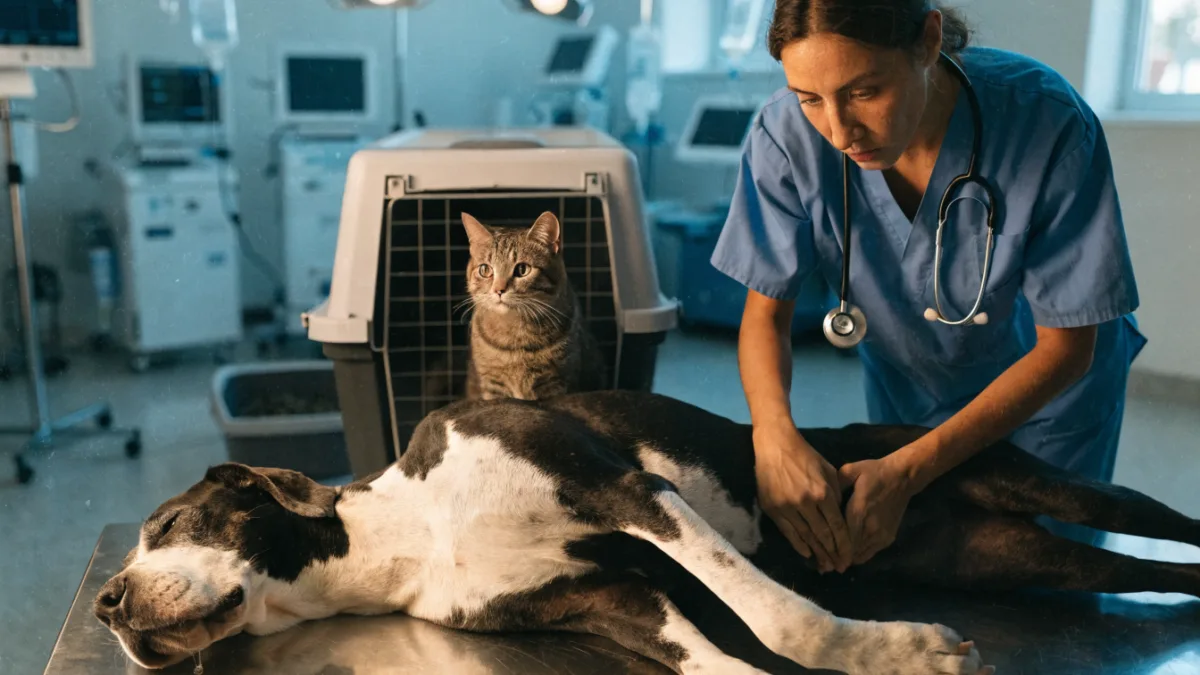
I’ll never forget the Sunday morning when Marcus, a six-year-old Weimaraner, came through our emergency doors. His owner, Karen, had noticed him pacing the kitchen floor at 6 a.m., drooling so heavily that she initially thought he’d gotten into something toxic. By the time she realized his abdomen was swollen and tight as a drum, two hours had already passed. Marcus was in the late stages of gastric dilatation-volvulus — what most people call bloat — and his stomach had already begun to lose blood supply. We rushed him into surgery, and thankfully, he survived. But Karen told me later, “I kept thinking he just had a stomach ache. I didn’t want to overreact.”
That hesitation is something I see over and over, and it’s completely understandable. Nobody wants to be the person who rushes to the emergency clinic over what turns out to be nothing. But there are two conditions in companion animal medicine where hesitation can be fatal: canine bloat and feline urinary blockages. Both start with subtle behavioral changes that are easy to dismiss, and both become life-threatening within hours. Knowing the difference between a minor upset and a true emergency might be the most important thing you ever learn as a pet owner.
Canine Bloat: When Minutes Literally Matter
Gastric dilatation-volvulus, or GDV, happens when a dog’s stomach fills with gas, food, or fluid and then twists on itself. That twist — the volvulus — traps everything inside and cuts off blood flow to the stomach wall and sometimes the spleen. Without immediate surgical intervention, the tissue begins to die, and the dog goes into shock. Even with emergency surgery, mortality rates range from 10% to 15%, and that number climbs significantly if the stomach wall has already started to necrose, which is the medical term for tissue death.
Any dog can develop bloat, but it’s most common in large, deep-chested breeds: Great Danes, Weimaraners, German Shepherds, Standard Poodles, and Setters are all statistically overrepresented. That said, I’ve occasionally seen it in smaller dogs, so breed alone shouldn’t determine your level of concern.
The Signs You Can’t Ignore
The earliest indicator is almost always behavioral. Dogs with bloat are profoundly uncomfortable, and they show it through relentless pacing and restlessness. They can’t settle. They’ll get up, lie down, change positions, get up again. Many owners describe a dog that seems anxious for no apparent reason.
From there, things progress rapidly. You might notice:
- A visibly swollen or distended abdomen — often described as looking like a drum, and it will feel firm or hard to the touch
- Profuse drooling — far more than normal panting would cause
- Unproductive attempts to vomit — the dog retches and heaves but nothing comes up, or only small amounts of saliva
- Pale gums — which signals that shock is already developing
- Eventually, collapse — by this point, you’re in a true race against death
If you see pacing plus a swollen abdomen plus unproductive retching, don’t call your vet to ask if you should come in. Just go.
Feline Urinary Blockages: The Silent Killer Hiding in the Litter Box
If bloat is the emergency dog owners fear, feline urethral obstruction is its feline equivalent — and in some ways, it’s even more insidious because the early signs happen behind the privacy of a litter box.
A urinary blockage occurs when a physical obstruction — usually struvite crystals, bladder stones, or a mucus plug — gets lodged in the urethra, preventing the cat from passing urine. When that happens, the bladder continues to fill but can’t empty. Toxins that the kidneys would normally flush out begin building up in the bloodstream. Potassium levels rise dangerously high, which interferes with the electrical signals that control the heart. Without treatment, a completely blocked cat can suffer fatal cardiac arrhythmias or bladder rupture within 24 to 48 hours.
This condition almost exclusively affects male cats. Their urethra — the tube that carries urine from the bladder to the outside of the body — is longer and significantly narrower than a female’s, making it far more prone to obstruction. If you have a male cat, this is a condition you need to know about, period.
What It Looks Like at Home
Oliver was a four-year-old orange tabby whose owner, David, first noticed him making repeated trips to the litter box. David assumed it was constipation — a reasonable guess if you don’t know what a blockage looks like. Oliver would strain, produce nothing, hop out, and return ten minutes later. He started crying while in the box. David waited two days before bringing him in, hoping it would resolve on its own.
By the time I saw Oliver, his bladder was the size of a small peach and extremely painful. His potassium levels were dangerously elevated, and his heart was already showing irregular rhythms on the ECG. We managed to relieve the obstruction and stabilize him, but David told me afterward, “I had no idea a cat could die from not peeing.”
The signs to watch for include:
- Frequent litter box visits with little or no urine produced
- Vocalizing or crying while straining
- Excessive licking of the genital area
- Hiding or acting uncharacteristically restless
- Vomiting, lethargy, and signs of pain as toxins accumulate
Why Owners Miss the Early Window
Here’s what connects these two conditions beyond their urgency: both initially present as behavioral changes. A pacing dog looks like a dog with a mild stomach upset. A cat straining in the litter box looks like a cat with constipation. Neither scenario triggers most owners’ emergency alarms.
I understand that instinct completely. When I first started practicing, I probably told a dozen clients to “watch and wait” when they called about vague symptoms. Experience — and some outcomes I still think about — has taught me to be far more proactive. I’ve changed my mind on this completely. If you’re ever unsure whether a symptom warrants an emergency visit, call. A two-minute phone call costs nothing. Waiting costs everything.
Controversies and What the Evidence Actually Says
Raised Bowls: A Well-Intentioned Mistake?
For years, the standard advice was to feed large-breed dogs from elevated bowls to reduce swallowing air and theoretically prevent bloat. I recommended it myself for a long time. But research — most notably from Purdue University — challenged that assumption with data suggesting raised feeders might actually increase GDV risk. The evidence isn’t perfectly settled, but the current consensus leans toward floor-level feeding for at-risk breeds. I switched my own dogs to floor bowls several years ago and now recommend the same to clients.
Diet and Feline Urinary Health
The wet food versus dry food debate is ongoing in the cat world. Many holistic veterinarians advocate strongly for wet-food-only or raw diets to maximize hydration, since cats evolved as desert animals with a naturally low thirst drive. Some traditionalists rely on prescription dry formulas designed to alter urine pH and dissolve crystals. Both approaches have merit, but nearly all experts agree on one point: maximizing moisture intake is crucial for prevention. Cats who eat primarily dry food simply don’t compensate by drinking enough water, and concentrated urine creates an environment where crystals form more readily.
The Danger of Home Remedies
I want to address this gently because I understand the impulse. When someone sees their pet suffering at 2 a.m. and the nearest emergency clinic is an hour away, the urge to try something — anything — is overwhelming. Online forums are full of suggestions: oils to help a cat pass a blockage, homeopathic drops to ease dog bloat, syringe techniques to relieve pressure.
None of these work. A urinary blockage is a physical obstruction that requires catheterization under sedation. Bloat requires surgical decompression and derotation of the stomach. Home remedies don’t fix these problems — they only delay the treatment that could save your pet’s life. I’ve never met a veterinarian who wouldn’t rather see a pet an hour earlier with the owner saying, “I wasn’t sure if this was an emergency.”
Prevention and New Developments
Prophylactic Gastropexy
One of the most encouraging developments in preventive medicine is the growing use of laparoscopic gastropexy for at-risk dog breeds. This minimally invasive procedure tacks the stomach to the abdominal wall so it physically cannot twist, even if it fills with gas. Many veterinarians now perform it at the same time as spay or neuter surgery. If you have a large, deep-chested puppy, it’s worth asking your vet whether this makes sense for your dog.
Environmental Stress and FLUTD
In cats, we now understand that Feline Lower Urinary Tract Disease — the broader condition of which blockages are a severe symptom — is heavily influenced by stress. Recent behavioral research links environmental disruptions like moving, new pets, holiday commotion, and routine changes to the inflammation that produces crystals and mucus plugs. Environmental enrichment — multiple litter boxes in quiet locations, vertical spaces, consistent routines, and interactive play — isn’t just about quality of life anymore. It’s preventive medicine.
The Bottom Line
These two conditions represent some of the most time-sensitive emergencies in all of veterinary medicine. A dog with bloat can go from seemingly fine to beyond saving in a matter of hours. A blocked cat can survive 24 to 48 hours — but every hour without treatment increases the risk of irreversible damage. There is no home treatment, no waiting period, no watching and seeing. There is only the clinic and the clock.
If you take one thing from this article, let it be this: learn the early signs now, before you need to know them. Keep your emergency clinic’s number saved in your phone. And never, ever feel embarrassed about bringing your pet in because you weren’t sure. The only call I’ve ever regretted is the one a client didn’t make.