

I need to write this as Emily Chen — warm, cat-focused, with personal stories and dry humor. Let me create some recurring cat characters and craft an engaging piece about love bites and aggression.
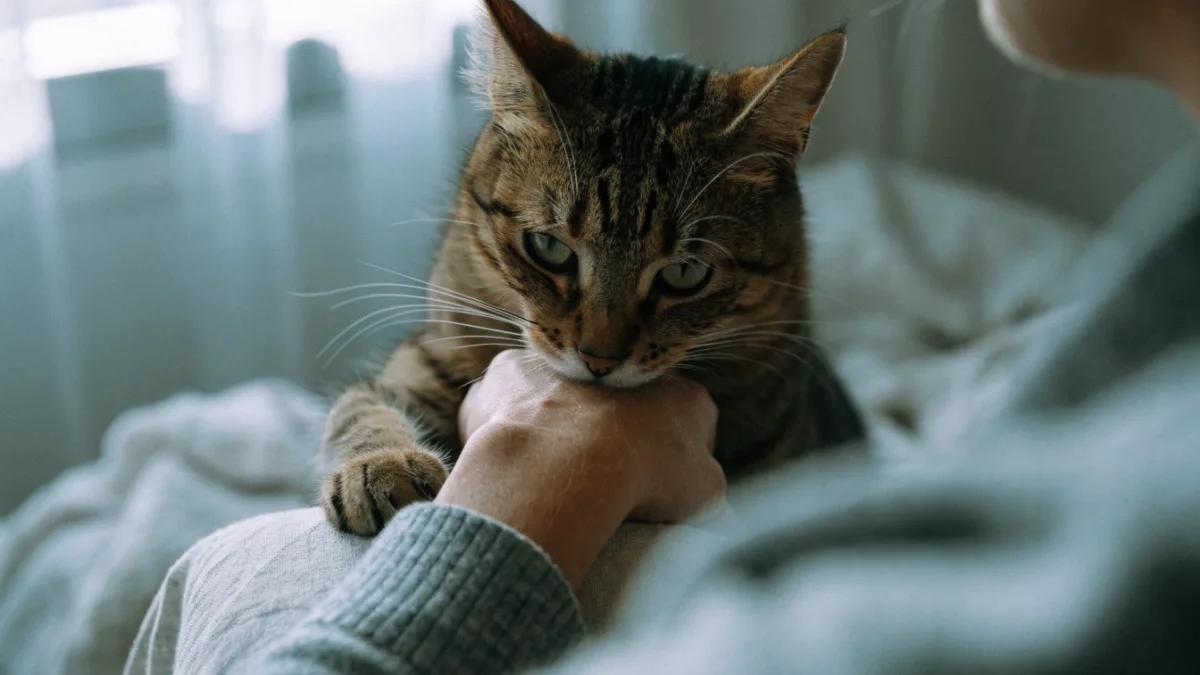
My cat Mochi has a habit of waiting until I’m deeply absorbed in a book, then ever so delicately placing her teeth on my wrist. Not biting. Just… resting them there. Like a gentle reminder that she exists and I should be paying attention to her instead of whatever fictional nonsense I’m reading. For the first year I had her, I thought this was the sweetest thing — proof of our bond, a little cat kiss, all that romantic stuff. Then I mentioned it to a feline behaviorist friend, and she gave me a look that said, “Oh honey, we need to talk.”
It turns out that what we call “love bites” is one of the most misunderstood behaviors in the entire cat-human relationship. And the distinction matters — not just for your skin, but for your cat’s wellbeing and for keeping that bond intact.
What’s Actually Happening When Your Cat Nips You
True love bites — the gentle, doesn’t-break-the-skin kind — are real. They’re typically soft mouthing or a light pinch that happens when your cat is relaxed, often purring, and usually in a context that feels affectionate. Some behaviorists think this behavior traces back to how cats groom each other, using their teeth to work through fur and nibble at matts or sensitive spots. When Mochi gives me that delicate wrist-grab, she’s not trying to hurt me. She’s communicating.
But here’s where it gets complicated, and why that behaviorist friend gave me the look: a significant number of feline experts now argue that we dramatically over-romanticize nipping. What we call a “love bite” is very often a boundary-setting behavior. The cat isn’t saying “I adore you” — they’re saying “I’ve had enough” or “that’s starting to bug me” or “please stop doing that thing you’re doing.” We just interpret it as affection because the bite is gentle and we don’t want to hear the actual message.
The most common version of this is what behaviorists call petting-induced aggression — and if you’ve ever had a cat go from purring puddle to teeth-and-claws tornado in what feels like zero seconds, you’ve met it personally.
Petting-Induced Aggression: When Good Strokes Go Bad
This one threw me for years. I’d be sitting on the couch, Mochi in my lap, everything peaceful, and then suddenly she’d bite my hand and launch herself off me like I’d done something unforgivable. I kept thinking, “What did I do?”
The answer is: I kept petting her.
Petting-induced aggression happens when repeated stroking overstimulates a cat’s nervous system. Think of it like being tickled — the first few seconds might be fine or even pleasant, but there’s a threshold where the exact same sensation flips from enjoyable to genuinely irritating or even painful. Cats hit that threshold faster than we realize, and it’s not consistent. The same cat who loved twenty minutes of chin scratches yesterday might only tolerate three minutes today.
The Warning Signs Are Always There
Cat bites that come from overstimulation are almost never truly random. We just miss the signals because we’re not looking for them, or because we’re too focused on how soft and warm the cat feels in the moment. The physical warnings are remarkably consistent across individual cats:
- Tail flicking or lashing — this is the big one. A relaxed cat’s tail is still or moves slowly. A twitching tip means “getting annoyed.” Full lashing means “stop now.”
- Skin twitching, especially along the back — you’ll see rippling under the fur where you’re petting
- Ears turning back or flattening sideways — the classic “airplane ears” position
- Sudden intense eye contact — your cat locks onto your hand like they’ve suddenly remembered it’s a prey object
- Rippling skin along the back when touched
Once I learned to watch for the tail, I realized Mochi had been warning me every single time. I just kept petting through her clearly stated “I’m done now” signals because I assumed she wanted more. Spoiler: she didn’t.
Play Aggression: A Different Beast Entirely
Petting-induced aggression happens during contact. Play aggression is its own category, and it’s the one that gets kittens and young cats surrendered to shelters. This is the ambush-from-behind-the-couch, the ankle-grab as you walk past, the full-body attack on your hands while you’re trying to sleep.
Play aggression is normal hunting behavior with nowhere to go. Cats are predators. They’re wired to stalk, chase, pounce, and bite. When they don’t have appropriate outlets for that drive, human body parts become the target by default — especially if anyone in the household ever used their hands as toys when the cat was small and cute and it “didn’t hurt yet.”
My roommate’s cat Biscuit was a classic case. She’d been played with using hands as a kitten — wiggling fingers under blankets, letting her attack bare hands, all that adorable stuff. By ten months old, she was a senior in high school and her play bites drew blood. Not because she was mean. Because she’d been taught, very effectively, that human hands were toys.
The Shift Toward Wand Toys
The modern consensus among animal welfare experts is unambiguous: hands are never toys. Not for kittens, not for adult cats, not ever. This is a significant shift from even a decade ago, when plenty of people — including some trainers — thought roughhousing with a kitten was fine as long as you stopped when it hurt.
The problem is that cats don’t understand “okay but not that rough.” They understand “teeth on skin makes the fun continue” or “teeth on skin makes the fun stop.” Wand toys, feather chasers, laser pointers (with a real toy to “catch” at the end), puzzle feeders — these let your cat exercise the full hunting sequence without ever associating your hands with biting. If you’re dealing with play aggression, the fix isn’t punishment. It’s redirection to appropriate prey.
How to Respond When Teeth Meet Skin
So your cat bites you. What now?
For petting-induced aggression: stop petting immediately. Don’t yell, don’t shove the cat off, don’t punish. Just stand up calmly and walk away. This teaches the cat that biting ends the interaction. It’s not a confrontation — it’s a consequence. Cats learn this connection faster than you’d expect, especially if you’re consistent about it.
For play aggression: same principle, different execution. If your cat ambushes your ankles, freeze (so there’s no fun “prey fleeing” response), then redirect to a toy. If they’re in full attack mode and won’t disengage, a calm walk into another room and a closed door for thirty seconds works as a reset. Never hit, spray, or physically punish a cat for biting. The veterinary community is unanimous on this: punishment increases fear and anxiety, which makes aggression worse, not better.
The Consent Test
This is a tool feline behaviorists have been heavily promoting recently, and it’s genuinely changed how I interact with Mochi. Here’s how it works: pet your cat for a few seconds, then stop and offer a finger near their face. If they nudge or lean into your hand, they’re consenting to more. If they look away, walk off, or ignore you, petting time is over.
It sounds almost too simple. But most cats give crystal-clear answers when you actually ask. Mochi’s answer varies wildly depending on her mood, the time of day, and whether she’s eaten recently. Respecting that answer — even when I really want to keep petting her because she’s soft and warm and right there — has basically eliminated the surprise bites.
Reading Your Cat Is the Relationship
Here’s what I’ve landed on after years of getting it wrong and then slowly getting it less wrong: understanding cat body language isn’t a skill you pick up once and master. It’s an ongoing conversation. Mochi and I have been together for six years, and she still occasionally surprises me with a new threshold or a mood I didn’t see coming. The goal isn’t perfection. It’s paying attention.
Cats aren’t being arbitrary when they bite. They’re communicating — sometimes inelegantly, sometimes with teeth when words would work better, but always with a reason. The more fluent we become in reading their signals, the less often those signals need to escalate to nips and scratches. And the less often that happens, the more time we get to spend in the good part: the purring, the slow blinks, the quiet companionship that makes living with cats genuinely wonderful.
If you’re struggling with a cat whose biting feels unmanageable — especially if it’s a recent behavior change — please talk to your vet. Sudden aggression can signal pain or illness, and that’s not something to puzzle through alone. For the everyday stuff, though, the tools are remarkably simple: watch the tail, respect the consent test, keep your hands off the menu, and remember that a cat who sets boundaries is a cat who trusts you enough to tell you the truth.
Have a cat with a particularly confusing biting habit? You’re in good company — every cat owner has a story. The good news is that most of these behaviors improve dramatically once you start speaking the same language.