

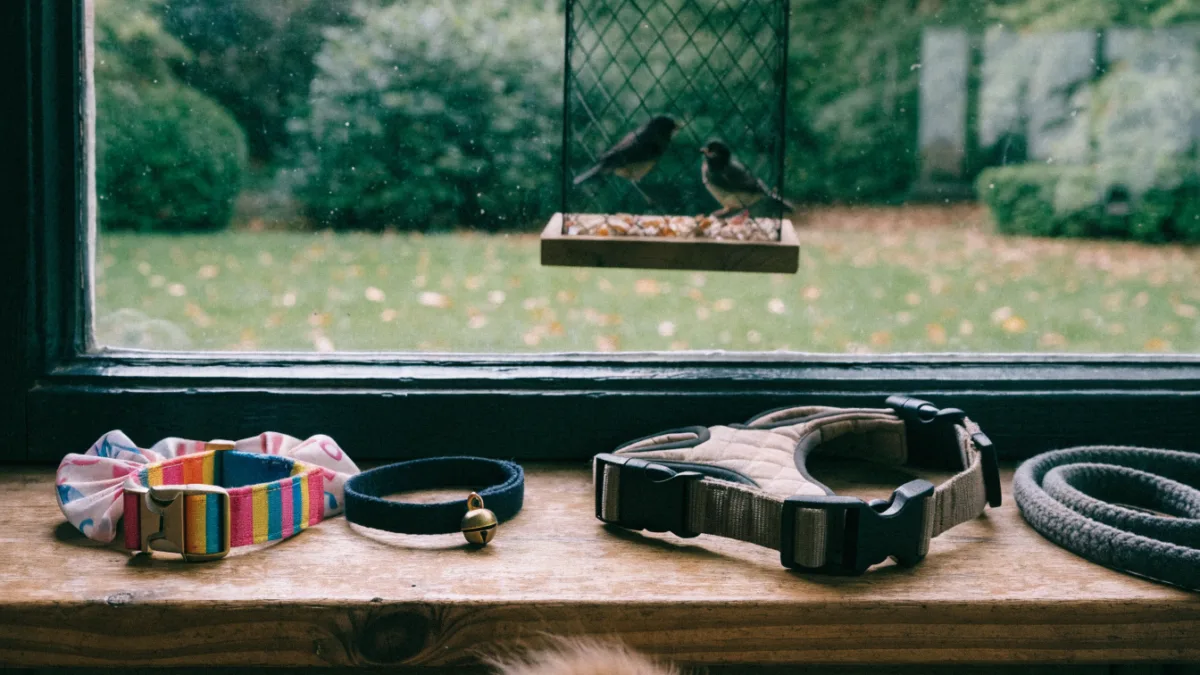
Here’s something I had to sit with for a while: if your cat goes outside and you’ve never once found a “gift” on the doormat, that doesn’t mean she isn’t hunting. When researchers strapped tiny video cameras to 60 free-roaming cats in Georgia, they discovered the cats brought home only about 23% of what they killed. Roughly half the prey was left at the kill site, and another 28% got eaten out there. The doormat isn’t a receipt. It’s a rounding error.
My cat Mochi spent her first three years as a neighborhood stray before she moved in with me, so I already knew she had a hunting résumé I’d never get full accounting of. What I didn’t appreciate was how much of cat predation on wildlife happens completely off the books — and how badly the most popular “fix” performs. So let’s look at the actual research: the numbers, why bells mostly fail, and the small handful of interventions with real data behind them. No shame spiral. Just numbers, and what to do with them.
The Scale Nobody Wants to Hear
The study that rearranged this whole conversation came out in Nature Communications in 2013, when Scott Loss, Tom Will, and Pete Marra pulled together every predation dataset they could find and ran the math:
Free-ranging domestic cats kill an estimated 1.3–4 billion birds and 6.3–22.3 billion mammals every year in the United States alone — likely the largest single source of direct human-caused mortality for birds and mammals in the country.
For context, that rivals or exceeds building collisions (~600 million birds a year) and vehicles (~200 million) combined. And before you assume this is all feral cats: un-owned cats do account for roughly 69% of bird kills and 89% of mammal kills, but owned outdoor cats still contribute hundreds of millions of deaths — concentrated in exactly the suburban yards where songbirds feed and nest. Domestic cats can reach densities of hundreds per square mile, orders of magnitude above any native predator. Ecologists call this the “subsidized predator” problem: a predator with vet care, regular meals, and zero territory limits.
Globally, the picture is starker. A 2023 synthesis documented cats preying on 2,084 species worldwide — about half of them birds, and around 347 of conservation concern. Cats are linked to at least 63 modern extinctions, mostly on islands, and the domestic cat sits on the IUCN’s list of the 100 worst invasive alien species. One more uncomfortable detail from that camera study: reptiles made up about 41% of prey, versus roughly 12% birds. Nobody posts about the lizard body count, but it’s real.
And no, keeping a cat well-fed doesn’t help. Hunting motivation in cats is hardwired and largely decoupled from hunger — Mochi will leave a full bowl to watch a leaf with criminal intent. (Worth noting: the 2013 authors received harassment and death threats over their paper. This topic is charged, which is exactly why I’d rather deal in evidence than vibes.)
Why Bells Mostly Don’t Work
The bell is the intervention everyone reaches for first, and I understand why — it’s cheap, it’s easy, it feels like a solution. Mochi wore one for a summer. She looked like a tiny librarian. The local wildlife did not appear to notice.
There’s a mechanical reason bells fail: cats hunt in slow motion. The whole final approach of a stalk is smooth, low, and deliberate — precisely the kind of movement that doesn’t ring a bell. The thing only makes noise at the pounce, which is far too late for an animal whose entire survival strategy is fast reflexes. On top of that, birds don’t have any innate wiring that reads “tinkling sound” as “cat.” A bell is just ambient noise until it isn’t.
The evidence bears this out. Some UK owner surveys found modest reductions in mammals brought home, but controlled trials — including the 2021 University of Exeter study — found no significant effect on birds at all. Cats killing birds is exactly the problem the bell is supposed to solve, and it mostly doesn’t.
What Actually Has Data Behind It
Here’s the good news: a 2021 trial published in Current Biology (Exeter, with collaboration from ecologists) tested practical interventions on real pet cats, and several of them worked. None are perfect. All are better than a bell.
The bright collar cover — for birds specifically
If you’ve researched BirdsBeSafe collar effectiveness, you’ve seen the numbers: cats wearing the bright fabric collar cover killed about 42% fewer birds in the 2021 trial, and earlier field studies found reductions up to 58%. The mechanism is elegant. Birds have superb color vision — far better than ours — so a cat wearing a rainbow-bright fabric sleeve over its breakaway collar gets spotted early. From a bird’s perspective, the cat essentially glows.
The catch: mammals have poor color vision, so the cover does roughly nothing for mice and voles. Some data even suggest rodent catches tick up slightly, possibly because clumsy young rodents are just easier than alert birds. If birds are your concern, though, this is the single best-studied collar option. The other device worth knowing is the pounce protector bib, which interferes with the timing of the lunge — in the 2007 trial, it stopped 81% of cats from catching birds at all, with about a 45% reduction in mammals. Yes, your cat will look ridiculous. The birds do not care about aesthetics.
The boring stuff: protein and play
The Exeter trial found that cats fed a meat-rich, grain-inclusive-of-nothing diet brought home about 36% less prey, and cats who got five to ten minutes of dedicated interactive play each day brought home about 25% less. The logic: hunting drive isn’t hunger, but a wand toy dragged, killed, and immediately followed by dinner scratches the full predatory sequence in a way a food bowl never does. (Puzzle feeders, sadly, showed no benefit in trials — possibly a slight increase. Nature is unfair.) One caveat from me: run any diet change past your vet before overhauling Mochi’s menu.
Curfews
Mammal hunting skews nocturnal, and dawn and dusk are peak predator hours generally. Keeping cats in overnight costs you nothing but a protest yowl, and keeping them in during spring and early summer spares the fledgling window — the weeks when young birds are on the ground and genuinely can’t fly yet.
The gold standard — and a new reason to consider it
Full containment — a catio, harness training, cat-proof fencing — is 100% effective for that cat, no trial required. And GPS tracking of nearly a thousand pet cats found their median range is tiny, around one hectare in the suburbs. Your cat’s whole world is basically your yard and the two adjacent ones. That’s sobering, but it’s also empowering: the pressure is hyper-local, so your choices genuinely reshape your corner of the ecosystem.
There’s also a cat-side argument now.,[1] and disease flows in both directions — outdoor cats are the most commonly reported rabid domestic animal in the US, and their feces spread Toxoplasma that has killed endangered sea otters. More recently, avian influenza has changed the math again: cats died in Poland’s 2023 outbreak, barn cats died during the 2024 US dairy outbreak, and a house cat in Oregon died in late 2024 linked to contaminated raw pet food. The CDC and AVMA now recommend keeping cats indoors and off raw diets. Hunting and scavenging wild birds is a genuine exposure route, so the catio is suddenly a cat-safety feature, not just a bird one.
If You Feed Birds, You’re Part of This Equation
A feeder next to a shrub is a buffet with an ambush lane attached. If you’re going to feed birds — and you should — do it thoughtfully:
- Place feeders at least 10–15 feet from dense shrubs or cover, so birds can see trouble coming.
- Clean up spilled seed regularly; ground-feeding birds foraging under a feeder are the most vulnerable animals in your yard.
- If a cat stakes out your feeder, take it down for a couple of weeks. A staked-out feeder becomes a trap, not a restaurant.
And remember the toll goes beyond kills. Research shows parent birds reduce feeding and provisioning simply when a cat is visible nearby — a fear effect that quietly starves nests without a single body on the doormat.
So where does this leave those of us with indoor-outdoor cats? With a genuinely data-backed middle path: a bright collar cover for the birds, a meatier diet, ten minutes of real play, and a night curfew. Combined, that cuts a cat’s hunting by roughly half — without ending outdoor access entirely. Full containment remains the ceiling, and I’m working on it. The catio plans are drawn. Mochi supervises the lumber with an expression of profound skepticism.
Here’s my takeaway, after sitting with all this research: cats aren’t villains. They’re doing exactly what we spread across every continent and island and backyard on Earth. The chipmunk, the cardinal, the absurd lizard — they’re all just trying to make a living in a yard that a predator they never evolved alongside now patrols three times a day. We get to decide how much of that yard we share, and how much we hoard for the wild things that have nowhere else to go. Half measures, done honestly, are a real start.
Sources
- Outdoor cats commonly live 2–5 years versus 10–15 or more indoors — vetmed.tamu.edu