

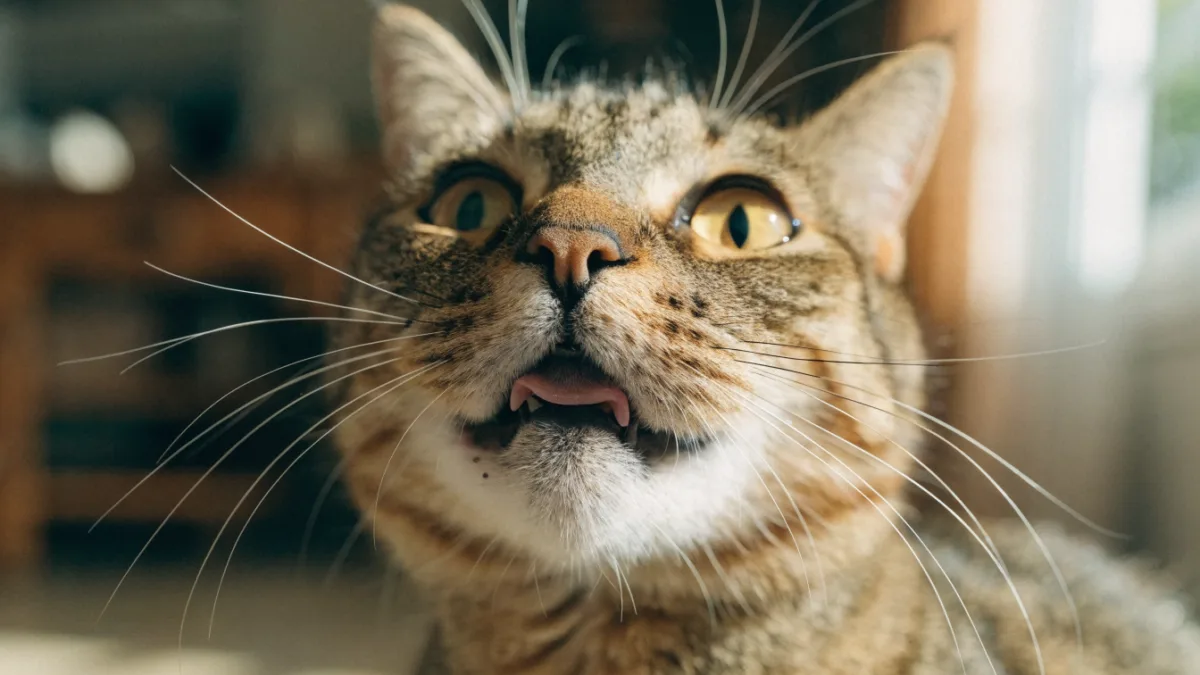
You’re sitting on the couch, your cat is doing that thing where they’re obsessively sniffing your gym bag, and then it happens. The upper lip curls back. The mouth cracks open just slightly. The eyes get squinty and almost glazed over. For a solid five to ten seconds, your cat looks like they just smelled the worst thing on the planet — and they’re genuinely offended by it.
Every single pet owner I’ve ever talked to has seen this face. Most people laugh, grab their phone to film it, and assume their animal is completely grossed out. I used to think the same thing. Then I learned what’s actually going on, and it completely changed how I read animal body language.
That bizarre expression has a name. It’s called the Flehmen response, and it’s not about disgust at all. It’s one of the most sophisticated scent-analysis tools in the animal kingdom.
What Exactly Is the Flehmen Response?
The word “Flehmen” comes from German, and it roughly translates to “bareing the upper teeth.” But don’t let that fool you — this isn’t an aggressive display. It’s a deliberate, voluntary action that animals take when they want to investigate a scent more deeply.
When your pet makes this face, here’s what’s happening physically:
- The upper lip curls back and up
- The mouth opens just a crack
- The nostrils may close partially or fully
- The head often lifts slightly
- The eyes squint or take on a distant, unfocused look
That combination creates what pet owners affectionately call the “stink face,” “stank face,” or “sneer.” And while cats get most of the internet fame for it, they’re far from the only animals who do this. Horses are absolute pros at the Flehmen response — I’ve seen stallions hold that curled-lip pose for a genuinely impressive amount of time. Goats, cows, deer, lions, tigers, and many other mammals all share this behavior.
It’s a cross-species biological function. And once you understand why it happens, you start noticing it everywhere.
The Science Made Simple
Two Different Sniffing Systems
Here’s where most people get tripped up. They assume an animal’s nose works like ours — one system, one way of processing smell. That’s not how it works for most mammals.
Animals like cats and dogs actually have two separate scent-detection systems. The first is the one you’re familiar with: regular sniffing through the nostrils. Air carrying scent molecules enters the nasal cavity, hits the olfactory receptors, and the brain processes it. This is your pet’s everyday smelling — finding food, noticing a new person, detecting that you opened the cheese drawer.
The second system is where things get interesting. Tucked away in the roof of the mouth — specifically in the nasal septum area — is a specialized structure called the vomeronasal organ, also known as Jacobson’s organ. This organ doesn’t process regular smells. It’s tuned specifically for detecting pheromones and other complex chemical signals that regular olfactory receptors can’t fully interpret.
How the Lip Curl Helps
The problem for your pet is that the vomeronasal organ isn’t directly exposed to the outside air. Scent molecules can’t just drift in there on their own. The animal needs to physically move those molecules to where the organ can access them.
That’s exactly what the Flehmen response accomplishes. By curling the upper lip and opening the mouth slightly, your pet creates a kind of funnel. This draws air — and the scent molecules suspended in it — into a small duct located just behind the front teeth. From there, those molecules travel directly to the vomeronasal organ for deep analysis.
Think of regular sniffing as skimming the headline of a news article. The Flehmen response is your pet clicking through to read the full story.
Why Pets Do It (And What They’re Learning)
So your cat is making the face. Your dog occasionally does it too. What exactly are they trying to figure out?
The vomeronasal organ specializes in detecting pheromones — chemical signals that animals release through urine, sweat glands, and other bodily secretions. When your pet triggers a Flehmen response, they’re usually trying to gather very specific information:
- Mating readiness: Is a nearby female in heat? Is a rival male in the area? Pheromones in urine carry this data clearly.
- Territory markings: Who’s been here? Another animal’s scent marks tell a detailed story about identity, status, and how long ago they passed through.
- Individual identification: Animals can distinguish between specific individuals based on their unique chemical signature. It’s like reading a name tag, but way more detailed.
- Stress or alarm signals: Some pheromones communicate fear or stress. An animal picking up on these knows to be on alert.
I remember working with a client who had a German Shepherd that would make this face every time they came home from visiting a friend’s house. The dog wasn’t being weird or aggressive — he was reading the scent of the friend’s dogs that had transferred onto his owner’s clothes. He was essentially catching up on the neighborhood gossip through his nose.
The Big Misconception: Disgust vs. Deep Analysis
Here’s where human perception and animal reality completely diverge, and it’s worth spending a minute on because it changes how you interpret your pet’s behavior.
When we curl our lip and wrinkle our nose, it means disgust. Something smells bad. We don’t like it. We want to get away from it. We naturally project that same meaning onto our pets.
But here’s the thing: animals making the Flehmen response aren’t expressing an opinion about whether a smell is good or bad. They’re collecting data. It’s investigation, not revulsion.
That’s why your cat might make the stink face when smelling the inside of your shoe, your gym socks, the spot where another animal urinated, or even a baby’s head. These scents contain information — pheromones, hormones, chemical traces — that the vomeronasal organ can decode. Your pet isn’t saying “eww.” They’re saying “hang on, let me get a better read on this.”
It’s also worth noting that animals will often Flehmen in response to scents that humans find completely neutral. I’ve seen cats make the face after sniffing a blank piece of paper that had been sitting near another animal. There’s nothing we’d consider “smelly” about it, but to the cat, it carried a chemical story worth investigating.
Stink Face vs. Something Else
While the Flehmen response is completely normal and harmless, it’s smart to know the difference between stink face and behaviors that might actually need attention.
Flehmen response is brief — usually lasting a few seconds to maybe half a minute. The animal appears calm and focused afterward, often going about their business or investigating the scent source further. The lip curl is relaxed, not tense.
If you see your dog or cat with a curled lip and stiff body language, hard staring, growling, or raised hackles, that’s not a Flehmen response. That’s a warning signal, and you need to pay attention to the context. Similarly, if the mouth is open and the animal seems to be struggling to breathe, pawing at their face, or drooling excessively, that could indicate a respiratory issue, dental problem, or something stuck in the mouth. In those cases, a vet visit is the right call.
But the classic stink face — the one that looks hilarious and makes you reach for your phone? That’s just biology doing its thing.
Why Understanding This Matters
Learning about the Flehmen response isn’t just trivia for your next trivia night. It genuinely changes how you read your pet.
When you understand that your animal isn’t disgusted but actively investigating their world, you start to appreciate how incredibly rich their sensory experience is. We humans are visual creatures. We understand our environment primarily through what we see. For cats, dogs, horses, and countless other mammals, smell is the primary language. The Flehmen response is their way of reading the fine print.
It also reinforces something I tell pet owners constantly: let your animal sniff. When you’re rushing through a walk and yanking your dog away from every interesting scent post, you’re cutting short their version of reading the morning paper. When your cat spends five minutes thoroughly investigating the spot where your neighbor’s cat sat on the porch, they’re not being obsessive — they’re gathering information that matters to them.
The Flehmen response is a reminder that our pets live in a world we can barely imagine. Their noses pick up stories written in chemicals, and every now and then, when a scent is especially complex or interesting, they make that ridiculous face to make sure they catch every detail.
So the next time your cat looks at you with that curled lip and slightly horrified expression after sniffing your laundry, don’t take it personally. They’re not judging you. They’re just reading your chemical resume — and apparently, you’ve got some interesting things to say.