

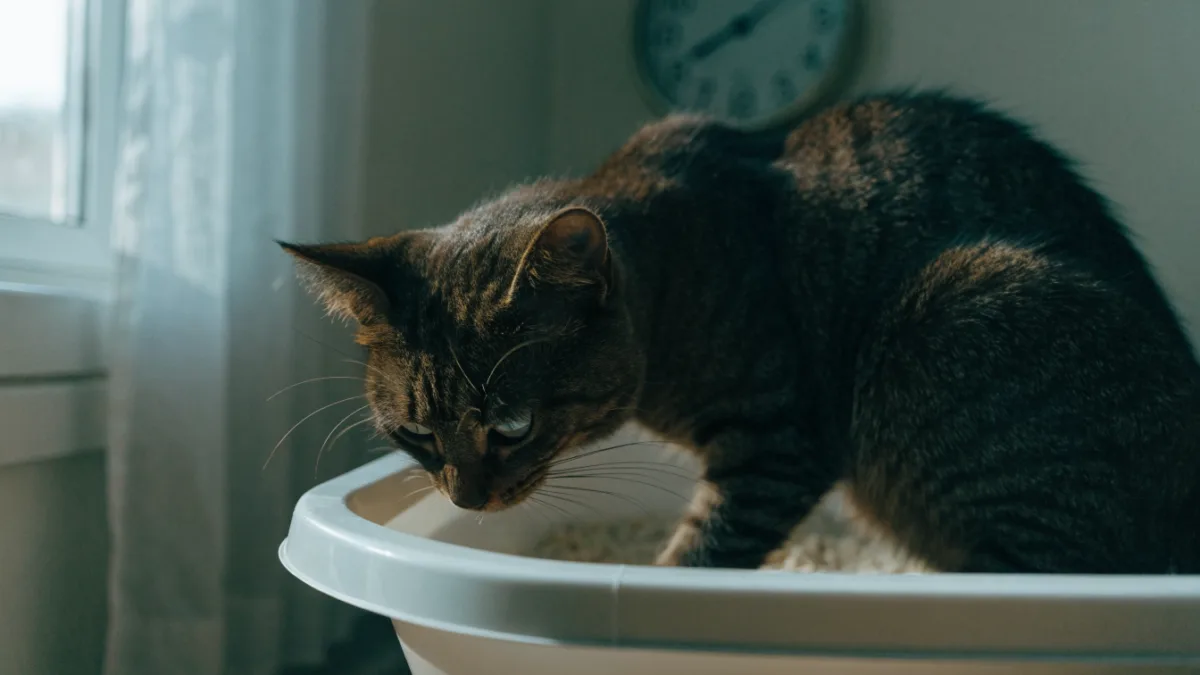
When Milo, a three-year-old gray tabby, started making trip after trip to the litter box and straining without producing anything, his owner did what most caring people would do: she assumed he was constipated and stirred a little pumpkin into his dinner. By morning he was vomiting and hiding under the bed. By the time he reached our clinic, his bladder was swollen, firm, and painful — completely obstructed. The pumpkin was a kind instinct, but it cost Milo about eighteen hours. He survived, but he’s the reason I give every cat owner the same speech: in a male cat, straining in the litter box is never a wait-and-see situation. Here’s why, and what the clock actually looks like once a blockage starts.
The Constipation Trap: The Most Expensive Guess a Cat Owner Can Make
The single biggest reason cats arrive at emergency clinics in crisis isn’t ignorance — it’s a reasonable wrong conclusion. A blocked cat squats, strains, and pushes in the litter box. So does a constipated cat. From the doorway, they look identical, and because constipation feels like a “manageable at home” problem, owners wait. Sometimes for a day or more.
To be clear, I recommend pumpkin for actual constipation all the time — it’s a legitimate fiber source. The problem is that you can’t reliably tell the two apart from across the room. What you can do is look for the pattern that suggests urine trouble rather than stool trouble:
- Many trips to the box with little or nothing produced
- Crying or vocalizing while straining
- Excessive licking of the genital area
- Blood-tinged spots on tile, in the bathtub, or on laundry — blocked cats often seek cool, smooth surfaces
- Urinating outside the box in unusual places
And here’s the part I need you to memorize, because it removes the guesswork entirely:
No pee in 12 hours from a straining male cat? Go now. Not tomorrow morning. Now.
You don’t have to diagnose anything. You just have to know whether urine is coming out. If you’re scooping the box and finding nothing — or only tiny, shrinking clumps — that’s your answer, regardless of what else you’re seeing.
Spaghetti Anatomy: Why Male Cats Block and Dogs Usually Don’t
This is where the whole “cat problem” framing comes from, and it’s pure plumbing. A male cat’s urethra — the tube that carries urine from the bladder out of the body — is long and narrow, and at the tip it constricts to roughly the width of a strand of spaghetti. Crystals, mucus plugs, or even a spasming urethral muscle can seal that opening completely. Female cats and dogs of both sexes have shorter, wider urethras, so they typically pass crystals rather than dam up behind them. That’s why the overwhelming majority of obstructed feline patients — commonly cited at 80 to 90 percent or more — are male.
The umbrella term for all of this is FLUTD, feline lower urinary tract disease, which covers idiopathic cystitis, crystals, bladder stones, urethral plugs, and infection. The breakdown surprises people: in cats under ten, roughly 60 to 70 percent of cases are feline idiopathic cystitis — inflammation with no infection and no crystals, strongly linked to stress. Crystals, stones, and plugs account for maybe 20 to 30 percent, and actual bacterial infection is rare in young cats — under about 2 to 5 percent of cases.
But What About Crystals in Dog Urine?
Dogs absolutely get urinary crystals — vets see them on routine urinalysis all the time, often incidentally. The types even follow patterns: struvite crystals often ride along with urinary infections (especially in females), calcium oxalate crystals favor small-breed males like Schnauzers, Yorkies, and Bichons, urate stones are classic in Dalmatians and English Bulldogs, and cystine stones show up in intact males. I once managed a Dalmatian named Coach whose urate stones genuinely did obstruct him — it happens, and it’s an emergency when it does.
But the distinction matters: dogs tend to carry crystals, while male cats block on them. The 2 a.m. “blocked pet” walk-in at an emergency hospital is, overwhelmingly, a male cat. And a quick note for dog owners reading this anyway: struvite stones in dogs can often be dissolved over several weeks with a therapeutic diet, while calcium oxalate stones require surgical removal — which is exactly why a urinalysis and crystal identification matter more than any over-the-counter guess.
The Countdown: When Straining Turns Life-Threatening
Once a male cat is fully blocked, the clock starts, and it moves faster than most owners believe. Here’s the timeline I walk clients through:
- 0–12 hours: Straining, frequent unproductive box trips, vocalizing, genital licking, blood-tinged urine, restlessness. The bladder becomes firm and distended. The cat still usually looks “okay-ish” — this is the window people waste.
- 12–24 hours: Toxins that the kidneys normally flush out start building in the bloodstream. Vomiting, hiding, appetite loss, and lethargy appear. The cat now looks sick.
- 24–48 hours: Rising potassium levels begin disrupting heart rhythm. This is the truly dangerous phase — slowed heart rate, arrhythmias, collapse.
- 24–72 hours: Per,[1] complete obstruction can become fatal within this window through cardiac arrhythmia, kidney failure, or bladder rupture.
The subtler killer is the partial obstruction. A partially blocked cat keeps producing small amounts of urine, so the situation looks manageable — it waxes and wanes for days. Pepper, a five-year-old black-and-white neutered male, dribled tiny spots for three days while his owner assumed he was improving. What actually saved him was that she noticed the clumps in the box getting progressively smaller and called. That observation is the single best free monitoring tool you own: clump size is urine output. Shrinking clumps mean shrinking flow, and shrinking flow means a vet visit.
What Happens at the Emergency Clinic
I describe this part deliberately, because fear of the unknown — the procedure, the cost — is a real driver of delay. When you arrive, the team will feel the bladder, and often relieve pressure first with a needle through the abdominal wall (decompressive cystocentesis), which takes seconds and provides enormous relief. Then, under sedation, they place a soft urinary catheter and flush the obstruction backward out of the urethra. Most cats stay hospitalized 24 to 72 hours on IV fluids to clear the toxin buildup, with pain medication and sometimes urethral relaxants while the catheter stays in. You can see a detailed walkthrough of.[2]
The genuinely good news: treated promptly, survival rates run around 90 to 95 percent. Cost varies enormously by country and clinic, but expect roughly $1,000–$3,000 for the unblock plus hospitalization — and for cats who block repeatedly, a surgical widening procedure called a perineal urethrostomy can run $2,000–$4,000 or more. Those numbers sting, but they’re the argument for acting in hour six rather than hour thirty, when the case becomes longer, riskier, and more expensive. Knowing [3] is, quite literally, money and life saved.
After the Unblock: The Critical Thirty Days
Here’s what nobody tells you on discharge day: 20 to 40 percent of blocked cats re-obstruct — some studies put it near 50 percent within the first six to twelve months — and the highest-risk window is the first 30 days after treatment. So the month after a blockage is when vigilance matters most, including the follow-up urinalysis your vet recommends. That recheck isn’t upselling; it’s how we catch crystals or concentrated urine before they become blockage number two.
Long-term prevention comes down to moisture, weight, and stress:
- Wet food and water: Dry-only diets are associated with FLUTD risk because low-moisture eating concentrates urine — the association is strong even though proving pure causation is tricky. Switching to wet food or adding water to meals is the cheapest intervention in veterinary medicine.
- The n+1 litter box rule: One box per cat, plus one extra, in separate locations. Box competition is a quiet, chronic stressor.
- Environmental stress reduction: Research from Ohio State on “multimodal environmental modification” — routine, enrichment, thoughtful resource placement — shows substantial reductions in recurrence. Some researchers now frame idiopathic cystitis not as a bladder disease at all but as a stress-driven whole-body condition, nicknamed Pandora syndrome.
Two honest confessions from practice. First, for years I sent every unblocked cat home with prazosin, a urethral relaxant — then a 2019 study in JAVMA found it didn’t reduce re-obstruction any better than placebo. I’ve changed my mind and rarely reach for it now. Second, because bacterial infection causes such a small fraction of feline FLUTD, routine antibiotics are a recognized overuse problem in cats. If your vet wants to run a urine culture before prescribing, that’s careful medicine, not hesitation.
The takeaway I’d leave you with is this: cats evolved to hide discomfort, and they’re remarkably good at it — they won’t dramatically announce a urinary emergency. The only window into their urinary health most of us have is a litter box, which means the humble daily scoop is the most underused diagnostic tool in your house. Domestic cats gave up wild independence for us somewhere back in history, and in exchange they rely completely on our attention. A blocked cat is counting on exactly that — someone who knows what shrinking clumps and silent straining mean, and who doesn’t wait until morning.
Sources
- PetMD's guidance on urinary blockage in cats — petmd.com
- how emergency clinics handle blocked male cats here — fvpetemergency.com
- how to recognize the signs of a urinary blockage early — vetcheckforpetsfishers.com