

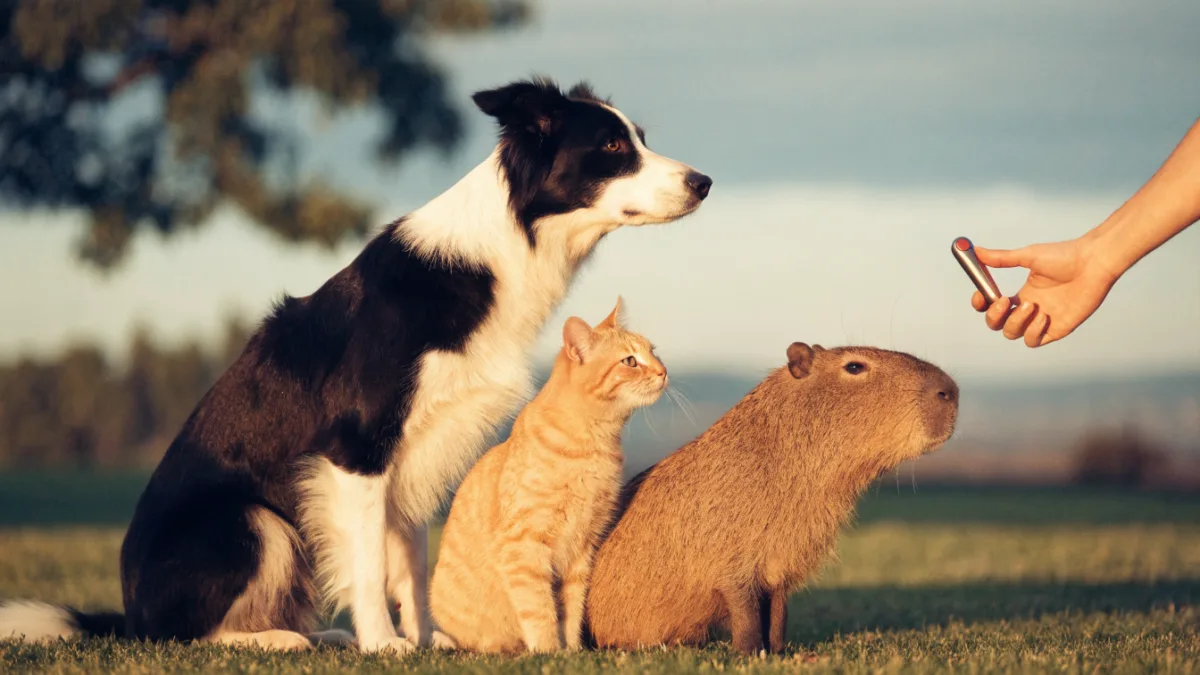
You wouldn’t think a hyperactive border collie, a skeptical housecat, and a 3,000-pound hippo would have much in common. But give me a small plastic box that makes a clicking sound, and I can teach all three of them the exact same behavior. Clicker training isn’t magic, though it definitely feels like it when you first start. It’s just pure, uncomplicated communication. It cuts through the language barrier between humans and animals, telling them exactly what they did right, precisely when they did it.
The Science of the Click
At its core, a clicker is a mechanical bridge. It’s a neutral sound—usually a distinct, sharp click—that we pair with a primary reward like food. Through classical conditioning, the animal learns that the sound predicts a payoff. Once that connection is made, the sound becomes a conditioned reinforcer.
It works because animals live in the present tense. If you ask a dog to sit, and they sit, but it takes you three seconds to fumble a treat out of your pocket, the dog is already looking around, sniffing the ground, or wagging their tail. By the time they get the food, they have no idea what they did to earn it. Maybe they think they got a treat for sniffing the dirt.
Think of the clicker as a camera taking a snapshot of the exact behavior you want. You click the shutter at the exact second the behavior happens.
This isn’t just dog trainer folklore, either. A highly cited 2020 study by N. Pfaller-Sadovsky analyzed the efficacy of conditioned reinforcement in applied animal training settings. The research proved what those of us working with animals every day already knew: using a conditioned reinforcer like a clicker significantly improves training speed and accuracy, even in the chaotic environment of a normal living room, not just a sterile laboratory.
Charging the Clicker and Nailing Your Timing
Before you can ask an animal to do anything, you have to “charge” the clicker. This just means teaching them what the sound means. It takes about five minutes. You click, you give a treat. You click, you give a treat. You do this about ten or fifteen times until the animal hears the click and visibly looks to you for the reward. You’ve successfully created an association.
From there, the real work begins, and it’s completely on you. The most common mistake people make is bad timing. I used to be terrible at this. I’d wait for the dog to complete the whole behavior, hold it for a second, and then click. I was clicking the pause, not the action.
If you want to teach a dog to put their paw on a target, you don’t click when they leave their paw there for five seconds. You click the exact millisecond their paw touches the target. If you click a second too late, you might be rewarding the dog for looking at your face or shifting their weight. Timing is everything, and human reflexes are naturally slow. You have to anticipate the behavior and click as it’s happening.
Breaking the Species Barrier: It’s Not Just for Dogs
People assume clicker training is a “dog thing.” It’s not. Positive reinforcement is a universal law of learning. If a species has a brain capable of making associations—which is basically all of them—you can use a clicker. But you have to tailor the approach to the animal in front of you.
The High-Drive Dog
Let’s take a Malinois or an Australian Shepherd. These dogs are genetically wired to work. For them, food is great, but a game of tug or a thrown tennis ball might be the ultimate payoff. With these dogs, you can use the clicker to shape incredibly complex behaviors. You click the intense eye contact, and the reward is a fast-moving toy. The clicker helps them slow down their frantic brains just enough to figure out exactly which behavior triggered the throw.
The Skeptical Housecat
Cats are phenomenal clicker training candidates, but you’ll lose them instantly if you treat them like dogs. You can’t use a loud clicker right next to a cat’s sensitive ears—you might want to use a quieter marker, like the click of a retractable pen or a soft tongue click. And while a dog will often work for dry kibble, a cat usually requires high-value, smelly treats. Think tiny bits of tuna or freeze-dried chicken. If you try to train a cat when they are sleeping, they’ll ignore you. You have to catch them when they’re naturally active and curious. (There are some great communities out there dedicated entirely to the nuances of training cats and other non-dog species).
The Shy Rescue Animal
This is where the clicker truly shines. I’ve worked with feral dogs and undersocialized cats who were absolutely terrified of human hands. If you try to force physical affection on them to “build trust,” you just make them more afraid. Instead, you use the clicker to reward distance. If the animal takes one step toward you, you click and toss a treat far away from you, giving them space. The clicker removes the pressure. It says, “You did good, and I’m not going to get in your space.” Over time, this builds incredible confidence. You aren’t just teaching obedience; you’re giving them a way to control their environment and get paid for being brave.
The Great Debates: Clickers vs. Voice
Some trainers argue that you don’t need a plastic clicker; a consistent verbal marker like the word “Yes!” works just fine. I use both, but a mechanical clicker has a distinct advantage. Human voices carry emotion. If you’re stressed, your “Yes!” sounds different. If you’re excited, the pitch goes up. A mechanical clicker produces a pure, consistent frequency every single time. There is no ambiguity, which is incredibly helpful for an animal trying to learn a new skill.
Then there’s the “dependency” myth. People worry their animal will only behave if they have a clicker in their hand. I promise you, this isn’t true. The clicker is a teaching tool, not a lifetime requirement. You use it to install the behavior. Once the dog reliably sits on cue, you stop clicking for sits. You save the clicker for the next new trick.
The biggest danger with clicker training is simply human error. Because the clicker is so precise, a sloppy trainer will accidentally reward the wrong thing. If your timing is off, you’ll confuse the animal. But the beauty of positive reinforcement is that if you mess up, the worst thing that happens is the animal gets a free treat. You haven’t damaged your relationship or broken their trust. You just try again.
From Your Living Room to Wildlife Conservation
While you’re using a clicker to teach your dog to stop jumping on guests, zoos and wildlife sanctuaries are using the exact same science to save endangered species. This is arguably the most exciting application of clicker conditioning today.
In the past, getting a blood sample from a tiger or trimming the hooves of a rhino required physical restraint or dangerous chemical sedation. Today, modern zoos use clicker training to teach these animals to participate in their own medical care voluntarily. A snow leopard is clicked and rewarded for walking up to the enclosure mesh and allowing a veterinarian to draw blood through the fence. A hippo is clicked for opening its mouth so a vet can examine its teeth. An elephant is clicked and rewarded for calmly presenting its ear for routine blood draws.
This completely eliminates the stress of sedation and physical force. It gives the animal a choice. They can walk away if they want to, but because the communication is clear and the rewards are worth it, they usually choose to participate. This drastically reduces injuries for both the animals and their keepers, and it plays a massive role in the success of conservation breeding programs for endangered species.
Clicker training is a quiet revolution in how we interact with the animals sharing our planet. It shifts the dynamic from compulsion to collaboration. Whether you’re trying to teach a rescue mutt to trust again, convincing a cat to use a scratching post instead of your couch, or keeping a gorilla healthy at a sanctuary, the conversation is the same. Listen to the animal, reward the behavior you want, and snap a mental photo of the exact moment they got it right.