

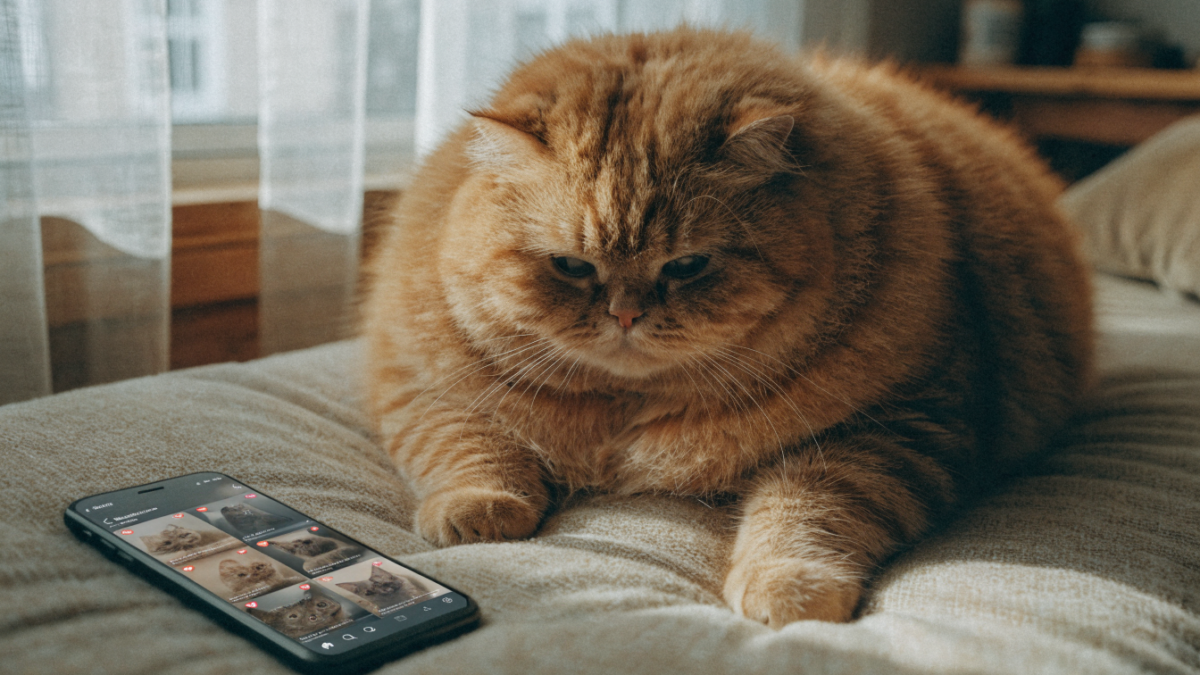
Consider an orange tabby named Saul, brought into a clinic last spring by an owner who proudly pulled up a TikTok video with 2.3 million views. “They love him,” she said, beaming. “Everyone comments about what a chonk he is.” Saul weighed 24 pounds. His back legs buckled slightly when he tried to jump onto the exam table, and he couldn’t reach his own hindquarters to groom himself. His skin was matted and flaky underneath. He was seven years old and, based on his bloodwork, already showing early signs of insulin resistance — a precursor to diabetes. His owner loved him deeply. She just didn’t realize that the internet’s favorite joke was quietly stealing years from his life.
How We Turned a Disease Into a Compliment
If you’ve spent time on Instagram, Reddit, or Facebook, you know the vocabulary. A cat is “a fine boi,” then “heavy plump,” then a “megachonk.” The internet’s playful tier list ends with “Oh Lawd He Comin'” — reserved for animals so heavy they can barely move. These phrases get slapped on photos of dogs and cats who waddle when they walk, whose bellies nearly touch the floor, who flop down heavily after a few steps. And honestly, the language is funny. I understand why people use it. The memes are well-crafted.
But that’s exactly the problem. When you give something a cute nickname, you make it harder to take seriously. “Chonk” doesn’t sound like a medical concern. It sounds like an endearing quirk. And the engagement algorithms reward it — every like, share, and comment about an animal being an “absolute unit” signals to social media platforms that this content is popular, which pushes it to more feeds, which normalizes it further. We’ve collectively agreed that an overweight pet is entertaining rather than concerning, and that shift in language has real medical consequences.
What “Chonkiness” Actually Does to a Body
Let me walk through what excess weight does to an animal, because I think people genuinely don’t connect the meme with the underlying physiology. And I’ll keep this accessible — no textbook jargon without translation.
Adipose tissue — body fat — isn’t inert storage. It’s biologically active. Fat cells release inflammatory compounds called adipokines that circulate through the bloodstream and cause low-grade, chronic inflammation throughout the entire system. In practice, that means an overweight animal is fighting a constant, low-level war against its own body. Over months and years, that inflammation damages organs, blood vessels, and joint tissue.
The clinical realities I see regularly include:
- Osteoarthritis: Extra weight means extra force on joints with every step. A dog carrying 20% more than its ideal body weight puts significantly more mechanical stress on its knees, hips, and spine. The cartilage wears down. The animal hurts. And because it hurts to move, the animal moves less — which means it burns fewer calories, which means it gains more weight. It’s a brutal cycle.
- Diabetes mellitus: In cats especially, obesity drives insulin resistance, where the body’s cells stop responding properly to insulin. I’ve diagnosed diabetes in cats as young as five because they were significantly overweight. Treatment means twice-daily insulin injections for the rest of the animal’s life — and owners aren’t always prepared for that commitment.
- Cardiovascular strain: The heart has to pump blood through more tissue. Over time, that additional workload contributes to heart disease and high blood pressure, conditions that are difficult to manage even with medication.
- Respiratory compromise: Fat around the chest and abdomen restricts lung expansion. Overweight dogs and dogs with short snouts — like pugs, French bulldogs, and Boston terriers — struggle particularly hard, especially in warm weather.
- Shortened lifespan: Multiple studies have shown that dogs maintained at a lean body weight live significantly longer — sometimes up to two years longer — than their overweight counterparts. With cats, the data is similarly clear.
I had a patient, a beagle named Mabel, whose owner brought her in for what she described as “slowing down.” Mabel was nine, weighed 48 pounds, and should have been closer to 28. She wasn’t slowing down because she was aging. She was slowing down because every step hurt. We put together a weight management plan, and over eight months, Mabel lost 16 pounds. At her follow-up, she was trotting into the exam room. Her owner cried. She hadn’t seen Mabel move like that in two years.
The Illusion of “Cute” and the Social Media Echo Chamber
Here’s where social media makes things genuinely harder. When an owner posts a photo of a heavily overweight pet, the response is almost universally positive. People comment with heart emojis. They call the animal “majestic” and “glorious.” They share it with friends. There is no critical voice in that feedback loop — or if there is, it gets drowned out or flagged as negativity.
I think about a cat named Bug who went viral for his round belly and sweet personality. Bug’s chonkiness wasn’t a genetic quirk or a natural body type. It was the result of years of severe overfeeding by previous owners before rescuers stepped in. The internet celebrated Bug’s appearance without knowing — or, in some cases, without caring — that his size represented neglect. The round belly that everyone found adorable was actually a sign that something had gone wrong for a long time.
This creates a strange contradiction. People genuinely love animals. They want them to be happy and healthy. But the engagement structures on social platforms reward content that is visually striking and shareable, and an unusually round animal is visually striking. The platform doesn’t distinguish between “this is adorable” and “this animal is suffering.” Both generate the same clicks.
When Does It Cross the Line?
There’s a genuine debate happening in animal welfare circles, and I’ll lay it out honestly. Some people argue that viral chonky pets raise awareness — that when a rescue shares the story of a massively overweight animal and its rehabilitation journey, it educates the public and raises funds for care. There’s truth to that. Some of these animals have been successfully rehomed and rehabilitated because their viral status brought attention and donations.
But there’s a tension. The same post that raises money for one animal also models obesity as entertainment for millions of viewers. And some accounts have taken it further — intentionally overfeeding animals to reach that “Oh Lawd He Comin'” tier for ongoing content. That’s not a rescue story. That’s manufactured cruelty for engagement.
Animals cannot open the pantry. They cannot measure their own portions. They cannot choose a salad over a third helping of kibble. We make every dietary decision for them. And because dogs and cats will enthusiastically eat whatever is offered — they’re wired that way — owners often interpret a good appetite as proof that the animal is happy. I’ve had owners tell me, “But she loves food, she’s always begging!” Dogs and cats beg because begging is a learned behavior that has been rewarded, not because the animal has calculated its caloric needs.
What Actually Helps
If you’re reading this and feeling a pang of recognition, please don’t feel ashamed. I’ve seen hundreds of overweight pets in my career, and the overwhelming majority of their owners are kind, loving people who showed affection through food because that’s how our culture teaches us to express love. The good news is that weight management is one of the most impactful things you can do for your pet’s health, and it’s never too late to start.
Here’s what I recommend:
- Talk to your veterinarian before making changes. Sudden calorie restriction, especially in cats, can cause a dangerous liver condition called hepatic lipidosis. Weight loss needs to be gradual and supervised. Your vet can calculate a target weight, recommend a daily caloric intake, and suggest an appropriate diet — therapeutic weight-loss formulas are higher in protein and fiber to maintain muscle mass and satiety while reducing calories.
- Measure every meal. Not with a coffee mug. Not by eye. Use a proper measuring cup or, ideally, a kitchen scale. The difference between a level scoop and a heaping one can be significant relative to a small animal’s daily needs.
- Rethink treats. Treats should make up no more than 10% of daily caloric intake. Many commercial treats are calorie-dense. Try substituting with appropriate fresh foods — green beans, cucumber, or small pieces of plain cooked chicken — and factor those calories into the daily total.
- Increase movement gradually. For an animal with joint pain, this might mean short, gentle walks or swimming rather than vigorous exercise. For cats, puzzle feeders and short play sessions scattered throughout the day can make a meaningful difference.
- Be honest about body condition. You should be able to feel your pet’s ribs without pressing hard. When viewed from above, the body should have a visible waist behind the ribs. If you can’t feel the ribs or see a waist, schedule a conversation with your vet.
Love Doesn’t Come in a Bowl
Saul, the orange tabby I mentioned at the beginning? His owner was devastated when I explained what his weight was doing to his body. But she was also determined. We built a plan together — measured meals, a puzzle feeder, short play sessions twice a day. It took nine months. Saul lost eight pounds. He started grooming himself again. He could jump onto the windowsill to watch birds — something he hadn’t done in over a year. His owner told me, quietly, that she’d rather have a few thousand Instagram likes than a healthy cat. The account is still active. But these days, the comments are about how good Saul looks, how bright his eyes are, how much energy he has.
The chonk trend isn’t going away. The memes are too embedded in internet culture. But we can change how we respond to them. The next time a video of a wildly overweight animal crosses your feed, I’d encourage you to pause before you hit “like.” Ask yourself whether you’d share it if you knew the animal was in pain. Because odds are, it might be. Express love for your pets through presence, play, and proper care — not through portion sizes. They trust us completely to make the right choices for them. Let’s make sure we do.