

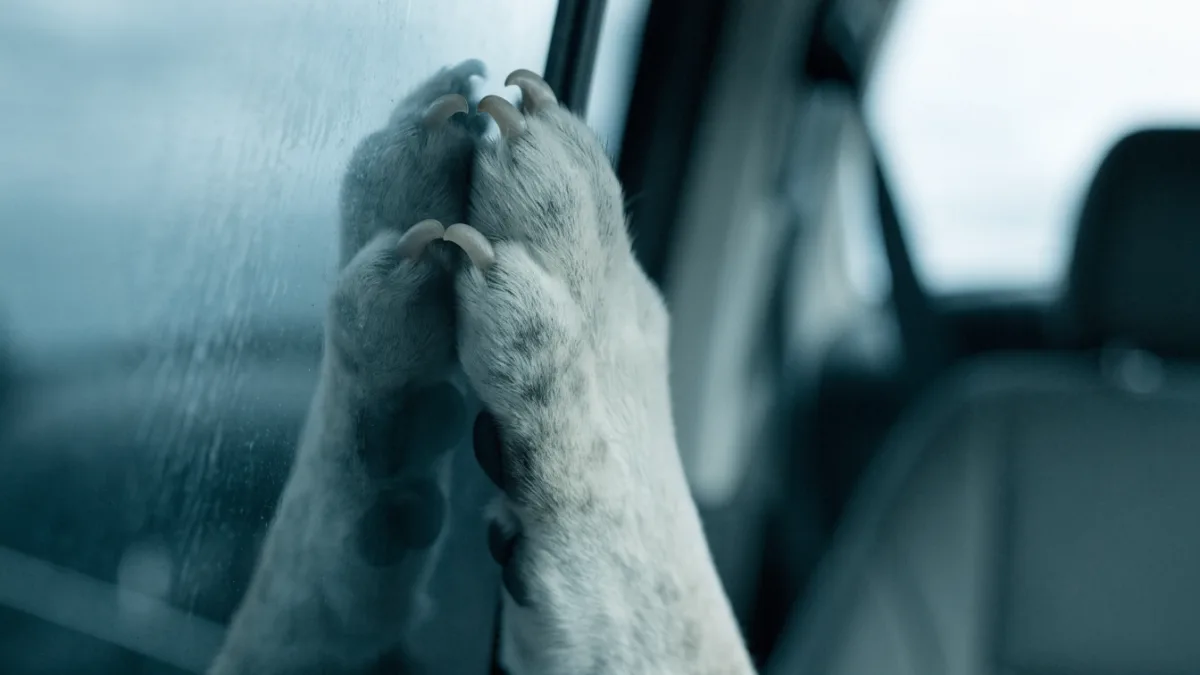
Just last month, a family brought in their Golden Retriever, Biscuit — a sweet five-year-old girl who’d been riding unrestrained in the back seat on the way to the dog park. They were only two miles from home when a driver ran a red light. The car stopped suddenly, but Biscuit didn’t. She launched forward into the front seat, hitting the dashboard hard. By the time she reached my exam table, she had a fractured pelvis and internal bruising that kept her hospitalized for nearly a week. Her owner, sitting in the passenger seat, walked away with bruises across her chest from where Biscuit’s body struck her. “We were almost there,” her owner kept repeating. “It was a five-minute drive.” Those five minutes nearly cost Biscuit her life — and it’s a scenario I see far more often than most pet parents would believe.
The Physics Nobody Wants to Think About
Here’s the thing about sudden stops: they don’t care how short your trip is. Most accidents happen within a few miles of home, precisely because we let our guard down on familiar roads. That quick ride to the coffee shop or the vet? That’s exactly when you’re statistically most likely to get into a collision.
When a car stops suddenly at just 35 miles per hour, physics takes over in a brutal way. A 60-pound dog — think a standard poodle or a smaller Labrador — becomes a projectile carrying roughly 2,700 pounds of force. That’s not a typo. Your dog’s body, moving at the speed the car was traveling, has nowhere to go but forward. At that force, the outcome is often fatal for the pet, and the human passengers sitting in the path aren’t much safer.
I remember a consultation with a client whose French Bulldog, Pierre, had been riding on her lap during a fender bender. Pierre weighed 22 pounds. The airbag deployed — and that’s when a minor accident became a tragedy. Airbags deploy at speeds up to 200 miles per hour. For a human, that’s a lifesaver. For a small dog positioned directly in front of one, it’s like being hit by a baseball bat.
Distracted Driving Is the Hidden Risk
But crashes don’t only happen because of other drivers. According to the ASPCA, roughly 84% of drivers travel with their pets, but only a fraction restrain them. A dog moving freely between seats, a cat climbing onto the dashboard, a nose blocking your view of the side mirror — these are all moments your eyes leave the road. Research shows that looking away for just two seconds doubles your crash risk. And let’s be honest: if your dog is whining to get into your lap, you’re not glancing away for two seconds. You’re having a full conversation while trying to steer.
Where Your Pet Sits Could Save Their Life
Let me be direct about this: pets should never ride in the front seat. Not on your lap, not in a carrier buckled into the passenger seat, nowhere near those airbags. I know some small dog owners love having their pup ride shotgun — and I understand the impulse. But airbags were designed for adult human bodies. When they deploy against a small animal, the force can easily break a neck or cause fatal chest trauma.
The back seat is the safest place for your dog or cat. Period. If you drive an SUV and want to use the cargo area, that’s a reasonable option too, provided your pet is properly secured — which brings me to the part most owners get wrong.
What Actually Works: Honest Answers About Restraints
This is where I see the most confusion in my exam room, so let me break it down by species and setup.
For Dogs
The best option is a crash-tested travel harness that attaches directly to your car’s seatbelt system. Notice I said “crash-tested” — not just “for car use” or “travel harness.” There’s a significant difference, and unfortunately, the pet product industry hasn’t always been honest about which is which.
Here’s what to look for: harnesses tested by the Center for Pet Safety (CPS), an independent nonprofit that actually crash-tests pet restraints using federal motor vehicle standards. Their certification means the harness survived real impact testing — not just a manufacturer’s in-house quality check. A proper travel harness will have a broad chest plate to distribute force, sturdy metal hardware (not plastic clips that snap under pressure), and a tether that connects to the car’s seatbelt, not a flimsy clip that hooks onto a collar loop.
If your dog travels better in a crate, that’s an excellent option too — but only if the crate is crash-tested and properly anchored. A hard-sided travel crate that’s secured in the cargo area or back seat can be just as safe as a harness, sometimes safer for dogs who get anxious during rides. The key word is secured. An unsecured crate becomes the same 2,700-pound projectile an unrestrained dog does.
For Cats
Cats should never — and I cannot stress this enough — be loose in a moving vehicle. I’ve treated cats who escaped their owners’ cars during accidents and were never found again. One client, bringing her tabby Mochi in for a routine checkup, had the carrier door pop open when she braked hard. Mochi spent three hours hiding under a stranger’s porch before animal control could retrieve her.
The safest setup for a cat is a hard-shell carrier — not a soft-sided bag — strapped into the back seat using the seatbelt threaded through the carrier’s handle or designated belt loops. The carrier shouldn’t slide or tip when you push it. If it moves easily when you nudge it, the seatbelt isn’t tight enough.
The “Crash-Tested” Label Problem
I want to address something that frustrates me as both a veterinarian and a consumer: the marketing around pet travel gear. Until recently, there were no federal standards for pet restraints. Manufacturers could slap a “crash-tested” label on a product that had never seen a real impact test. Many cheap harnesses sold online will snap the moment they’re actually needed.
This is why I direct clients to the Center for Pet Safety’s published results. They’ve tested dozens of products independently, and their findings are eye-opening. Some harnesses that look sturdy fail catastrophically. Some crates marketed as “travel-safe” buckle under forces that a real crash would easily generate. The good news is that reputable manufacturers are paying attention, and automakers are increasingly designing vehicles with built-in pet restraint anchors and cargo dividers engineered to actual safety standards.
I’ve changed my own recommendations over the years as better data emerged. A decade ago, I used to tell clients that any harness was better than none. After reviewing CPS testing data and seeing what actually happens in real accidents, I no longer believe that. A poorly made restraint can fail in ways that cause worse injuries than being unrestrained — a snapped tether that whips a dog forward, a harness that cinches tight across the abdomen during impact. Buy certified gear or don’t bother. There’s no safe middle ground here.
What About Truck Beds and Pet Barriers?
In rural areas, I still see dogs riding loose in truck beds regularly. It’s incredibly dangerous and increasingly illegal. A dog can be ejected during a sharp turn, a sudden stop, or even just because something startled them. Even at moderate speeds, the injuries from being thrown from a truck bed are almost always severe or fatal. If you absolutely must transport a dog in a truck bed, they need to be in a secured, ventilated crate anchored to the vehicle — and even that carries risks I wouldn’t accept for my own animals.
As for metal barriers in SUVs — the theory is sound, but execution matters enormously. A poorly anchored barrier can bend and snap during a crash, turning the barrier itself into a heavy metal weapon inside the cabin. If you use a barrier, make sure it’s specifically rated for crash safety and properly installed according to the manufacturer’s specifications for your exact vehicle model.
Legal Consequences You Probably Don’t Know About
Most drivers have no idea what the law says about traveling with pets — and honestly, the patchwork of regulations doesn’t make it easy. In many jurisdictions, an unrestrained pet falls under broader distracted driving laws. That means you could face fines, points on your license, or both if you’re pulled over with a dog on your lap or moving freely through the cabin.
Leaving a pet unattended in a vehicle under dangerous conditions — extreme heat or cold — is currently illegal in 28 U.S. states, and several more have expanded their Good Samaritan laws to legally protect civilians who break into locked cars to rescue distressed animals. If your unrestrained pet is injured during an accident you caused through distracted driving, some prosecutors have pursued animal cruelty charges in addition to traffic violations.
Animal safety advocates are actively lobbying for standardized federal legislation around pet restraints in vehicles, similar to seatbelt laws for humans. It hasn’t passed yet, but the momentum is building — and in the meantime, local laws vary widely.
The Bottom Line
I think about Biscuit often. She healed, eventually — a long recovery with restricted activity, pain management, and a lot of physical therapy. Her family now uses a CPS-certified harness for every single trip, even the half-mile drive to the mailbox. They learned the hardest way possible that “almost there” doesn’t protect anyone.
Here’s my honest ask: look at how your pet rides in your car right now, and ask yourself whether that setup would hold up in a 35-mile-per-hour collision. If the answer is no — or worse, “I don’t know” — it’s time to make a change before you’re sitting in my waiting room at 8 p.m. on a Tuesday, hoping I can save your friend. The research is clear, the certified gear exists, and the alternative is a risk none of us should be willing to take.