

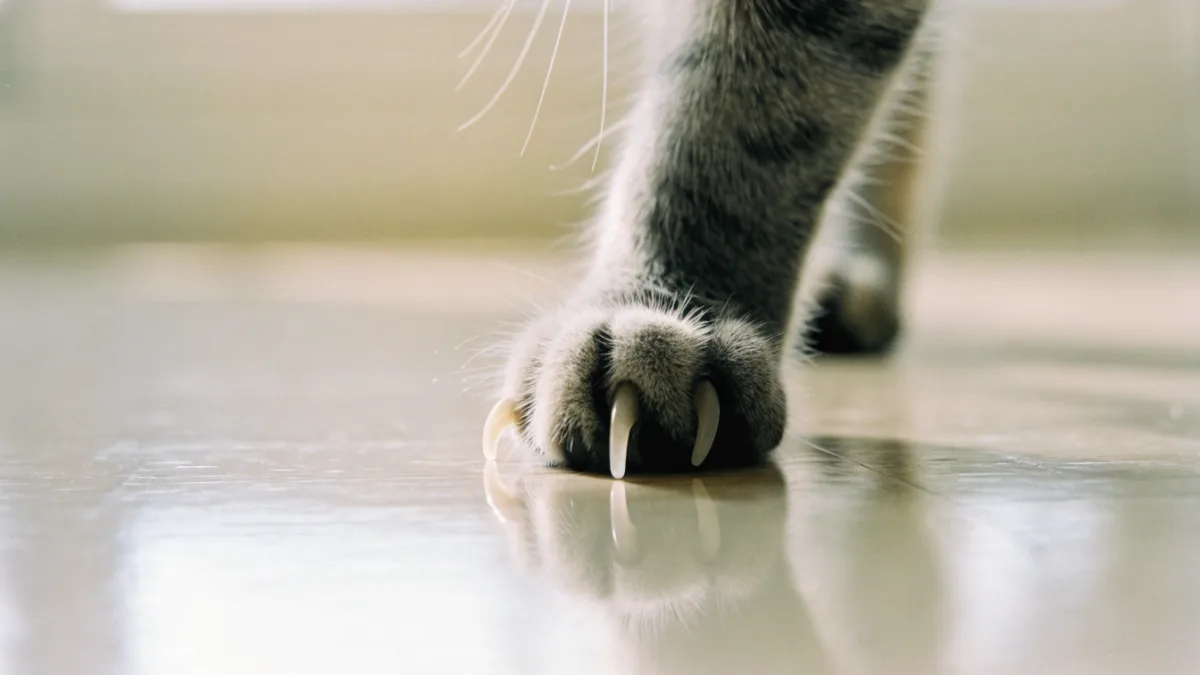
Watch a cat try to chase a toy mouse across a glossy hardwood floor sometime. Mochi, my gray tabby, made it exactly two strides before her back legs went left, her front legs went right, and she belly-slid into the ottoman like a very fluffy curling stone. She got up, glared at me as if I’d personally greased the floor, and then refused to walk on that room’s surface for three days.
I laughed — until I noticed she was favoring her shoulder.
That was the moment flooring stopped being a design decision for me and became a welfare one. And if you’re reading this, you’re probably at that moment too, standing in a showroom trying to reconcile what looks beautiful with what won’t send your animals sliding into the furniture or destroy your investment within six months.
The Slip Problem: Why Traction Is a Safety Issue, Not an Aesthetic Preference
Here’s the thing nobody tells you when you’re picking flooring: that sleek, glossy finish you’ve been pinning on inspiration boards? It’s essentially an ice rink for anything operating on four paws instead of two feet.
Slippery floors aren’t just inconvenient or undignified for pets — they’re genuinely dangerous. When dogs and cats can’t gain traction, they compensate by altering their gait, splaying their legs, and tensing muscles that shouldn’t be constantly tensed. Over time, this leads to joint strain, muscle fatigue, and actual injuries. Senior pets are especially vulnerable. A slip that a young dog shakes off can mean months of recovery for an older one.
And cats? Cats don’t usually injure themselves sliding across floors, but they will simply stop using those spaces. Mochi’s three-day boycott taught me that a cat who doesn’t feel safe on a surface will find workarounds — climbing on furniture to avoid touching the floor, refusing to cross certain rooms, becoming more sedentary. That’s not just inconvenient. It affects their quality of life.
When you’re evaluating flooring, look for textured, matte, or low-gloss finishes. Anything you can feel under your fingertips — a subtle grain, a slight roughness, a brushed quality — is going to provide the grip your pets need. The flooring industry has actually started catching on to this, with more products specifically marketed as having textured surfaces for slip resistance. The aesthetic trade-off is real, but here’s my honest opinion: a slightly less glossy floor that your arthritic senior dog can walk across without fear is worth every sacrifice on the inspiration board.
The Toenail Truth: How Pets Actually Destroy Floors
Pet damage to floors comes from two primary sources, and understanding both will make you a smarter shopper.
First: toenails. Every time your dog runs to greet you at the door, their claws are acting like tiny chisels against your floor’s surface. Every time your cat launches off the hallway floor to chase a moth at 2 AM — and if you have cats, you know this happens — those back claws dig in for traction. Over weeks and months, this creates scratches. Over years, it creates a finish that looks perpetually cloudy and worn.
Second: accidents. Urine, vomit, tracked-in water from water bowls, the mysterious wet patches that appear when you have pets — all of these can stain and even structurally damage certain flooring materials if they seep into seams or penetrate finishes.
When you’re comparing flooring options, you need to evaluate them against three specific metrics:
- Scratch resistance: How well does the surface hold up against claw impacts? This is your primary concern if you have active dogs or cats who frequently run and jump indoors.
- Stain resistance: How easily can you clean up accidents without permanent damage? Look for materials with moisture barriers and water-resistant cores.
- Mark resistance: Will scuffs from running, sliding, and general chaos show up permanently? This matters more than people realize — those black scuff marks from frantic zoomies add up fast.
The durability you need scales directly with your pets. A single elderly Chihuahua who sleeps 22 hours a day is going to be far gentler on your floors than two young huskies who treat your living room like a wrestling ring. And the research backs this up — larger, more active dogs require significantly tougher surfaces. Don’t underestimate your household just because your pet seems calm at the shelter. Energy levels have a way of emerging once an animal feels truly at home.
Material World: What Actually Holds Up
Let’s talk specifics. After Mochi’s slide incident, I went down a research rabbit hole that consumed an embarrassing number of evenings, and here’s what I found.
Vinyl: The Practical Workhorse
Modern vinyl flooring — specifically the higher-quality plank and tile options — has become the go-to recommendation for pet households, and for good reason. Quality vinyl is engineered to be scratch-resistant, stain-resistant, and mark-resistant all at once. It can convincingly mimic wood or stone while offering protection that natural materials simply can’t match. It’s also generally more affordable than hardwood or natural stone, which matters when you’re accounting for the reality that no floor is truly pet-immune.
When shopping for vinyl, look beyond the surface appearance. The key feature to ask about is the wear layer — this is the transparent protective coating on top of the design layer, and its thickness determines how well the floor will resist scratches and scuffs over time. A thicker wear layer means more durability. Ask about the core material too — you want something water-resistant or waterproof, because pet accidents will happen, and they need to be cleanable events, not structural catastrophes.
The industry has responded to pet owners with increasingly specialized product lines that combine moisture resistance, scratch resistance, and textured surfaces in a single floor. You don’t need to buy a specifically “pet-branded” line, but the features these products highlight — grip, durability, waterproofing — are exactly the features you should prioritize regardless of what you choose.
The Multi-Pet, Multi-Everything Household
If your household includes kids, multiple cats with claws, and one or more dogs, you need to be brutally honest about what your floors will endure. I’ve seen discussion threads from families where cats, dogs, and children have combined forces to destroy flooring materials that any one of them alone wouldn’t have touched. Cat claws in particular are sharp, concentrated points of force — multiple cats Rocketing around a house can etch patterns into surfaces that a single dog never would.
There is no floor on earth that will emerge completely unscathed from a household containing three cats, two kids, and a large dog. The goal isn’t perfection. The goal is choosing something that will look acceptable in five years rather than ruined in six months.
The Honest Truth: There Is No Holy Grail
If you spend any time in pet owner communities, you’ll find endless debates about the “best” flooring for animals. You’ll also notice something quickly: there’s no consensus. None. Someone will swear by their luxury vinyl and another person will say the same product looked destroyed within a year. Someone will praise their hardwood and someone else will show you photos of claw marks that look like a bear attacked their dining room.
This isn’t because people are wrong or lying. It’s because every household is a unique combination of species, sizes, claw sharpness, activity levels, accident frequency, and cleanup habits. A floor that’s perfect for a household with one sedate senior cat might be a disaster for a family with a pair of young, high-energy large dogs. There is no universal answer, and anyone who tells you there is one is selling something.
What I can tell you is this: traction and durability both matter, and prioritizing one over the other is a mistake. The most scratch-proof floor in the world is worthless if your animals can’t walk on it safely. The grippiest, most pet-comfortable surface is a poor investment if it’s going to be stained and ruined within a year. You need both, and fortunately, the flooring market has finally started offering products that deliver both — if you know what to look for.
My own choice ended up being a textured vinyl plank with a substantial wear layer and a waterproof core. It’s not the most luxurious option that was available. It won’t be featured in any design magazines. But Mochi can chase her toy mouse across it without becoming a curling stone, my dog’s claws haven’t left a mark in two years, and when accidents happen — because they always do — I can clean them up without panic. That’s not a Pinterest-perfect outcome. It’s something better: a floor that works for everyone who lives here, including the ones with paws.
Your home is a shared habitat. The animals who live with us didn’t choose to be here — we brought them in, and they depend entirely on the environments we create. When we make choices that account for their physical comfort and safety, not just our aesthetic preferences, we’re honoring that responsibility. Flooring might seem like a mundane decision, but it’s the surface your pets will spend their entire lives walking on. They deserve something that lets them move through their home with confidence — running, playing, and living without fear of slipping or sliding. Choose accordingly.