

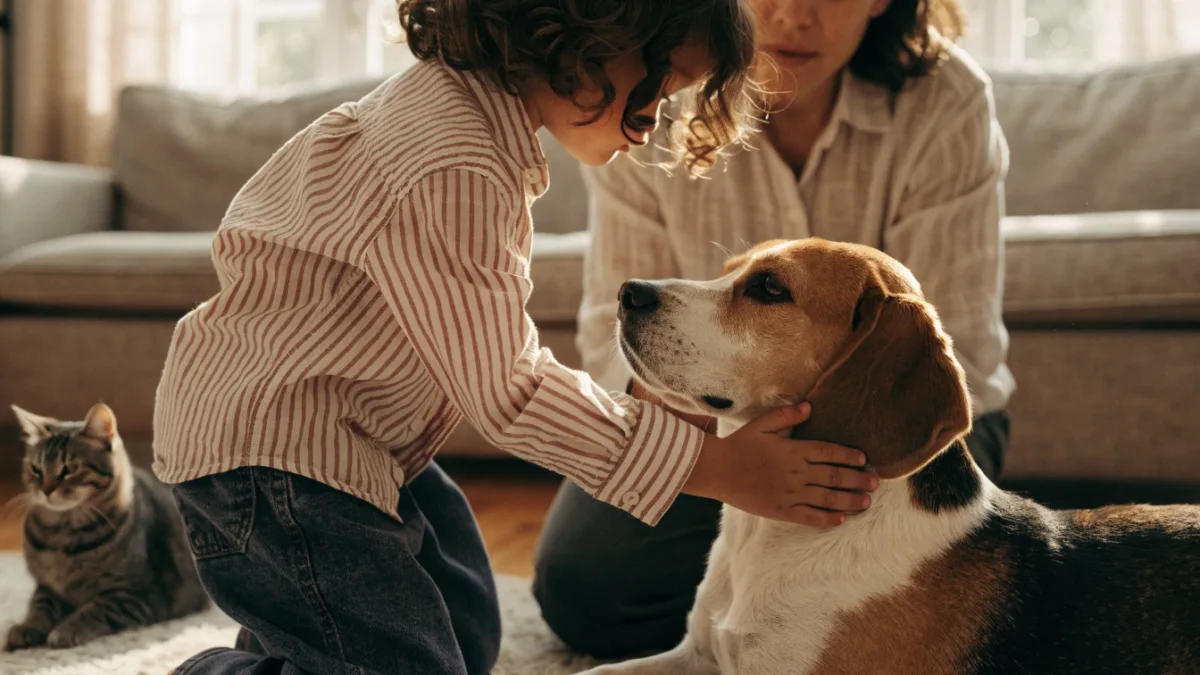
One of the most common sentences I hear in my exam room is, “He’s never done anything like that before.” Last spring it came from a family with an eight-year-old golden retriever named Sampson. Their six-year-old had leaned over him while he slept on his bed to deliver a goodnight hug, and Sampson snapped — a grazed cheek, three stitches, and a household full of guilt. Sampson wasn’t a bad dog. He was a senior dog with arthritic hips who got startled awake by a person he adored. The problem wasn’t his temperament; it was a communication gap. And communication gaps, happily, are things we can teach children to close.
Most bites and scratches to children are preventable. Not by avoiding animals, but by understanding them. Here’s what I wish every parent, grandparent, and teacher knew.
The Numbers — and the Hope Hidden in Them
In the U.S., the CDC estimates about 4.5 million dog bites a year, and roughly one in five requires medical attention. Children are the most common victims, with the highest injury rate between ages five and nine. Here’s the part that surprises people: according to the widely cited Stop the 77 campaign, about 77% of dog bites to children come from the family dog or a friend’s dog — not strays. Veterinary behaviorist Dr. Ilana Reisner’s research found most bites happened with familiar dogs, in familiar places, while an adult was present but not closely supervising. Present isn’t the same as paying attention.
Cats have their own math. With roughly 400,000 cat bites annually in the U.S. and around 12,000 diagnosed cases of cat scratch disease each year — highest in kids ages five to nine — feline injuries skew toward infection because those narrow teeth inject bacteria deep into tissue. Almost all of it traces back to play or petting that escalated, which means it traces back to a missed signal.
That’s the hopeful reframe: this isn’t a “bad dog” or “bad cat” problem. It’s a communication and supervision problem. Both are fixable.
Teaching Kids to Hear What Dogs Are Saying
The whisper before the bark
Dogs almost always warn before they bite — we just don’t teach children what the warnings look like. Research by Dr. Kerstin Meints at the University of Lincoln found that children under seven frequently misread dog signals; some even interpreted bared teeth as a “smile.” So don’t assume kids will intuit it. Teach them explicitly, and make it a game. At the park, play “dog detective” and spot two signals together:
- Lip licking when there’s no food around, or yawning when the dog isn’t tired
- Turning the head or whole body away
- “Whale eye” — the whites of the eyes showing as the dog watches sideways
- A sudden freeze or stiff, still body
- A stiff, fast wag (a loose, wiggly wag is joy; a tight one is tension)
Ask twice, then count to three
The rule I teach every family: ask the owner, then “ask” the dog. Asking the dog means letting it approach. If it turns away, that’s a no — and no is a complete answer. I’ll admit I’ve changed my mind on the old “hold out your hand for a sniff” ritual. Many modern behaviorists (and I now agree) prefer letting the dog initiate all contact, since a hand thrust toward a shy dog can read like a reach.
Then use the consent test: pet for three seconds, stop, and watch. If the dog leans in, that’s a yes. If it steps back or shakes off, that’s a no. Pet the chest, shoulders, or under the chin — never reach over the head, which feels like looming. And no hugging or kissing. One well-known photo analysis found over 80% of hugged dogs showed stress signals; the methodology was debated, but behavior professionals agree — teach kids that dogs prefer scratches, sitting side by side, or tossing a treat to express love.
Finally: a dog that’s eating, sleeping, chewing a bone, or in its crate is off-limits. In our house we said “the crate is the dog’s bedroom, and the bedroom door is closed.”
If a loose dog runs up
Teach the “Be a Tree” drill used in school safety programs: feet planted like roots, arms folded like branches, eyes on the ground — no running, no squealing, no eye contact. Running turns you into a chase game. If a child gets knocked down, “Be a Rock”: curl up, knees to chest, hands protecting neck and ears. Practice at home until it’s automatic.
Teaching Kids to Pet Cats Without Getting Scratched
Pepper, a three-year-old gray tabby I see for checkups, loves exactly four strokes along her back. Her family’s eight-year-old learned about the fifth the hard way. Vets call it petting-induced aggression — petting that felt good gradually builds into irritation, and the cat warns before it acts: the tail starts lashing, the skin ripples, the ears rotate back like satellite dishes. Teach kids that those signals are the cat’s stop sign.
Let the cat come to you
A small cat repair [1] that circulates every year says it plainly: teach children to respect pets and interact gently. Concretely, that means sitting down on the floor so you’re not looming — to a cat, a standing human is a giant predator silhouette — keeping hands still, and waiting. A slow blink from your child is cat-language for “I’m friendly.” The cat that chooses to approach is a cat that wants to be there.
Where to pet, where not to
Cats have scent glands on their cheeks, chin, and the base of their ears, so gentle strokes there feel wonderful to most cats. The belly, despite the tempting display, is off-limits for many cats — an exposed belly is an expression of trust, not an invitation, and reflexes take over fast. The three-second consent test works exactly the same way as it does with dogs.
Hands are never toys
Use wand or fishing-pole toys so teeth and claws land on feathers instead of fingers. Rough hand-wrestling with a kitten teaches it that hands are prey — adorable at eight weeks, painful at eight pounds. For toddlers, one mom in a [2] asked how to teach her two-year-old “soft hands,” and the answer I’d give is the same one I give in practice: one simple word — “gentle” — paired with hand-over-hand stroking, practiced first on a stuffed animal until it becomes automatic.
One thing I won’t recommend as a scratch fix: declawing. Major veterinary organizations consider it inhumane. Regular nail trims, tall scratching posts, and the rules above are the real solution.
Supervision Is a Verb: The Grown-Up’s Job
Active watching, not just being there
Remember Dr. Reisner’s finding: adults were often nearby when bites happened. Active supervision means within arm’s reach, eyes on, ready to interrupt. Babies and toddlers are never left alone with any pet, even for a moment. When you can’t watch closely, manage the environment physically — baby gates, crates, closed doors, cat trees. Give every pet an escape route and a kid-free zone, and praise the animal for choosing to walk away. That’s not rejection; that’s a dog using its words.
Never punish the growl or hiss
A growl is a smoke alarm. Punishing it doesn’t put out the fire — it just breaks the alarm, and next time the pet may skip the warning entirely. Thank the growl, separate everyone calmly, and figure out what triggered it. I’ve seen too many “he bit with no warning” cases where the dog had been scolded for growling for years.
Age-appropriate involvement
Keep expectations realistic, and remember that “he’s good with kids” is never a guarantee — tolerance can run out when stressors stack up, as Sampson’s family learned. A helpful [3] lines up with what I recommend: toddlers get brief, hand-over-hand strokes; preschoolers become signal detectives and help fill water bowls; school-age kids can measure meals (with an adult double-checking), do treat-based training, and read aloud to pets — which is genuinely wonderful for both parties. Solo dog walks generally wait until at least age ten to twelve, depending on the child and the dog. And one important caveat: evaluations of one-off bite-prevention programs show that a single lesson or app doesn’t reliably change children’s real-world behavior. Repeated, modeled, supervised practice does. Narrate what you see out loud — “Luna’s yawning, she needs a break” — because kids copy what we do far more than what we say once.
If a bite or scratch does happen, have your child tell an adult right away, wash the wound with soap and running water for at least five minutes, and seek medical care — especially for any cat bite, deep puncture, or wound on the face or hands.
Sampson finished his golden years peacefully, by the way, with a little girl who had learned to sit beside him instead of on him. That’s what this is really about — not raising fearful kids, but fluent ones. When a child learns to ask permission of a dog, to notice a cat’s stop sign, to respect a “no” that comes without words, those habits don’t stop at the back door. Children who learn that every animal has feelings and boundaries worth honoring tend to grow into adults who extend that same gentleness to horses, wildlife, and the living world itself. Kindness is a skill. It’s practiced one small, respectful interaction at a time — and the pets napping in our homes are the very best teachers.
Sources
- rescue post — facebook.com
- parenting group — facebook.com
- age-by-age guide from PetMD — petmd.com