

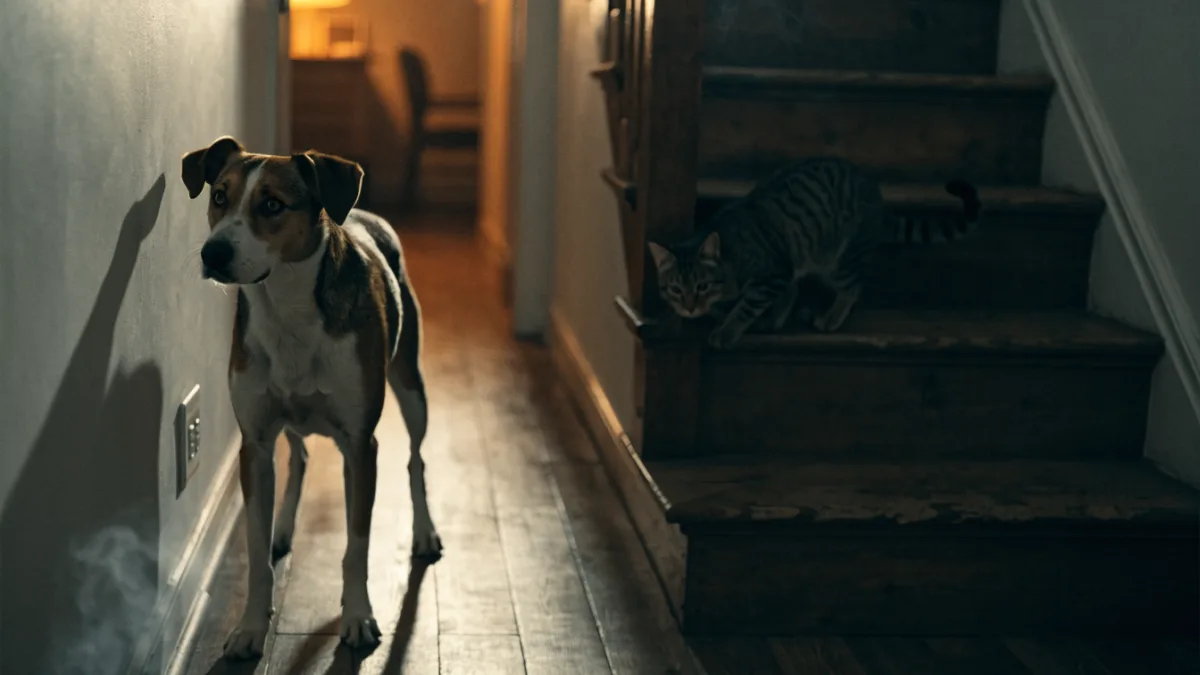
One cold night a few winters back, I got a Monday-morning phone call I still think about. Gus, a six-year-old German Shorthaired Pointer, had spent the previous night pacing the kitchen and staring — locked-on, ears-forward staring — at a spot on the wall behind the dishwasher. His owner found nothing: no smell, no smoke, no sound. The next day, mostly to humor the dog, she called an electrician, who pulled the appliance out and found wiring that had been slowly charring inside the wall for what he estimated was weeks. “He’s never been a watchful dog,” she told me. “He sleeps through doorbells.” Her smoke alarm never made a sound that night, because there was nothing for it to detect yet. Gus’s nose already knew. That’s the gap this article is about: your smoke alarm waits for smoke to reach the ceiling. Your dog may smell the fire that hasn’t started yet.
A Nose That Outpaces Your Smoke Alarm
Dogs carry an estimated 220 to 300 million olfactory receptors — the microscopic sensors that catch odor molecules — compared to our paltry 5 to 6 million. Their brains reflect that hardware: proportionally, a dog devotes roughly 40 times more brain tissue to analyzing scent than we do. The result is a sense of smell estimated at 10,000 to 100,000 times more sensitive than ours, capable of flagging odor compounds at concentrations of parts per trillion.
Here’s why that matters for fire safety: overheating wiring and electronics don’t burst into flame out of nowhere. They off-gas — releasing distinct chemical odors from heated insulation and plastics — for hours, sometimes days, before there’s a spark or a visible wisp of smoke. To you and me, that stage is invisible and odorless. To a dog, it may be as obvious as burnt toast.
If you doubt a nose can do that kind of work, the past few years have been humbling for us humans. Trained dogs identified COVID-19 infections from sweat samples with better than 90 percent accuracy in multiple international studies, and a 2019 study in Scientific Reports showed dogs can distinguish the specific body odor that accompanies a seizure. Researchers building artificial “electronic noses” still benchmark their sensors against the dog..[1]
One honest caveat, because I’d rather be accurate than romantic: nearly every story of a pet alerting to smoke or sparks [2] is anecdotal. We hear from the dogs who saved the day, not the ones who slept through it. Individual variation is enormous. Treat your dog’s nose as a remarkable backup system — never your primary one.
Ears, Whiskers, and the Feline Early-Warning System
“Do cats sense danger before it happens?” is one of those questions [3] — and the answer is yes, just not through anything mystical. Cats simply run on a completely different set of sensors.
Start with hearing. A cat’s range runs from roughly 48 Hz up past 64,000 Hz — one of the broadest of any mammal. Humans top out near 20,000 Hz and dogs around 45,000, which means a cat can hear the high-frequency crackle of electricity arcing inside a failing outlet that neither you nor your dog can perceive. Each feline ear is steered by about 32 muscles (we have six) and can rotate 180 degrees, letting a cat pinpoint exactly which wall that sound is coming from.
Their vibrissae — the stiff whiskers on the face and legs — do more than measure gaps. They detect minute air currents and pressure changes, the kind of subtle airflow shifts combustion creates. Cats also have a vomeronasal organ, or Jacobson’s organ: essentially a second, chemical-detecting nose in the roof of the mouth. When your cat pauses mid-sniff and pulls that funny open-mouthed grimace — the Flehmen response — she’s literally tasting the chemistry of her environment.
Miso, a twelve-year-old tabby I see for arthritis check-ins, spent a week refusing to enter the laundry room, sitting in the doorway with her ears swiveled like satellite dishes, staring at a power strip. Her owner finally traced it to a failing surge protector buzzing at a frequency none of us could hear.
“She looked like she was watching something move inside the wall,” he told me. In a sense, she was.
Is It a Sixth Sense? Decoding the Warning Behaviors
Early in my career, when clients told me their pet had a “sixth sense,” I’d gently talk them out of it. I’ve changed my mind — not about the mysticism, but about the respect. Behavioral scientists rightly reject paranormal explanations, but the sensory explanations are, to me, far more impressive. A dog pacing before a storm isn’t psychic; it’s detecting the barometric pressure drop and the static charge building in the air. (The earthquake-prediction debate is more genuinely unsettled — the leading hypotheses involve animals reacting to fast-moving primary seismic waves or infrasound that arrive before the destructive shaking, but rigorous causal evidence is still thin.)
What matters in your living room is the behavior. A rough decoding guide:
- Pacing and restlessness, especially at night or when nothing else has changed, often means the animal has scented or heard something it can’t resolve.
- Fixated staring at an outlet, appliance, vent, or one specific patch of wall usually means the pet is tracking an odor or high-frequency sound from failing electronics. Take it seriously: feel the outlet plate for warmth, unplug the appliance, and if the fixation persists, get an electrician. Don’t trust your own sniff test — your nose isn’t in this race.
- Hiding, especially in cats, is a classic threat response. Note where they go; you’ll want to know (more on that below).
- Vocalization changes, sudden clinginess, or refusing to enter a room — any abrupt, unexplained behavior shift deserves a second look before it’s dismissed as quirks.
And I’d be a poor vet if I didn’t add this: restlessness and hiding have medical causes too — pain, nausea, cognitive decline in older pets. If there’s no household explanation and the behavior continues, bring your pet in. Sometimes the danger they’re alerting you to is inside their own body.
The Part They Can’t Do for Themselves
Now the other half of this partnership. In the United States alone, an estimated 40,000 pets die in house fires every year — and pets themselves accidentally start roughly 1,000 of them annually, by nudging stove knobs, toppling lamps, or chewing through cords. A few preparations genuinely move the needle:
- Know their hiding spots now. When firefighters arrive, “she’s probably under the bed or in the closet on the left” is lifesaving information.
- Never corner a panicked cat. When an alarm sounds, most cats bolt for cover; chasing and restraining them burns irreplaceable minutes. Better to open a door or window on your way out and give them an escape route.
- Use monitored smoke alarms — systems that contact a monitoring center and dispatch the fire department even when nobody’s home. That cellular-dispatch feature is the thing to look for, since pets can’t call for help.
- Keep window decals current with the number and type of pets inside, keep carriers accessible (not buried in the attic), and keep microchip registration up to date.
One more note: carbon monoxide is odorless — no nose on Earth can detect it — but because pets are smaller and breathe faster, they typically show symptoms like wobbliness and unusual lethargy before people do. The literal canary in the coal mine. If every pet in the house suddenly seems off, let that weigh in your decisions. July 15 is National Pet Fire Safety Day in the U.S., a reminder worth adopting anywhere: check alarms, update decals, and rehearse who grabs which carrier.
My takeaway after two decades of practice is this: the senses that let a pointer smell charring wire inside a wall were inherited from wild ancestors who needed them to survive — wolves reading distant smoke on the wind, small wildcats listening for the crack of a breaking branch. Our companions still carry that equipment; they’ve simply repurposed it for our kitchens and laundry rooms. The least we can do is pay attention when they use it, and handle the planning — the alarms, the decals, the drills — that their remarkable noses and ears can’t do for them. That unexplained stare at the wall might just be the earliest warning system your home has.
Sources
- Working-dog handlers have understood this advantage for decades — workingdogmagazine.com
- before disaster struck — facebook.com
- I’m asked constantly — quora.com