

When Mabel, a twelve-year-old tabby, set her tail on fire brushing past a lit candle on the coffee table, her owner Linda did what most of us would do. She screamed. Mabel panicked and bolted under the bed. The flame went out on its own before anything caught, but Linda sat on her kitchen floor afterward, shaking, realizing she had absolutely no plan for getting a terrified cat out of her apartment in an actual emergency. A week later, at a routine checkup, she asked what she should have done. That question stuck with me because Linda’s anxiety about it was entirely justified — and her instinct that she was unprepared was correct.
According to the American Veterinary Medical Association, an estimated 40,000 pets die annually in residential fires, and the vast majority of those deaths come not from flames but from smoke inhalation. Because dogs and cats live closer to the ground, and because smoke rises before filling a room from the top down, our pets are often in serious danger before we even realize the full scope of a fire. Having a plan isn’t paranoia. It’s responsible ownership.
Why Pets React Differently Than You Think
I’ve seen this play out in clinic settings enough times to know that most owners dramatically overestimate how their pet will behave in a crisis. A dog who comes when called at the dog park may completely ignore you when the smoke alarm is screaming. A cat who normally sleeps on your chest may vanish into a gap you didn’t even know existed behind your dryer.
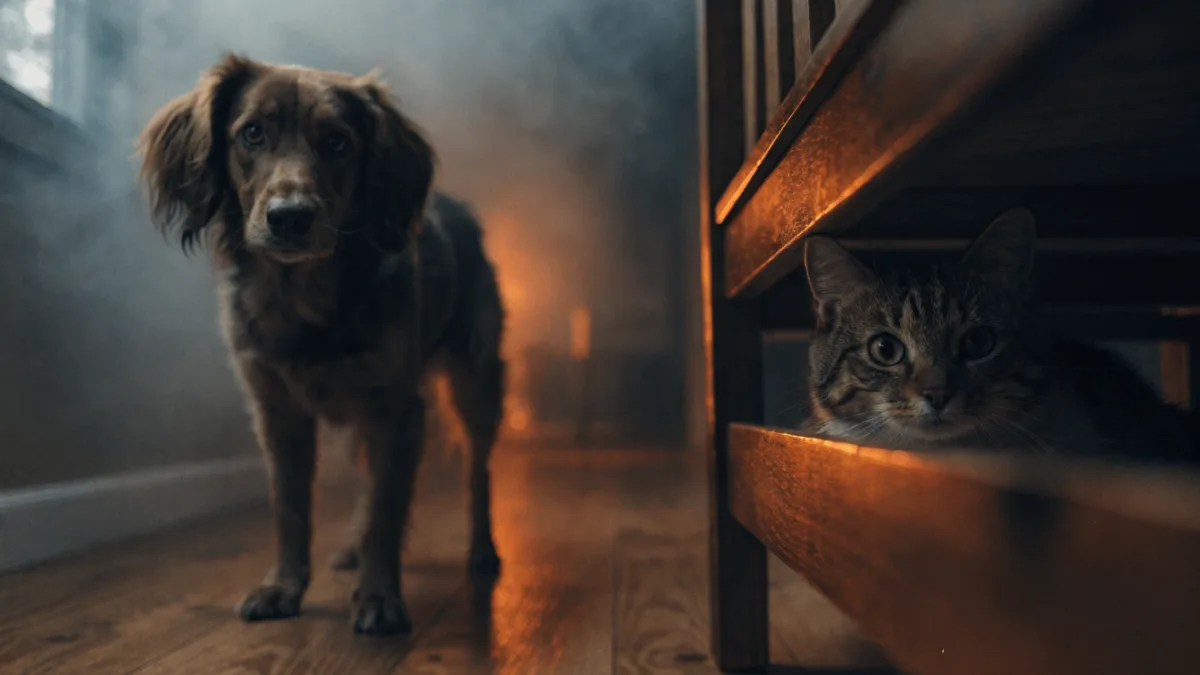
Cats are wired to hide when frightened. It’s deeply embedded survival behavior. When smoke fills a room or loud alarms start blaring, a cat’s instinct isn’t to run toward you — it’s to find the smallest, darkest, most inaccessible space available and compress herself into it. Under beds, inside closets, behind refrigerators, inside box springs. I once treated a cat named Pepper who survived a small kitchen fire by wedging herself so tightly behind a built-in oven that the firefighters had to partially dismantle the cabinetry to reach her. She was fine. Her owner was traumatized.
Dogs, on the other hand, tend toward flight responses. A panicked dog will often bolt through the first open door he sees, regardless of what’s on the other side. Emergency clinics see dogs hit by cars after running out of their homes during false alarm activations. The “come” command that works perfectly in your backyard often fails completely when your dog is flooded with adrenaline and surrounded by chaos.
Preventing Pets From Starting Fires
Here’s something that surprises people: pets accidentally start hundreds of house fires every year in the United States alone. The most common scenario involves a dog or cat jumping onto a kitchen counter or stove and accidentally turning a burner knob. Large dogs can easily reach stove knobs, and cats are notorious for investigating warm surfaces after you’ve been cooking.
Stove and Kitchen Safety
If your pets are home alone, remove stove knobs or use covers that prevent them from being turned accidentally. Some owners simply block off kitchen access entirely with baby gates when they’re out. It takes thirty seconds and could genuinely save your home and your pet’s life.
Open Flames and Electrical Cords
I love a good candle as much as anyone, but I never leave them burning when I’m not in the room, and I never leave the house with one lit. Cats are particularly prone to singeing their tails or knocking candles over. Exposed electrical cords are another major hazard — pets who chew through wiring can cause electrical fires and suffer severe oral burns simultaneously. Use cord protectors, tuck wires behind furniture, and offer appropriate chewing alternatives if your pet has a habit of gnawing.
Building Your Pet Evacuation Plan
The single most important thing you can do is practice. Not just mentally rehearse — physically walk through it. Front Range Fire Rescue notes that in a house fire, you may only have seconds to safely escape, so knowing exactly where your pets are likely to be and having your supplies ready can make the difference between a smooth evacuation and a desperate search.
Know Their Hiding Spots
Spend a few minutes thinking about where your cat goes when she’s scared. Maybe it’s the back of a closet, under the bed, or behind the washing machine. Now think about whether those spots are accessible in an emergency. Blocking off dangerous hiding spots before a crisis happens is far easier than trying to extract a terrified cat from one during a fire. Crawl around at floor level occasionally — it gives you a completely different perspective on what your pet experiences and what gaps they can access.
Supplies and Accessibility
Keep leashes hanging near your primary exit. Keep carriers in a spot you can reach without navigating around obstacles. Prepare a pet go-bag with food, water, medications, vaccination records, and basic first-aid supplies. Store it near your own emergency kit so you’re not running to different rooms collecting things while smoke fills your hallway.
Place pet alert window clings on your front windows indicating how many pets live in your home and what types they are. This information is genuinely useful to firefighters. The ASPCA offers these decals, and many fire departments also distribute them. Make sure you update them if your pet count changes.
Rescuing a Hiding Cat During a Fire
This is where I have to be honest about a difficult truth. If your cat is hidden and you cannot find her quickly, you may have to make an agonizing decision. I’ve spoken with firefighters who emphasize this point firmly: human life always comes first. You should never delay your own safe exit, and you should never re-enter a burning building for a pet.
That said, there are strategies that can help. If you know your cat’s preferred hiding spots, go directly to them rather than searching randomly. Bring a carrier to the hiding spot rather than trying to carry a panicked cat through a chaotic environment. A towel or blanket can be enormously helpful — throw it over the cat to reduce visual stimulation and provide something to bundle them in if they’re fighting you.
The Open Window Last Resort
There’s a conversation happening in pet safety communities about whether to leave a window or accessible door open for a hiding cat if you absolutely cannot get them out. The logic is sound in one sense: animals have powerful survival instincts, and a cat may use an escape route once smoke or heat forces her to move.
However, I need to be clear about the risk. Opening a window can feed oxygen to a fire and accelerate its spread, which is why firefighters generally advise against it. I recommend this only as an absolute last resort, only if human life is not at risk, and only if the fire is contained to another area of the structure. This is a judgment call, and there’s no perfect answer. Talk to your local fire department about what they recommend for your specific living situation.
Managing a Panicked Dog
Dogs are in some ways easier because they’re generally larger and more responsive to humans, but they bring their own set of challenges. A panicked dog can be surprisingly strong, and emergency clinics regularly see dogs who slipped out of collars, chewed through leashes, or simply overpowered their owners during emergency situations.
The moment an emergency is identified, get your dog on a leash or into a carrier immediately. Do not assume you can hold onto a panicked dog without restraint. If you have multiple dogs, use slip leads — they’re faster than trying to clip collars and can be looped over a dog’s head in seconds. Keep a couple near your door.
Training matters here more than people realize. A solid recall command, practiced repeatedly in distracting environments, gives you a much better chance of your dog actually coming to you when the smoke alarm goes off. I changed my own thinking on this after a client’s golden retriever, Biscuit, ran back into a smoke-filled home during a kitchen fire because he wasn’t reliably trained to stay. The dog survived, but it was entirely preventable.
Technology That’s Changing Outcomes
Two developments have genuinely improved survival rates in recent years. First, monitored smart smoke detectors can automatically alert the fire department even when you’re not home. This matters enormously for the many hours when pets are alone while owners are at work. Second, there’s been a significant push to equip fire trucks with pet-specific oxygen masks. Standard human oxygen masks don’t fit properly over a dog or cat’s snout, which limits their effectiveness. Specialized pet masks are now standard equipment on many modern fire trucks, dramatically improving post-rescue survival rates for pets pulled from smoke-filled homes.
I’d encourage you to ask your local fire department whether they carry pet oxygen masks. If they don’t, several organizations run donation programs to supply them. It’s a concrete way to help not just your own pets but every pet in your community.
Here’s my bottom line, the same thing I told Linda that day in the exam room with Mabel purring on the table between us: you cannot control everything in an emergency, but you can prepare. You can know where your pets hide, keep supplies accessible, practice your plan, and make peace with the fact that no plan is perfect. What you do in advance matters more than what you wish you’d done differently afterward. Our pets depend on us completely for their safety, and giving them the best possible chance means taking that responsibility seriously before the alarm ever sounds.