

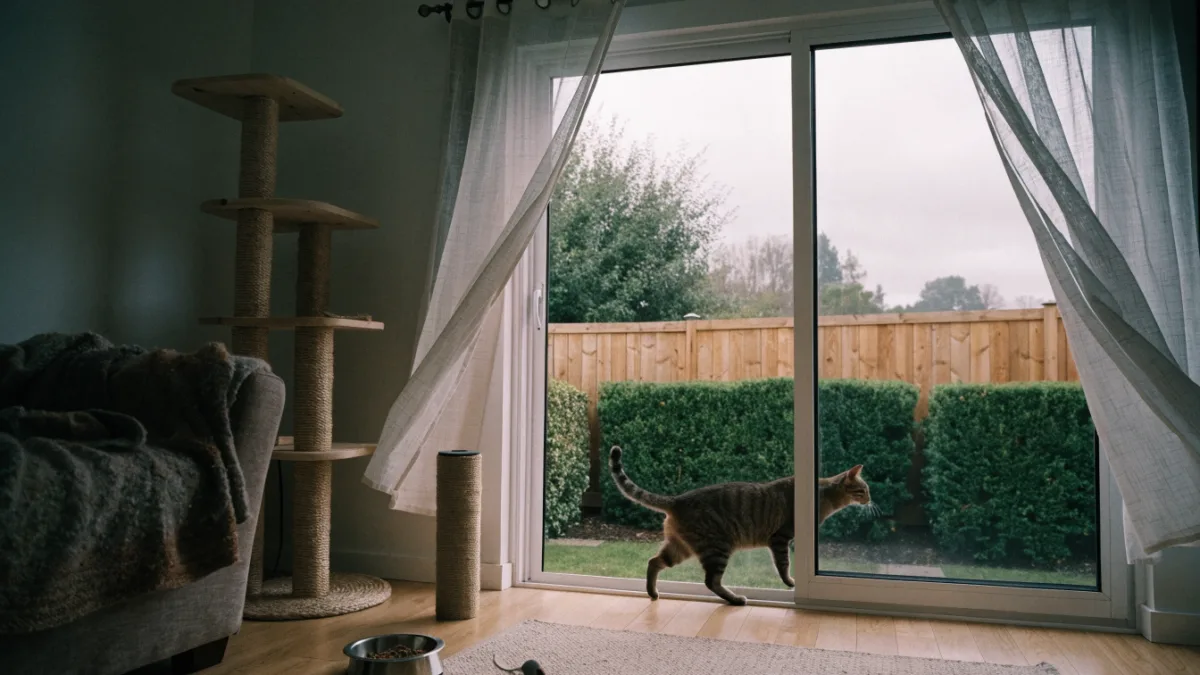
I’ll never forget the Thursday afternoon when Elena, a regular client of mine, called the clinic in absolute tears. Her seven-year-old spayed tortoiseshell, Cleo, had bolted out the front door when Elena’s nephew accidentally left it ajar while bringing in groceries. Cleo had never set a paw outside her apartment. Within seconds, she vanished into the dense shrubs lining the street.
Elena was frantic, repeatedly telling me through her sobs that Cleo didn’t know how to survive outside. Fortunately, this story has a happy ending. A neighbor found a terrified, hissing cat hiding under their porch two days later. They brought Cleo into our local animal shelter, a technician scanned her for a microchip, and Elena was reunited with her best friend within the hour.
When I speak with clients about microchipping, I frequently hear the same objection: “But she’s strictly an indoor cat. She never goes outside.” It’s a completely understandable perspective. If your cat lives a life of luxury on a cat tree by the window, why would they need a permanent ID? The reality, however, is that the indoor environment is an illusion of total control. Even the most docile, homebound feline can become an “escape artist” given the right set of unpredictable circumstances.
Here is why microchipping is an essential, non-negotiable layer of protection for every cat, regardless of their lifestyle.
The Myth of the “Safe” Indoor Cat
Cats are incredibly curious creatures with deeply ingrained prey drives. When an indoor cat sees an open door, a cracked window, or a torn screen, they often don’t perceive danger—they perceive an opportunity to explore or chase a passing moth.
The Unpredictable Escape
In my years of practice, I’ve seen indoor cats slip out during the most mundane moments. A delivery person leaving the door open while you sign for a package. A child running inside and forgetting to close the screen door. Even natural disasters or home emergencies, like a kitchen fire or a broken pipe, can force first responders to open your doors, allowing a panicked cat to flee into the chaos.
Panic Mode and the Silent Hider
When an indoor cat suddenly finds themselves outside, their instinct isn’t to bravely explore the neighborhood. It is to panic. They enter what we call a “fear response.” Unlike outdoor cats who know the territory and where the safe hiding spots are, an indoor cat outside will usually run to the nearest dark, tight space—under a deck, up a tree, or deep inside a car engine—and stay completely silent.
Because they are so terrified, they rarely respond to their owner’s voice. They won’t meow back. This makes them incredibly difficult to find using traditional search methods. An.[1] hiding in survival mode is virtually invisible, which means you are entirely reliant on someone eventually trapping them and taking them to a facility equipped with a microchip scanner.
The Limitations of Traditional ID
I always recommend collars and ID tags for cats. They are a fantastic first line of defense because they immediately tell a neighbor, “I belong to someone nearby.” However, they are deeply flawed as a standalone identification method.
Breakaway Collars are Designed to Fail
For cats, we specifically recommend “breakaway” collars. These are designed with a special clasp that snaps open when pressure is applied. Why? Because cats love to squeeze into tight spaces. If a cat’s collar gets snagged on a branch or caught on a fence, a standard collar can easily lead to strangulation. While the breakaway feature saves lives, it also means the collar is highly likely to fall off exactly when your cat is wandering loose.
The Elements Take a Toll
Even if the collar stays on, tags are subjected to the elements. Engraved metal tags fade, scratch, and become completely illegible over time. If your cat goes missing for a few weeks, exposure to rain, dirt, and friction can render your phone number unreadable.
A microchip, on the other hand, is a permanent form of identification. It cannot fall off, it cannot fade, and it cannot be physically separated from the animal.
How Microchipping Actually Works
Let’s demystify the technology. A microchip is about the size of a grain of rice. We implant it subcutaneously (which just means “under the skin”) right between the cat’s shoulder blades. The procedure takes about two seconds and feels to the cat exactly like a routine vaccination. It requires no anesthesia, though I often recommend doing it while a cat is already sedated for a spay, neuter, or dental cleaning just to minimize any momentary stress.
Not a GPS Tracker
There is a surprisingly common misconception that microchips are GPS trackers. They are not. A microchip is a passive Radio Frequency Identification (RFID) transponder. It has no battery and no internal power source. It only activates when a special scanner is passed over it, sending out a low radio frequency that provides the chip with enough power to transmit its unique identification number.
The number itself doesn’t hold your name or address. Instead, it acts as a key. The shelter or clinic calls the microchip registry, provides the number, and the registry contacts you. It is an incredibly reliable, [2]
Proof of Ownership and Deterrent to Theft
Beyond simply finding a lost cat, a microchip serves a vital legal function: it is the most definitive way to prove ownership.
I once treated a gorgeous Russian Blue named Ivan. Ivan had been missing for nearly six months. His owner, Marcus, had given up hope. One day, a woman brought a remarkably similar-looking cat into our clinic for a checkup. Out of standard protocol, my technician scanned the cat. It was Ivan.
When we informed the woman, she was devastated. She had found Ivan wandering the streets, assumed he was a stray, and had taken him in, bought him toys, and loved him. It was a heartbreaking situation, but because Marcus’s information was registered to the microchip, Ivan was ultimately returned to his legal owner.
While cases of genuine cat theft are rarer than simple straying, they do happen. The presence of a microchip actively deters pet theft because it makes it exceptionally difficult for a thief to pass off a stolen cat as their own at a veterinary clinic or shelter.
A Global Shift in Animal Welfare
The veterinary consensus on microchipping is universally positive, but we are now seeing a shift where governments are recognizing its life-saving value, too.
Recently, a major:[3] it is now a legal requirement to microchip all cats by the time they are 20 weeks old. Owners who fail to comply face fines.
This has sparked an interesting debate. Some pet owners view mandatory microchipping as government overreach, arguing that the decision should be left up to the individual. However, the modern veterinary perspective views microchipping as a basic civic responsibility for animal welfare. The cost of the procedure is incredibly low—often less than the cost of a single bag of premium cat food—and the risk of complications is statistically zero. When you weigh that against the devastating, lifelong emotional toll of a permanently lost pet, the argument for mandating the procedure becomes incredibly strong.
Check the Chip: A Registry is Only Good if It’s Updated
If there is one thing I want you to take away from this, it is this: a microchip is only as good as the contact information attached to it.
The most heartbreaking moment in my career isn’t telling an owner their pet is sick. It is scanning a lost animal, finding a microchip, calling the registry, and getting a disconnected phone number.
August 15th is recognized globally as “Check the Chip Day.” It serves as an annual reminder to log into your microchip registry and verify that your phone number, email address, and physical address are completely up to date. If you move, you must update the registry immediately. If you change cell phone providers, update the registry.
I’ve changed my mind on a few things over my years in medicine—diet trends shift, vaccination protocols evolve—but my stance on microchipping has only grown stronger. I used to tell clients it was just a “good idea.” Today, I view it as an absolute necessity.
We take our cats into our homes and make them entirely dependent on us for their survival. Microchipping is one of the most profound ways we can honor that bond, ensuring that if the unpredictable happens, we give them the absolute best chance of finding their way back to the family that loves them. Responsible pet identification isn’t just about looking after our companion animals; it reduces the burden on local shelters and helps manage community animal populations, creating a healthier, safer environment for both domestic pets and the local wildlife around them.
Sources
- indoor-only cat — lombardvet.com
- tamper-proof system — wildernesstracevetclinic.com
- development occurred in the UK — modernanimal.com