

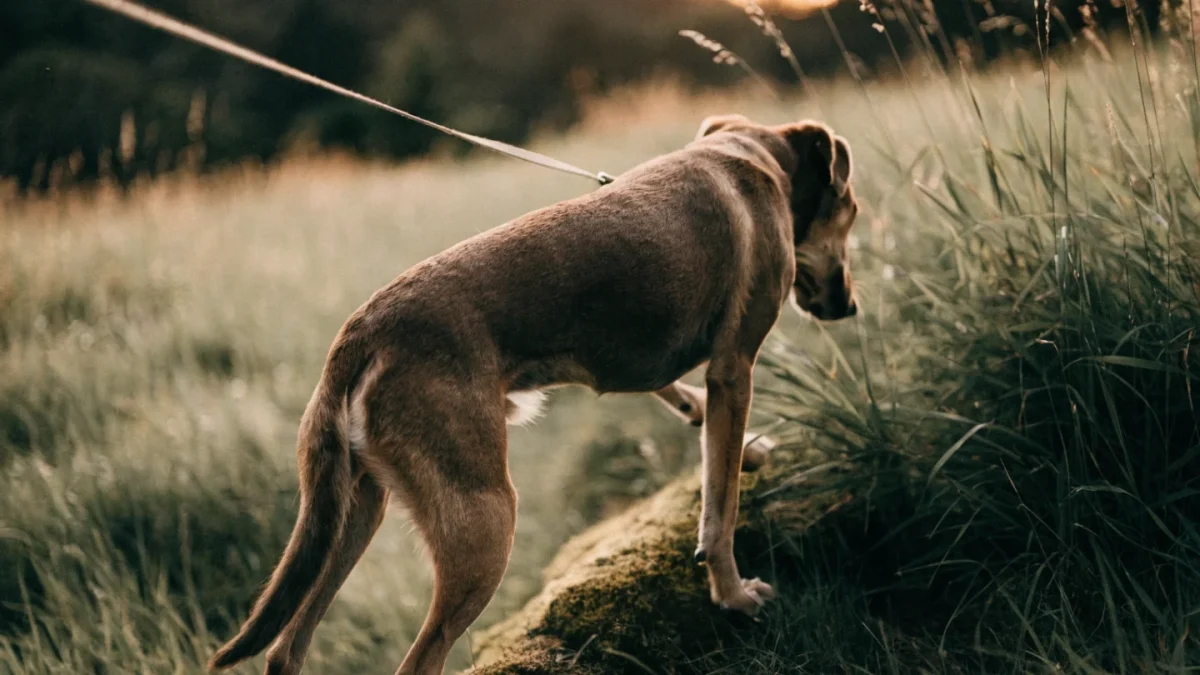
I had a reactive border collie mix in my classes once — a dog that needed a significant warm-up before he could function in any structured environment. Before every class, his owner would walk him for twenty minutes on a long line in a quiet field near the facility. Not exercise. Not training. Just sniffing.
By the time he came into the classroom, his cortisol was lower, his focus was better, and he worked for forty minutes without losing it. The decompression walk was doing something the structured walk to class wasn't.
What a Decompression Walk Is
A regular walk, for most dogs, involves a fair amount of pressure: stay close, don't pull, don't sniff that, keep moving, cross the street. The dog is being managed throughout.
A decompression walk removes that pressure. The dog leads. They sniff what they want for as long as they want. They set the pace. They meander. The human follows without agenda.
The name comes from diving — decompress too fast after a dive and things go wrong. Dogs need psychological decompression after intense experiences: stressful events, shelter stays, boarding, long car trips, or just a week of structured life.
Why Sniffing Is the Key
Why sniffing matters for dogs isn't just about enrichment — it's physiological. Sniffing activates the parasympathetic nervous system (the "rest and digest" mode as opposed to fight-or-flight). Research confirms that sniffing activates the parasympathetic nervous system — and a study published in Animals (MDPI, 2020) found that olfactory enrichment measurably affected heart rate variability in dogs, an established physiological marker of stress regulation.
The nose is the dog's primary sense. Using it isn't just pleasant — it's settling. A dog that's been allowed to sniff a field for twenty minutes is genuinely calmer than a dog that ran the same field in five minutes without stopping.
This is why enrichment specialists often recommend reducing vigorous exercise for stressed or reactive dogs and replacing it with long-sniff decompression walks. Running burns physical energy. Sniffing reduces the arousal state.
How to Do It
Location: Choose somewhere low-stimulation. A quiet park, a field away from roads and dogs, a trail without heavy foot traffic. The environment should have natural scent complexity — grass, trees, varied terrain — not a paved path.
Leash: A long line (10-30 feet) gives safety while allowing genuine freedom. Let the dog range as far as the line allows. Retractable leashes technically work but can feel tether-y to the dog and have real safety issues in some environments. A simple long line is better.
Your role: Follow. That's mostly it. Don't call the dog away from things unless safety requires it. Don't cue behaviors. Don't keep talking. Let the dog set the pace and direction within the length of the line.
If the dog wants to stand in one spot sniffing for five minutes, let them. That's exactly the point.
Duration: 20-30 minutes is meaningful for most dogs. You don't need hours. What matters is that the dog has uninterrupted, low-pressure time to follow their nose without being asked for anything.
Who Needs This Most
- Reactive or anxious dogs: decompress before exposure situations
- Dogs just home from boarding or shelters: the first weeks are overwhelming
- High-drive working breeds that never seem to fully settle
- Dogs that have been in structured training or sport work heavily — the brain needs rest, not just exercise
- Any dog that seems chronically wound up despite getting enough physical exercise
Adding It to the Routine
Even one decompression walk per week makes a difference for most dogs. Daily is ideal for high-needs dogs. (See also: relaxation protocol for dogs.)
It doesn't replace exercise or structured training. It supplements them. Think of it as giving the dog a chance to be a dog — nose down, unchoregraphed, doing exactly what their biology is designed for.
Dog sports and enrichment often focus on what dogs can do. Decompression is about what dogs need to just be.