

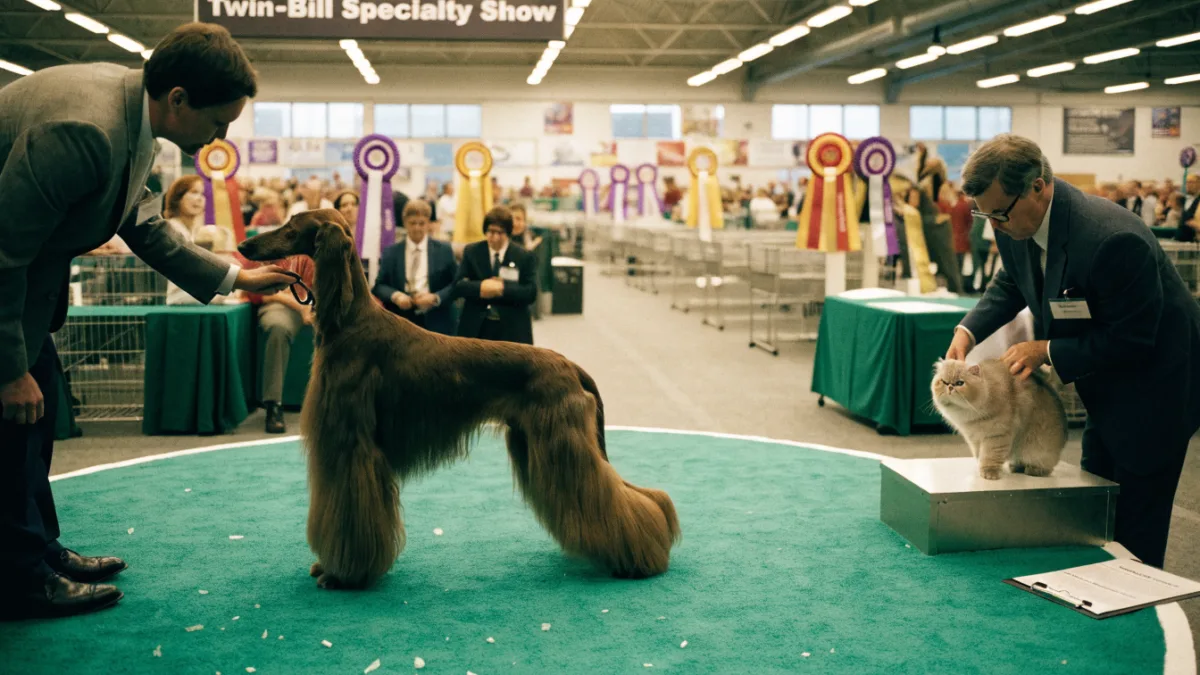
Dogs circling one ring, cats glaring from curtained benches across the hall, and a parking lot full of people who packed more gear for their animals than for themselves — that was Tinley Park, Illinois, over the weekend, where the,[1] put hundreds of canine and feline competitors under one roof. Twin-bill events like it are rare. The sports themselves are not: conformation showing — judging breeding stock against a written standard — is old enough that the first modern dog show, held in Newcastle, England, in 1859, featured exactly two breeds, Setters and Pointers. And yes, there’s a movie. Christopher Guest’s Best in Show, which [2] hits its 25th anniversary this year, and the fancy still can’t decide whether to quote it or wince.
What the Judge Is Actually Doing Up There
If you want dog shows explained in one sentence: the dogs aren’t competing against each other, they’re competing against a piece of paper. Every breed has a written standard — a blueprint for height, head, angulation, coat, and movement, drawn from the job the dog was built to do. Even in Group judging, where seven breeds share a ring, the judge isn’t ranking them on one scale; she’s asking which animal best embodies its own blueprint. The first time I stood ringside, I watched a judge spend two silent minutes with both hands on a Basset Hound’s rear assembly before she even looked at its face. That’s the sport. It’s a livestock evaluation wearing perfume.
The hands-on exam covers bite and dentition, shoulder layback, spring of rib, topline, tail set, and hocks — and the judge confirms males have two descended testicles, because a monorchid dog is disqualified on the spot. Then movement: the down-and-back to see whether the dog travels straight, and the go-round, where the judge reads side gait for reach and drive. Temperament counts too. A dog that shies or snaps isn’t winning, whatever its shoulders are doing.
Fifteen Points, Two Majors, One Very Long Season
The American Kennel Club — the registry behind most U.S. shows — requires 15 points for a Championship, and two of those wins must be majors of three to five points, taken under different judges. What a win is worth comes from a published point schedule based on how many dogs of your breed and sex you defeated that day, in your region. Beat four class dogs at a small show and you might collect a single point. Beat twenty-five at a big one and you’ve taken a five-point major — the best single day a dog can have.
The Ladder, Rung by Rung
Dogs enter classes by age and experience — 6-9 Month Puppy, 9-12 Month Puppy, 12-18 Months, Bred-by-Exhibitor (a point of pride: you bred the dog and you’re showing it yourself), and Open. Class winners face off for Winners Dog and Winners Bitch, which is where the points are awarded. Then comes Best of Breed, where already-finished champions — the “specials,” campaigned full-time for Group placements — join the fight; then the seven Groups (Sporting, Hound, Working, Terrier, Toy, Non-Sporting, Herding); then Best in Show. Westminster has run since 1877, the second-oldest continuously held sporting event in the United States behind the Kentucky Derby, and since 1992 every conformation entry has had to already be a champion. Getting there is the whole game.
What It Costs
Entry fees are the cheap part. Add fuel, hotels, and — if you hire one — a professional handler’s daily fee, and a weekend can outrun a mortgage payment. A season campaigning a special at the national level clears five figures without blinking. This sport is not cheap, and beginners deserve to hear that up front. (The rules above are the AKC’s; the UK’s Kennel Club and the FCI-affiliated registries elsewhere have their own systems, but the standard-based idea travels everywhere.)
Cats Get Judged Six Times Before Lunch
Cats joined the act in 1871, when Harrison Weir ran the first cat show at London’s Crystal Palace and wrote the first breed standards to go with it. The modern cat show is structured nothing like a dog show. A cat show runs four to eight independent rings in the same hall, each with its own judge holding a complete show. Your cat is evaluated by every one of them, so it can take Best Cat in one ring’s final and be ignored in the next. Two judges, two opinions, same afternoon. Dog people find this maddening. Cat people consider it the entire point.
Cat shows are also benched: exhibitors keep their cats in open, curtained cages between rings, and spectators walk the aisles at nose distance. A Maine Coon breeder once let me put a freshly sanitized hand into her grand champion’s cage after I asked — that’s the etiquette: ask first, always. In the U.S., two bodies sanction most shows: the Cat Fanciers’ Association, founded in 1906, and The International Cat Association, founded in 1979. Classes divide into kittens (four to eight months), championship (intact adults), premiership (altered adults — a neutered cat can still earn titles, an area where the cat fancy is years ahead of dog conformation), and household pet, where unregistered mixed-breed cats are judged on condition, grooming, and temperament. Judges work each cat on the table — head shape, ear set, eye color, proportions, coat texture — dangling a feather to read how the cat composes itself.
If cat shows for beginners sound friendlier than dog shows, that’s because they are. The household pet class is the fastest on-ramp into competitive animal showing anywhere: no papers, no breeder, no point schedule, and your neutered rescue tabby can finish the season with rosettes. The documentary Catwalk, pitched as “Best in Show with whiskers,” followed the rivalry between two top fanciers, Shirley and Kim — arrive thinking the cat circuit is the sleepy cousin of the dog world and you’ll leave corrected.
From Your Couch to the Catalog
Starting With a Dog
Find a breeder who shows their own dogs and say the magic words: “I’m looking for a show prospect.” Expect a waiting list, a contract, maybe a co-ownership, and honest talk about which puppy has the angles and which are pets — there’s always both. The puppy arrives registered; the education is yours. Handling classes through a local kennel club teach you to stack, bait, and gait a dog, and entering means going through the show’s entry service, with closing dates about three weeks out. The AKC even runs a 4-to-6-month beginner puppy competition — no points, no pressure. Your first weekends will end with nothing but a crated, happy dog and an education. That’s normal. Watch what the winners do, then steal it.
Starting With a Cat
Register nothing. Enter household pets, bring a cage with curtains, a litter box, and water, and the only real requirement is temperament: your cat has to tolerate a stranger stretching it, staring at its teeth, and waving a feather at it. If your cat lets the vet do that, it can show.
Twenty-Five Years of “God Loves a Terrier”
Guest’s mockumentary gave the public its permanent image of the sport — Parker Posey and Michael Hitchcock convinced their Weimaraner’s neuroses are their fault, Christopher Guest’s Harlan Pepper listing nuts on camera, and Fred Willard’s commentator babbling over the Group finals:
“And to think that in some countries, these dogs are eaten.” — Buck Laughlin, Best in Show
— before Winky the Norwich Terrier upsets Rhapsody in White for Best in Show.,[3] half the fancy can recite it and the other half wishes everyone would stop. The satire is loving. The criticism with teeth sits elsewhere: a written standard can reward extremes as easily as balance. The overwhelming majority of Bulldog litters are delivered by C-section, and the Persian’s flattened face comes with tear-duct and airway trouble baked in (I’ll leave the veterinary deep-dive to Dr. Sarah; the structural headline is enough here). After the BBC’s 2008 documentary Pedigree Dogs Exposed, the UK Kennel Club rewrote 78 breed standards in 2009, and the BBC dropped Crufts. Registries move slowly — but you can love a standard and still fix it. No ribbon should codify a breathing problem.
The show world’s best defense is what it preserves. The Sussex Spaniel dwindled to a few dozen dogs after World War II; in 2009, a ten-year-old Sussex named Stump — Ch. Clussexx Three D Grinchy Glee — won Westminster’s Best in Show as the oldest winner in the event’s history. Of the roughly 200 AKC-recognized breeds, plenty are that rare, and their gene pools stay alive because someone kept entering them.
Strip away the satire and you find a 160-year argument about what dogs and cats are for, carried on by people who memorize point schedules and drive four hours to lose gracefully. It ends in preservation: rare breeds don’t survive on nostalgia, they survive on entries. Go to a show — dog, cat, or a rare twin bill like Tinley Park. Ask before you pet, then ask the person holding rosettes how they started. Every one of them has an answer, and most will talk until the lights go out. The next Stump begins exactly that way.
Sources
- Great American Dog and Cat Show — youtube.com
- premiered at the Toronto film festival in 2000 — imdb.com
- A quarter-century later — facebook.com