

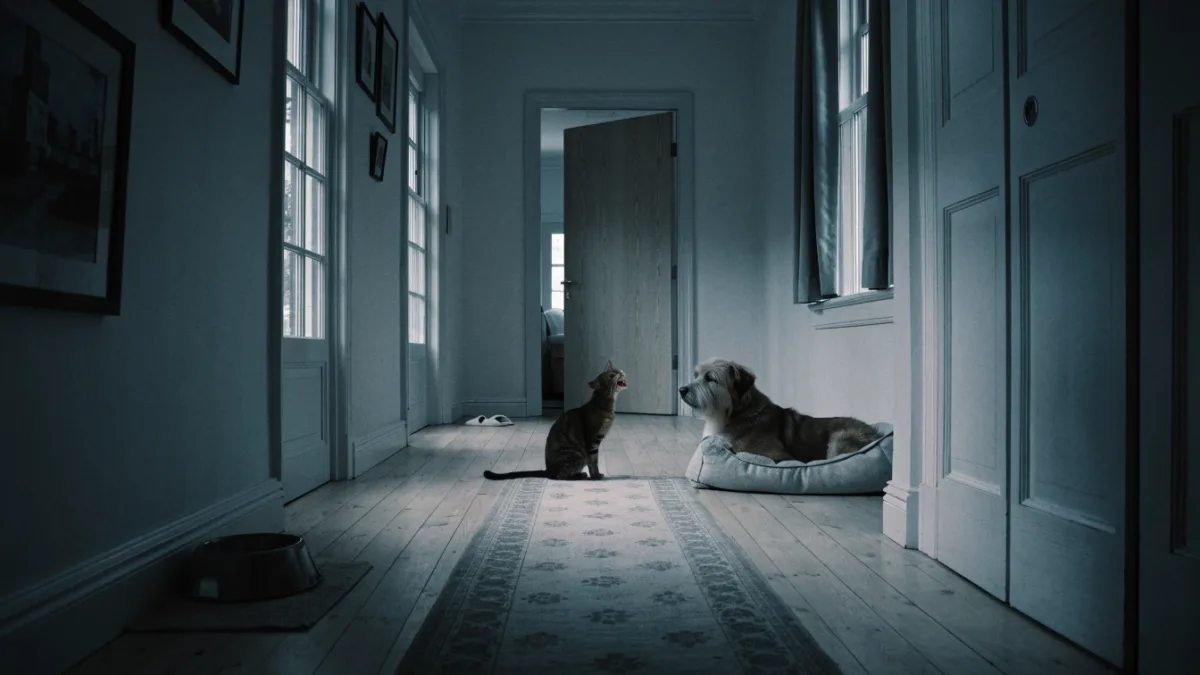
Here’s the fact that rearranged my brain the first time I heard it: adult cats basically don’t meow at each other. Feral cats hiss, yowl, and trill, and they lean hard on scent and body language — the meow mostly disappears from cat-to-cat conversation after kittenhood. So that sound your cat makes at 6 a.m.? It’s not cat talk. It’s a sound your cat developed for you. And once you get that, plus a few simple rules about pitch, duration, and context, you can start answering back in ways that actually land. No app required — and we’ll get to why the apps don’t work, too.
Your Cat Built a Private Language With an Audience of One
Kittens meow at their mothers. Feral adult cats largely drop the habit. Somewhere in the roughly 10,000 years since cats started shadowing humans around grain stores in the Fertile Crescent — descendants of the African wildcat, Felis lybica, a species still doing fine in the wild — they kept the meow because it worked on a brand-new audience: us.
Here’s the part most owners miss. Meows aren’t universal cat words. They’re closer to a private code each cat builds with each human. In a Cornell study (Nicastro and Owren, 2003), people listening to meow recordings with zero context guessed what the meow meant correctly only about a third of the time. Owners do better with their own cat, which tells you the code is local, not standard. If you feel like you’re guessing at a strange cat’s meow — you are. Everyone is.
There’s melody in it, too. Lund University’s “Meowsic” project, led by researcher Susanne Schötz, found cats use different melodic patterns in different situations — the tune at feeding time sounds different from the tune at the vet clinic — and that humans can learn to hear those differences. Think of it as tone of voice: the same “meow” can carry forty meanings depending on how it’s sung.
Cats are commonly credited with over 100 distinct vocalizations, versus maybe 10 for dogs. Researchers still argue the exact count, but the gap is real. Cats are the chatterboxes of the two species — they just aim nearly all of it at humans. Breed plays a role as well: Siamese, Orientals, and Bengals will narrate their entire day, while Persians and Ragdolls may barely comment.
I’ll admit it: I spent my first decade around dogs functionally illiterate in cat. Once I stopped treating meows like noise and started treating them like a conversation aimed at me, everything about living with cats got easier.
Cat Meowing Meaning: A Field Guide
- The trill or chirp. Short, rolling, friendly. This is a greeting — “oh, you exist, excellent.”
- The mid-length repeat meow. A request. Food, a door, your lap. It repeats because it’s a form you haven’t signed yet.
- The long, drawn-out meow. Escalation. The complaint department. Your cat has now asked twice.
- The silent meow. All jaw, no volume. Usually a demand delivered with maximum cuteness. It works, and your cat knows it.
- The yowl. Different animal entirely. Mating behavior in unspayed or unneutered cats, or — in seniors — confusion and distress. More on that below.
Then there’s my favorite piece of cat research. A 2009 study in Current Biology (McComb et al.) found that hungry cats embed a high-frequency component — roughly 220 to 600 Hz, right in the range of a human infant’s cry — inside an ordinary purr. People rated those purrs as significantly more urgent and harder to ignore. Your cat hacked your parental instincts. That wasn’t an accident; that was R&D.
One myth to kill while we’re here: purring doesn’t always mean contentment. Cats purr when stressed, injured, or even dying, possibly as self-soothing at low frequencies. Context decides.
So why does my cat meow so much?
Often for boringly legitimate reasons: a hunger routine, a greeting, attention-seeking, or stress from a change — a move, a new schedule, a new pet. Some cats are just talkers, especially the talkative breeds. If your cat has always been a commentator, a chatty Tuesday means nothing.
When the meowing is a red flag
The pattern I care about is change. A sudden jump in meowing — especially at night, especially in a senior cat — can signal hyperthyroidism, pain, hearing loss, or cognitive dysfunction. Most cats over 15 show at least one behavior change as they age, and vocalizing more is a classic one. A friend’s 16-year-old tabby, Smudge, started night-yowling out of nowhere. Everyone called him a dramatic old man. Bloodwork showed hyperthyroidism. Treated, and the yowling dropped off a cliff. If the quantity or the character of your cat’s meowing changes fast, do the vet visit first and the behavior plan second — vet hospitals that break down decoding pet vocabulary make the same point, because they’re the ones catching the medical cases hiding inside “he’s just loud.”
Why Do Dogs Bark? The Rules Are Real
Dog barks aren’t random noise. They follow acoustic rules — laid out in Morton’s motivation-structural rules back in 1977 and confirmed by decades of work since, including Pongrácz’s team at Eötvös Loránd University:
- Low-pitched, long, harsh — serious business. Alarm, threat, “I mean it.” Think stranger at the door.
- High-pitched, short, rapid, tonal — excitement, play, or distress. High pitch means high arousal, not high aggression.
- Alone barks — higher pitched and metronomically repetitive. That rhythm is the signature of isolation distress.
Here’s how this plays out in real life. A client’s terrier mix, Biscuit, had two barks. At the window, facing a stranger: low, gruff, spaced out — genuine alarm. At the fence, facing the neighbor’s dog: high, fast, machine-gun rhythm, whole body bouncing. The owner read both as aggression. The pitch told a different story — the fence bark was frustrated play solicitation. Completely different dog, emotionally, and completely different fix.
And these rules are honestly labeled. In Pongrácz’s cross-cultural studies, people classified a bark’s context from audio alone above chance levels — including people who had never owned a dog and didn’t speak the handlers’ language. Humans are built to read barks.
Beyond pitch, the common triggers shake out as: alarm and territorial barking, demand barking, boredom barking, play barking, and separation distress — which shows up in maybe a quarter to a third of dogs. If a neighbor reports relentless, rhythmic, high-pitched barking while you’re out, that’s data, not a complaint.
As for why dogs bark so much in the first place: wolves bark in under 3% of their vocalizations. Barking is largely a puppy trait dogs kept into adulthood, and then we spent thousands of years selectively breeding the barkiest guardians and alarm-ringers we could find. Your dog barks a lot because we designed dogs that bark a lot.
How to Actually Answer Back
Read the whole animal
Sound is half the message, at best. The other half is ears, tail, pupils, hackles, whiskers, and the play bow. High, rapid barks plus a play bow means “let’s go.” The same barks plus a tucked tail, pinned ears, and pacing means stress. Identical audio, opposite animals. Never translate a vocalization without the body it’s attached to.
Answering your cat
Cats recognize their own names — demonstrated in a 2019 Japanese study — and a 2022 French study found cats respond more to their owner’s version of baby talk than to a flat adult voice. So the cooing you’re slightly embarrassed about? That’s a real channel. Use it. Respond predictably to legitimate requests, because consistency is what makes the code learnable in both directions. Just don’t answer the 4 a.m. meow with food. Once is all it takes to teach a slot machine.
Answering your dog
Demand barking dies when it stops paying out. Don’t yell — from your dog’s side of the conversation, you just joined in. Wait for a beat of quiet and reward that instead. And expect the extinction burst: the barking will get louder before it dies, because from your dog’s perspective, the vending machine stopped working, so you push the button harder. If you cave at the peak, you haven’t failed — you’ve just taught persistence at volume. Start again. And meet the dog you actually have: livestock guardians and terriers came with opinions pre-installed. Give them a job before you ask for quiet.
About those translator apps
The app stores are full of:[1] that convert a meow into an English sentence. They’re party games. Some openly lean on recorded sound clips, and none of the translation claims has peer-reviewed support. The deeper problem is the one raised in [2] they don’t. There’s no syntax, no stable word-meanings. A bark broadcasts emotional state — arousal level plus valence, roughly “how worked up am I, and in which direction” — not “squirrel, third oak tree, heading north.” Real machine-learning work is happening: the nonprofit Earth Species Project released BarkHub, an open annotated bark dataset, in 2023, and a 2022 algorithm classified emotional valence in pig vocalizations with about 92% accuracy. Notice what even the good AI reads: emotion, not words. That’s the ceiling — and honestly, it’s the useful part.
So skip the app and use the equipment you already have. Your cat walked out of the wild roughly ten thousand years ago and, instead of learning our language, invented a small sound aimed at you specifically — tuned, when it really matters, to echo a human baby. Your dog’s bark follows acoustic rules so honest that strangers on another continent can decode them from audio alone. The conversation has been happening your whole life. The translation guide isn’t software — it’s pitch, duration, context, and the rest of the animal’s body. Learn to read those, and the least you can do, after all these millennia of them talking to us, is listen properly back.
Sources
- dog and cat "translators" — apps.apple.com
- discussions like this one about whether barks and meows count as language — quora.com