

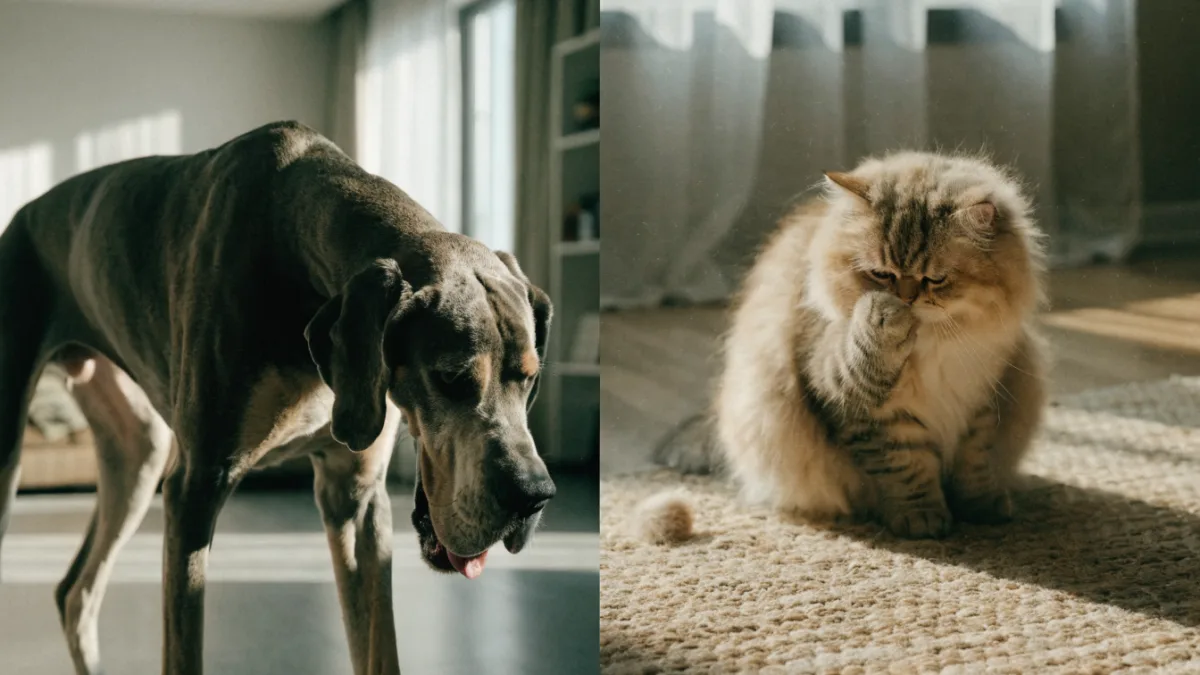
It was just past midnight on a Sunday when the call came in. A frantic owner was on the line, bringing in her four-year-old Weimaraner named Kaiser. She had been asleep on the couch and woke up to Kaiser pacing in circles, drooling so heavily that he was leaving wet spots on the hardwood floor. When he stood, his abdomen looked wildly distended, and he was dry-heaving without bringing anything up. She recognized immediately that something was terribly wrong. Across town, that same night, another owner was dealing with a very different midnight wake-up call: their twelve-year-old Maine Coon cat, Barnaby, was hacking up a massive, damp cylinder of fur onto the living room rug.
Both owners were dealing with gastrointestinal issues, but the stakes couldn’t have been more different. One was facing a life-threatening emergency that required immediate surgery, while the other was facing a messy, annoying, but largely harmless biological reality. Understanding the massive difference between GDV in dogs and feline hairballs comes down to the fascinating—and sometimes dangerous—differences in animal anatomy.
The Anatomy of a Disaster: Understanding GDV in Dogs
When a dog bloats, they are experiencing Gastric Dilatation-Volvulus, usually referred to as GDV. This condition happens in two distinct phases. First, the stomach fills with air, fluid, or food—this is the dilatation, or bloat. Second, the enlarged stomach twists on its axis—this is the volvulus. When the stomach flips, it seals off both the entry and exit points, trapping all the food, fluid, and gas inside. Worse, this twisting cuts off the blood supply to the stomach tissue and sometimes the spleen, leading to tissue necrosis, which is the medical term for tissue death.
But why does this happen? It all comes down to the shape of the dog. GDV overwhelmingly affects deep-chested dog breeds. Think of breeds like Great Danes, German Shepherds, Standard Poodles, and Weimaraners. Their chests are tall and narrow, rather than round and barrel-shaped. This gives their stomachs more vertical room to expand and swing. When a deep-chested dog eats a massive meal or drinks a huge amount of water, the heavy, engorged stomach can literally act like a pendulum, swinging around until it flips over on itself.
Recognizing Dog Bloat Symptoms
If your dog develops GDV, you don’t have time to wait and see if things improve. It is a “drop everything and drive to the emergency vet” situation. Over the years, I’ve seen too many owners second-guess themselves, and I always tell them that it is always better to be safe than sorry.
If you suspect bloat, look for these specific dog bloat symptoms:
- Distended abdomen: The belly will look swollen and often feel hard or tight, like a drum.
- Unproductive retching: The dog will try to vomit or dry-heave, but because the esophagus is pinched shut by the twist, nothing comes up except maybe a small amount of thick saliva.
- Pacing and restlessness: The dog will often be visibly distressed, unable to get comfortable, and may constantly shift positions or pace.
- Excessive drooling: Stringy, thick drool is common as the dog feels nauseous but cannot expel anything.
- Signs of shock: As the condition progresses, the dog’s gums may turn pale or blue, and their breathing will become rapid and shallow due to restricted blood flow and pressure on the diaphragm.
The Feline Equivalent: Why Cats Just Get Hairballs
Now, let’s talk about Barnaby the Maine Coon. Why don’t our fluffy, fancy feline friends face the same life-threatening stomach-twisting risk? Simply put, cats have a different overall body and chest structure. Their ribcages are shallower and rounder, making it highly unlikely for their stomachs to distend and flip like a deep-chested dog’s.
Instead, cats deal with hairballs, medically known as trichobezoars. Because cats are meticulous groomers, their tongues are covered in tiny, backward-facing barbs called papillae. These barbs act like a built-in hairbrush, catching loose fur and dead skin. The cat inevitably swallows this loose hair. In a healthy, well-functioning feline digestive tract, this hair either passes harmlessly through the intestines and comes out in the litter box, or it builds up in the stomach until the cat vomits it up.
While finding a slimy hairball on your bare foot in the dark is incredibly gross, it is rarely a cause for medical alarm. It is simply a normal physiological byproduct of being a cat.
Finding the Right Cat Hairball Remedy
Even though hairballs are normal, if your cat is hacking them up several times a week, it’s time to intervene. Frequent hacking can lead to irritation of the esophagus, and in rare cases, a massive hairball can actually cause an intestinal blockage. I constantly have clients ask me for the best cat hairball remedy, and my approach has definitely shifted over the years.
I used to recommend the standard petroleum-based hairball gels, which work by coating the fur in mineral oil so it slides through the gut. However, I’ve changed my mind on this. Continually feeding your cat petroleum derivatives isn’t ideal for their long-term digestive health. Instead, I now highly recommend a holistic, natural approach to managing feline hairballs:
- Routine grooming: This is your first line of defense. If you brush the loose undercoat out, they can’t swallow it. A daily brushing session with a deshedding tool works wonders.
- Petroleum-free digestive gels: Look for pastes that use natural lubricants, like a lysine or omega-3 fatty acid base, to help the hair glide through the digestive tract safely.
- Prebiotic and probiotic supplements: Adding a digestive enzyme and probiotic powder to your cat’s wet food helps maintain a healthy gut flora, which naturally supports gastrointestinal motility. A well-moving gut pushes hair right through.
- Fiber supplementation: A small amount of psyllium husk or canned pumpkin (ensure it is 100% pure pumpkin puree, not pie filling) added to their diet can bulk up the stool and help sweep the hair out the back end.
Prevention, Myths, and Changing My Mind
Preventing GDV is an ongoing conversation in the veterinary community. For a long time, standard advice included raising your large dog’s food and water bowls off the floor. The logic was that eating from an elevated position was better for their joints and would reduce the amount of air they swallowed. I recommended it for years.
However, I’ll be the first to admit that I’ve changed my mind on this. Groundbreaking research from Purdue University completely shifted the veterinary consensus on this topic. Their studies found that elevated bowls actually increase the risk of GDV in large breed dogs. Today, the evidence-based recommendation is to feed large and giant breed dogs from floor-level bowls.
Similarly, the pet industry has seen a massive boom in slow-feeder innovations. If you have a dog that inhales their food like a vacuum cleaner, slowing them down is critical. I highly recommend looking for puzzle mats, maze-style slow-feeder bowls, or specialized “gorge-blocking” kibble dispensers. These force the dog to work for their food, significantly reducing the amount of air they ingest during mealtime. As a general rule, try to enforce a strict “rest period” of at least an hour before and after vigorous exercise to prevent their stomach from swinging while they run and play.
The Case for Prophylactic Gastropexy
For owners of exceptionally high-risk breeds, like Great Danes—who have a lifetime risk of developing GDV that can be as high as 40%—there is a surgical option to consider. Prophylactic gastropexy is a preventative surgery where a veterinarian surgically tacks the stomach to the inside of the right abdominal wall. By doing this, the stomach is physically prevented from twisting, even if it fills with air.
There is some debate among owners about whether an elective surgery is worth the risk, but the recent advancements in laparoscopic gastropexy have made this a much easier choice. Using minimally invasive techniques, a vet can tack the stomach through a few tiny incisions. The recovery time is drastically reduced compared to traditional open-abdomen surgery, and it offers lifelong protection against the deadly volvulus (twisting) aspect of GDV. I frequently discuss this with owners of young, deep-chested breeds, as it can often be performed at the same time the dog is being spayed or neutered.
Whether you are sharing your home with a 150-pound deep-chested Great Dane or a ten-pound fluffy Persian cat, the goal is always the same: knowing what is normal for your pet, and what constitutes an emergency. While domestic dogs and cats are in no need of conservation efforts, our role as their caretakers is to advocate for their daily health and wellbeing. By understanding the mechanics of your dog’s deep chest and your cat’s grooming habits, you are perfectly equipped to keep their digestive systems safe, happy, and functioning exactly as nature intended.