
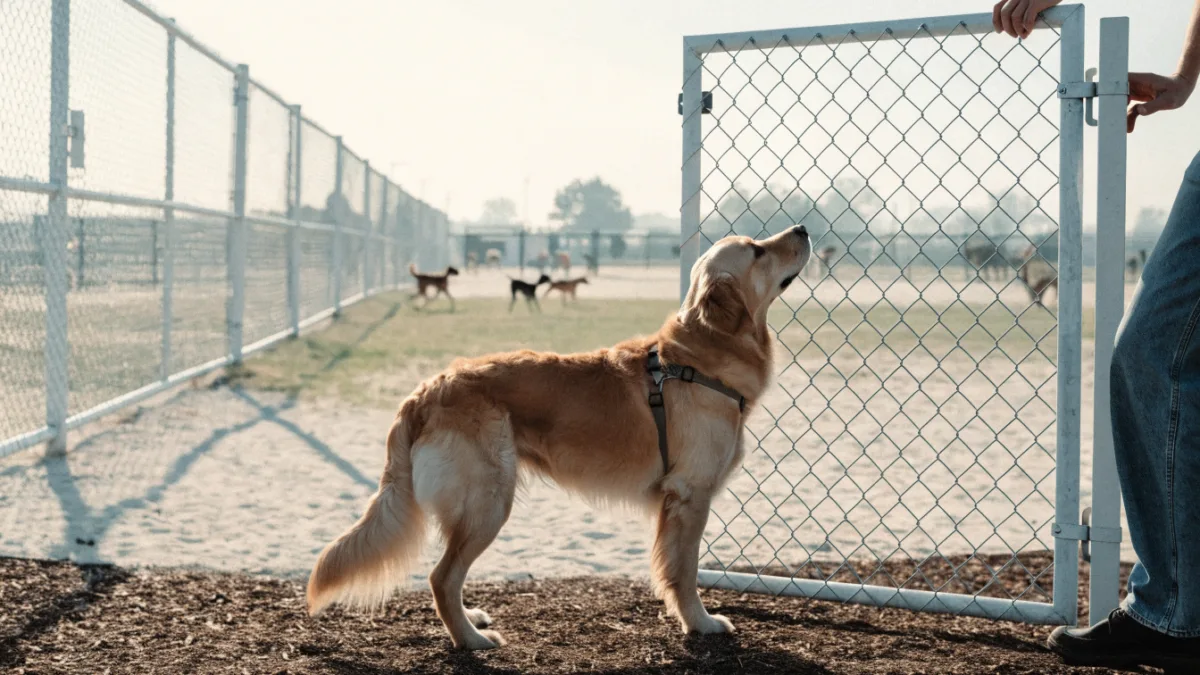
The scariest moment I’ve ever witnessed at a dog park happened in about four seconds, at the gate. A woman walked into the double-gated entry with her golden retriever still on leash, hesitated, and six off-leash dogs swarmed the fence line to greet him. The retriever panicked, the leash tangled around her legs, and by the time she got the gate open, her dog was air-snapping in a tight circle with a shepherd mix reading him like a threat. Nobody got hurt that day. But it was a perfect little demo of why dog park etiquette isn’t about being polite — it’s about physics, panic responses, and the fact that most injuries are predictable if you know what to look for.
The Gate Ritual: Where Every First Dog Park Visit Begins
Here’s the mechanic most first-timers miss: the leash comes off inside the double-gated airlock, before you enter. A leashed dog surrounded by loose dogs feels trapped. They can’t flee, they can’t signal normally, and the tension in the leash travels straight down to their shoulders. That’s exactly what happened with the golden retriever. It’s also why.[1] — this one tops almost every version.
If it’s your first dog park visit, stack the deck in your favor:
- Go at off-peak hours. A Tuesday morning with four calm dogs teaches your dog more than a Saturday free-for-all with thirty.
- Walk the perimeter first. Look through the fence before you commit. Stiff dogs, a pileup at the gate, an owner glued to their phone — pick another day.
- Ditch the retractable leash entirely. The thin cord burns skin, offers almost no control, and the lock fails under a sudden lunge. A standard six-foot leash, then off it in the airlock.
- Check the admin stuff. Most parks expect current rabies, DHPP, and bordetella vaccines, and a collar with ID. Some cities are even piloting permit systems that require proof.
- Burn some energy first. A dog who arrives already wired is a dog who plays rough. A twenty-minute walk before you enter changes everything.
Learn to Read the Room Before You Need To
Most owners can’t tell play from a fight brewing, and that gap is where dogs get hurt. So here’s your crash course.
What healthy play looks like
Loose, bouncy, almost sloppy movement. Play bows — front end down, butt up. Open, relaxed mouths. The best sign is role reversal: the chaser becomes the chased, the wrestler ends up on the bottom. Watch a well-matched pair and you’ll also see self-handicapping — I once watched a mastiff essentially play patty-cake with a spaniel, deliberately pulling every bit of force out of his paws. That’s a dog with good social skills.
What trouble looks like
- A dog who freezes mid-play, body stiff and low to the ground
- Hard staring, “whale eye” (whites of the eyes showing), closed mouth
- A stalking gait — slow, deliberate, head low, like a lion on a nature documentary
- Raised hackles paired with any of the above, lip curling, or a low growl
Then there’s the consent test, and it’s the single best trick I know. Worried the play is tipping into conflict? Briefly separate the two dogs a few feet apart, then let go. If both dogs bounce back toward each other, the play was mutual. If one walks away or keeps a stiff distance, playtime’s over. I used this with two Labradors whose wrestling had an owner convinced a fight was imminent — both dogs flew back together like magnets. She relaxed. The dogs kept playing. Everyone won.
One more timing note: leave before your dog gets tired. Fatigue is one of the most underrated fight triggers. Overtired dogs stop tolerating rudeness they’d normally shrug off — same as us at hour eleven of a family reunion.
Why the Small-Dog Side Exists: Predatory Drift Is Real
People ask me this constantly: “My chihuahua mix loves big dogs. Why can’t she use the big side?” Sometimes she genuinely can — some confident little terriers handle themselves beautifully, and I won’t pretend otherwise. But here’s the calculation you’re actually making.
First, the mechanical reality: even friendly, non-aggressive play from a seventy-pound dog can injure a fifteen-pound dog, purely through force. A body-slam that a lab shrugs off is a trip to the emergency vet for a dachshund.
Second — and this is the one nobody wants to hear — there’s a phenomenon called predatory drift: a sudden, often silent switch from play drive to prey drive directed at a smaller animal. It’s not aggression. It’s not a “bad dog.” It’s an old circuit firing, and it’s unpredictable. This is why size segregation exists even at parks full of sweet dogs.
Keep your small dog on the big side out of these situations:
- Any history of fearfulness or scrambling to hide behind your legs
- Large dogs playing rough, body-slamming style
- Sighthounds or intense herding breeds present — a strong chase instinct plus a small running dog is a bad equation
- Crowded conditions, period
And if things get tense, resist the urge to scoop your small dog up mid-encounter — unless it’s truly dire. Being lifted turns them into a dangling, squeaking target and can trigger the exact chase response you’re trying to avoid. Get between the dogs, move away calmly, use an exit.
The Etiquette Violations That Actually Get Pets Hurt
The CDC estimates about 4.5 million dog bites a year in the U.S., with roughly 800,000 needing medical attention, and dog parks see their share. Almost every one traces back to a human choice. [2] for a reason — and [3] The repeat offenders:
- Food, treats, or high-value chews inside the park. I’ll cop to this one — I used to carry treats for training mid-visit, until the day three dogs clocked the smell and I nearly caused the exact scuffle I was rewarding against. Resource guarding is a leading cause of park fights. Leave the food in the car.
- Toys. Same principle, more contested. Some parks allow them; many ban them because a tennis ball with six fans is a dispute waiting to happen. Check the posted rules and don’t bring anything you or your dog will guard.
- Phones. A distracted owner is an absent owner. If you can’t glance up every few seconds, sit outside the fence.
- Puppies before their full vaccine series, or intact males around females in heat. Both raise risk in ways that aren’t fair to other park users.
- Unpicked waste. Health hazard, parasite transmission, and the fastest way to make the whole community resent you.
- Kids running and screaming among unfamiliar dogs. Some parks ban young children outright for this reason. A squealing, darting child reads as prey-or-play to dogs who don’t know them.
If you remember one rule, make it this: supervise your dog as if everyone else’s dog is your responsibility, because at a dog park, it basically is.
Bonus Round: Cat Café Etiquette, Because Urban Pet Life Doesn’t Stop at the Fence
The first cat café in the U.S. opened in 2014, and there are now hundreds of them, many partnering with shelters for adoptions — which means feline etiquette is suddenly relevant. The good news: it’s the same core skill you just learned at the dog park. Consent.
- Let the cat initiate. A cat walking into your lap has chosen you. Reaching after a retreating cat has not.
- Never pick up or wake a sleeping cat, no matter how good the photo would be.
- No outside food or treats, and no flash photography.
- Don’t pursue or corner. A cat with an escape route is a relaxed cat; a cornered one is a lesson in claws.
- Respect booking windows and keep kids supervised — quiet voices, gentle hands, cat’s choice.
The Takeaway
Dog parks are the fastest-growing park amenity in American cities — the Trust for Public Land has tracked hundreds of new ones opening in just the last few years, right as millions of first-time owners adopted through the pandemic and showed up with no rulebook. Nobody hands you that rulebook at the gate. You build it by watching, by learning the body language, by leashing and unleashing at the right moments, and by leaving five minutes before you think you should. Shared animal spaces — dog parks, cat cafés, shelter visit rooms — only exist because enough people behave like they deserve them. Be the owner the regulars are glad to see walk through the gate, and if you’re looking to add to your crew, those shelter-partnered cat cafés are a pretty great place to start.
Sources
- veteran park regulars keep a running list of unspoken rules — reddit.com
- Vet clinics keep publishing the same warnings — hpanimalhospital.com
- when one local owners' group asked for an etiquette list, they got flooded with responses — facebook.com