

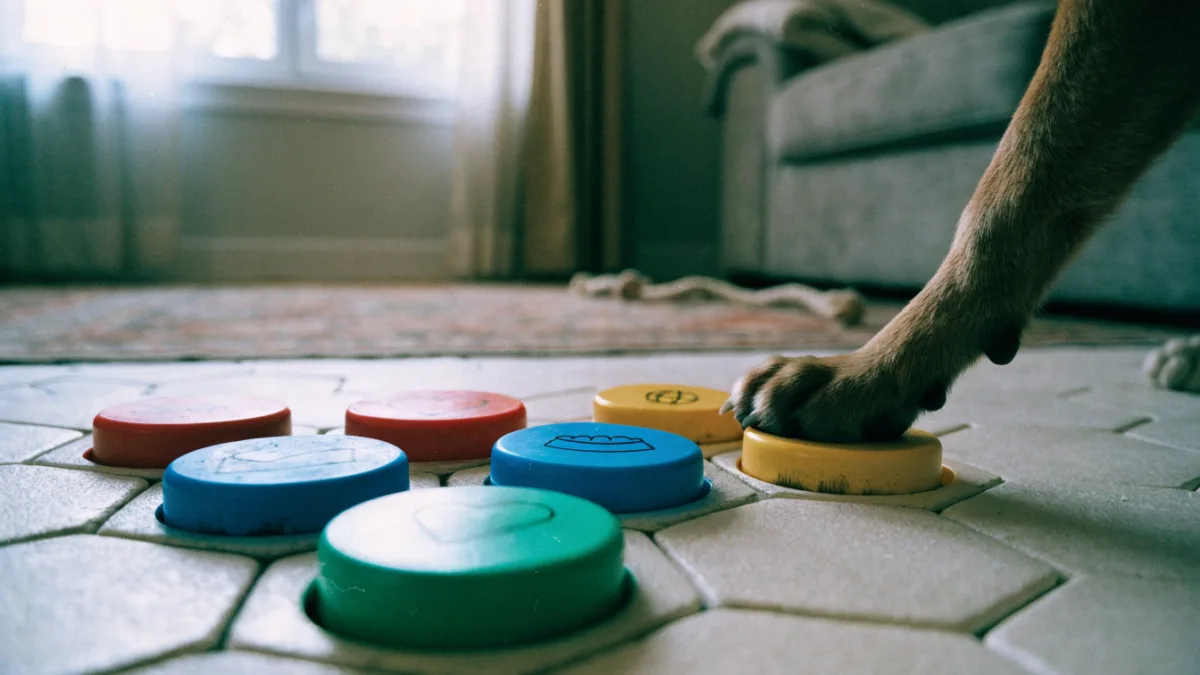
You’ve seen the clips. A dog stands on a grid of colorful plastic buttons, taps one with a paw, and a recorded voice says “outside.” Then another: “play.” The owner gasps. The comments lose their minds. I’ll admit it — I rolled my eyes at these videos for a solid year. Then a client showed me footage of her Australian Cattle Dog mix, Petey, pressing “play,” pausing, then pressing “outside” right after she’d told him “not now” on fetch. I’ve watched that clip maybe thirty times. I still can’t tell you whether Petey was building a sentence or just working down his wishlist. Neither can the researchers — yet. But they’re getting closer, and what they’ve found so far is worth taking seriously.
How a Speech Therapist’s Dog Started All This
Talking buttons for dogs have a specific origin story, not a vague one. Christina Hunger, a speech-language pathologist, spent her days helping toddlers communicate with recordable speech devices. Around 2018 she wondered what would happen if she taught the same system to her dog, Stella. Her posts about it — Hunger for Words — went viral in 2019, and the trend was off and running.
Then the pandemic hit, millions of people were stuck home with their pets, and button sales exploded. The dominant commercial setup came from FluentPet, a company founded by cognitive scientist Leo Trottier: recordable buttons that snap into color-coded foam tiles, organized by category so “food” words live in one spot and “outside” words in another. Generic recordable buzzers will run you $20–30; branded starter kits can push past $100.
The stars of the genre are real, too. Bunny the Sheepadoodle, from Tacoma, Washington, has millions of TikTok followers and is one of the most-followed animals on the internet. And then there’s Billi — a Florida cat who uses buttons, which is rare enough that Billi is basically carrying the entire feline category alone.
What the Science Actually Supports
Researchers tend to sort the claims into three tiers, and the evidence looks very different at each level.
Tier 1: One button, one meaning
This one’s settled. You model the press, the dog gets the outcome, you repeat — classic operant conditioning. It usually takes weeks to months before you see reliable, deliberate presses. Typical vocabularies are functional: outside, food, water, play, walk, plus the names of favorite humans. If a scientist tells you your dog can’t learn that pressing a button produces a result, that scientist is wrong. That said, dogs vary. Some take to buttons fast; plenty never press one on purpose, and that’s normal.
Tier 2: Do they know the word means the thing?
Here’s where 2024 got interesting. A peer-reviewed study in PLOS ONE, led by Federico Rossano’s comparative cognition lab at UC San Diego, tested around 60 button-trained dogs. The dogs responded appropriately to words whether the word was spoken aloud by a person or pressed on a soundboard — including when someone other than the owner did the pressing. That detail matters. It rules out the simplest version of “the dog is just reading the human” and suggests genuine word-referent learning: the sound stands for the thing itself. The study grew out of “They Can Talk,” a citizen-science project with thousands of dogs and cats enrolled worldwide.
Tier 3: Sentences
Not demonstrated. So far, most multi-button presses look like request strings — “food, play, outside” — rather than grammar. Bunny’s famous mirror moment, where she pressed combinations that seemed to ask about the dog staring back at her, is exactly the kind of thing that’s suggestive but unprovable. The UCSD lab is still combing the data for combinations that exceed chance. They haven’t found them yet.
The Clever Hans Problem
Now the uncomfortable part. In the early 1900s, a German horse named Hans appeared to do arithmetic, tapping out answers with his hoof. Psychologists eventually showed Hans was reading his questioner’s unconscious body language — tiny posture shifts that appeared when he reached the right number. Hans wasn’t doing math. He was doing people-reading, brilliantly.
Dogs are better people-readers than horses, so every button video carries that same question mark. When the Washington Post ran a piece on button dogs,,[1] for exactly this reason. Skeptics like Clive Wynne at Arizona State and Alexandra Horowitz at Barnard have made the same caution: pressing “food” can be a request lever without being a word with meaning. Scientists explaining the buttons publicly, like in [2] tend to land in the same place — the single-word stuff is real, the rest is open.
Two more biases stack on top. First, cherry-picking: owners post the astonishing press, not the forty taps of “food” at 2 a.m. Second, apophenia — the human talent for seeing patterns in randomness. A [3] puts a fine point on it: we celebrate giving pets a voice while having no way to verify what they actually intend, and the more fluent they seem, the more we may be projecting. There’s also a fair question about conflicts of interest, since the biggest study runs on data collected from a button company’s customer community. Rossano maintains the analysis is independent. And the field carries historical baggage: the great ape language projects — Koko, Kanzi, Nim Chimpsky — mostly ended in dispute or disappointment. The famous 1979 analysis of Nim concluded the chimp was mostly imitating his handlers and making requests, not constructing language.
So Can Cats Learn Words?
Yes — better than their reputation suggests, worse than the internet hopes. A 2019 study in Scientific Reports by Saho Takagi and colleagues showed cats reliably distinguish their own names from other similar-sounding words spoken by their owners. Cats do learn human words. The bottleneck with buttons isn’t feline cognition — it’s feline motivation. Dogs are wired to sync up with us and will work for food and play. A cat learns when the cat decides there’s something in it for her.
If you want to try with a cat, stack the deck: pick words for things she genuinely wants, keep sessions short enough that she stays voluntarily, and don’t expect dog-style enthusiasm. Billi proves it’s possible. Billi does not promise it’s common.
Run Your Own Experiment at Home
Whether you’ve got a button board already or a cheap set of recordable buzzers, treat this like a science fair project instead of a talent show. A few controls separate real signal from wishful thinking:
- Blind presses. Have someone else press the buttons, or press them yourself out of your pet’s sight. Does your dog respond to the word, or to you hovering next to the food tile?
- Generalization. Use the same word from different people, in different rooms. A “word” that only works when you say it in the kitchen might be a habit, not a meaning.
- Log everything. Every press, what happened next, what you were doing at the time. Your hit rate will be lower than the highlight reel suggested. That’s not failure — that’s data.
- Cold reads. Film sessions and hand the unedited footage to a friend who doesn’t know your pet. Have them call hits and misses without context, then compare against what random pressing would produce.
And if you discover your dog only nails it when you’re leaning in expectantly? Congratulations, you’ve replicated Clever Hans in your living room. That’s a real finding too.
Here’s where I’ve landed after my year of eye-rolling: I was half wrong. The sentence question is still open, and the honest answer is that definitive evidence may take a few more years of data. But the button trend already produced the first peer-reviewed evidence that dogs can learn actual word meanings from soundboards — that’s more traction than the ape projects got in decades of work. And practically speaking, a dog who can tell you she needs out instead of standing silently at the door? That’s communication, whatever you want to call it. The takeaway I’d offer is simple: take animal minds seriously enough to test them honestly, and stay humble about what you don’t know. Your dog probably isn’t composing sentences. But the fact that we’re finally asking — and checking — is the most respectful thing we’ve done for the animals in our homes in a long time.
Sources
- trainer communities picked it apart — reddit.com
- this researcher's breakdown — facebook.com
- 2024 academic paper on the phenomenon's paradoxes — pmc.ncbi.nlm.nih.gov