
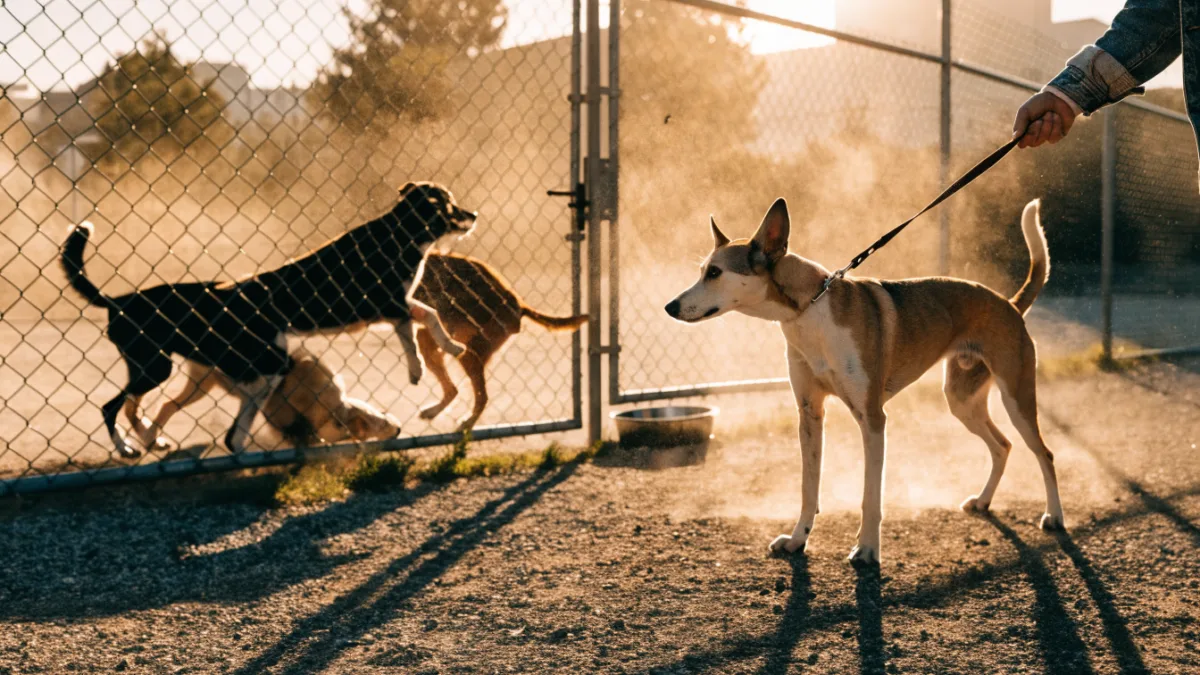
Every dog park fight I’ve ever seen coming was visible from the parking lot. Not from the dogs — from the setup. Too many dogs, one toy in the middle of the dirt, three high-arousal adolescents orbiting a nervous newcomer, and an owner scrolling their phone by the water bowl. The leash clip is the last decision you make with full information. Use it. Here’s how to read a pack before you and your dog walk into it.
The Two-Minute Scan Before You Unclip
Stand outside the fence for two minutes. Seriously — time it if you have to. You’re looking for five things:
- Head count. More dogs means more arousal in the air and fewer escape routes. If it feels crowded, it is.
- Gate crowding. If six dogs are camped at the entrance waiting to greet your dog, don’t enter yet. Gate clusters are where pile-ups happen. Wait for the crowd to disperse, or have someone inside the park clear the area.
- Food and toys. Resource-guarding around a tennis ball or a pocket full of treats turns friends into competitors fast.
- One-way traffic. Watch whether dogs are switching roles — chaser becoming chased — or whether one dog is being relentlessly pursued with no pause.
- Arousal level overall. Bouncy and loose is fine. Frantic, vocal, and accelerating is a park about to boil over.
Last spring I pulled up to a park with a client and her year-old Vizsla. From the car I could see three adolescent Labs running a tired Shepherd mix in widening circles — no stops, no role switches, the Shepherd’s tail dropping lower each lap. We drove two blocks to a sniff-and-walk route instead. That’s not a defeat. That’s the skill.
Once you’re inside, keep the three-second rule in mind for greetings: let dogs say hello for about three seconds, then call yours away happily. If both dogs turn back toward each other wanting more, release them again. Short greetings prevent the face-to-face tension that builds when two strangers stand locked nose-to-nose, neither sure what happens next.
What Healthy Play Looks Like — and What It Doesn’t
The green flags
Good play looks inefficient and a little silly. You’ll see play bows — front end down, butt up, often with a bounce. Ethologist Marc Bekoff’s research showed play bows function as a kind of disclaimer: “everything hard I’m about to do is still play.” Dogs even use them mid-session to re-set the terms after a rough moment. Alongside bows, look for loose, wiggly bodies, open mouths, exaggerated bouncy movement, and frequent self-interruptions — dogs that pause, shake off, and re-engage by choice.
Two more signs of healthy play deserve their own mention. Role reversal means the chaser becomes the chasee, the pinner gets pinned. Self-handicapping means the 80-pound Lab lies down to wrestle the 15-pound terrier at terrier scale. When a big dog inhibits its own force and size, that’s social skill, not weakness.
The amber flags
These mean play is tipping somewhere unhealthy, even if nothing has “happened” yet:
- Mounting — whether it’s arousal, stress, or play, the dog being mounted usually isn’t enjoying it, and other dogs often react badly to it
- Persistent one-way chasing with no role switches
- Play that never pauses — healthy play breathes; escalating play doesn’t
- Vocalizations climbing in pitch and intensity
- Crowding — three or four dogs targeting one dog at once
Use the consent test here: calmly interrupt the play for a moment. If the dog who was being chased or pinned circles right back for more, it was mutual. If it wanders off, stays near you, or avoids the other dog — it was being bullied, even if it never yelped.
The red flags
Intervene now, not later: total body stiffness or a freeze, a hard fixed stare, “whale eye” (whites showing as a dog turns its head away but keeps its eyes locked), a lifted lip, hackles up paired with a stiff forward approach, pinning with no release, shake bites, or one dog being cornered with no exit. And watch your dog’s stress signals too — lip licking, yawning, full-body shake-offs out of context, sudden ground-sniffing, hovering near the gate, or hiding behind your legs. Those aren’t quirks. That’s a dog telling you it’s done.
Play Styles Clash More Than Personalities Do
Most “fights” at dog parks aren’t aggression — they’re communication breakdowns between dogs with incompatible play styles. And play style is largely bred in.,[1] and humans designed each one for a job. Those jobs show up at the fence line every single day:
- Herders (Border Collies, Australian Shepherds) chase and nip heels — terrifying to a dog that doesn’t speak “sheep”
- Retrievers mouth and carry — which reads as biting to a dog that hates being grabbed
- Bully breeds tend to wrestle and body-slam — great with other wrestlers, overwhelming to a touch-avoider
- Sighthounds chase fast-moving things — which is exactly why size sections exist
About size: keep small dogs in the small-dog section even if they’re “confident.” Trainers use the term predatory drift for the moment normal play arousal tips into prey drive toward a small fleeing dog. Some behaviorists think the concept is oversimplified, and fair enough — but nobody disputes that size-mismatched play is a leading cause of serious injury. Use the sections as designed.
Know your own dog’s physical limits, too.,[2] and I see more of them at parks every year — flat-faced dogs overheat quickly because,[3] sweating only through their paw pads. Their prominent eyes are also vulnerable in rough wrestling. Short sessions, shade, water, and a honest read of who your dog actually wants to play with — that’s the whole game.
How to Break Up Trouble Without Becoming Part of It
The CDC estimates about 4.5 million dog bites a year in the US, and here’s the part people miss: a huge share of bites to humans happen when owners intervene badly. The classic is the collar grab. A friend of mine reached into a scuffle to snatch her dog’s collar and took a redirected bite to the hand — the dog wasn’t aiming at her, but her hand was in the arousal path. Never grab a collar mid-conflict.
Climb the intervention ladder instead:
- Interrupt first. A sharp noise, a cheerful “let’s go!” Many incidents at the amber-flag stage die right here.
- Create a barrier. Walk between the dogs, use a jacket or a park chair, open an exit route for the dog being cornered.
- Physical separation is the last resort — and if it comes to that, two people each lift a dog by the hind legs (the wheelbarrow method) and wheel them apart, moving in a curve away from each other.
Understand arousal stacking: dogs don’t shake off one incident and reset. Excitement compounds over the visit. A dog that’s been chased, body-slammed, and mounted for twenty minutes is sitting on a hair trigger — which is why the best intervention is often the exit. And when your dog does growl or snap, don’t punish it. A growl is information. It’s your dog telling everyone, politely by dog standards, that a line was crossed. Punish the growl and you get a dog that skips the warning next time.
Why There’s No Such Thing as a Cat Park
People ask this half-joking, and the answer is genuinely interesting: cats aren’t built for it. Cats are territorial, solitary hunters by ancestry. Feral colonies form around food resources and family lines — not around stranger play groups. There is no feline social norm of “meet a random new cat and romp.” Introductions between cats take weeks of scent-swapping and gradual acclimation, and when forced proximity goes wrong, it goes wrong with teeth: viruses like FIV and FeLV transmit primarily through deep bite wounds.
There’s a conservation reason, too, and it’s sobering. Research published in Nature Communications (Loss et al., 2013) estimated free-roaming cats kill 1.3 to 4 billion birds and 6.3 to 22.3 billion small mammals annually in the US alone. Encouraging cats to roam in groups — for “socialization” that doesn’t benefit them — would be a disaster on every front. The feline equivalent of a dog park already exists: it’s a catio or a secure garden enclosure, where a cat gets fresh air and enrichment without the stress of strangers or the toll on wildlife.
So the takeaway, whether you own a dog or a cat: advocacy beats social obligation. Your dog doesn’t need the park to have a good life — a decompression walk on a long line in a quiet field is socialization enough for plenty of dogs. Watch the pack before you unclip, know your dog’s style and limits, interrupt early, and leave while everyone’s still having fun. The best park regulars I know aren’t the ones with the boldest dogs. They’re the ones paying attention.
Sources
- Dogs diverged from gray wolves into more than 400 distinct breeds — britannica.com
- The French Bulldog has been America's most popular breed since 2022 — articles.heeper.com
- dogs cool themselves almost entirely by panting — en.m.wikipedia.org