

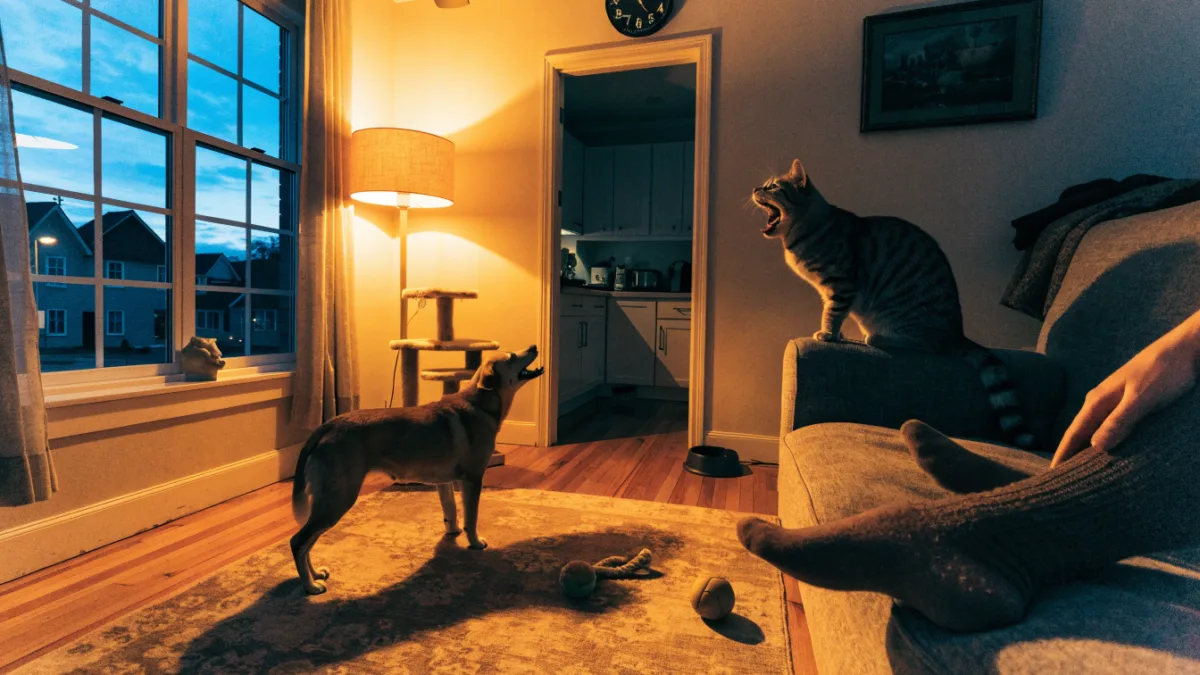
If you’ve ever been jolted awake at 3 AM by a sudden canine chorus, you know exactly how frustrating pet vocalization can get. You stumble out of bed, trying to figure out if your dog is warning you about a home invasion or just spotted a moth. Then there’s the cat crowd. A feline yowling outside your bedroom door at dawn sounds like a baby crying, and it is equally impossible to sleep through. When you’re living with a professional barker or a late-night chatterbox, it feels like you’re hosting a never-ending rock concert in your living room. But here’s the thing: your pets aren’t trying to drive you crazy. They’re just talking. To get some peace and quiet, we first have to figure out what they’re actually saying.
Decoding the Noise: What Are They Saying?
Before we can fix the noise, we have to translate it. Dogs and cats communicate for entirely different reasons, and their vocal habits are wired completely differently.
The Canine Barker
A dog’s bark is only half the message. The rest of the translation is written in their body language. I used to work with a sweet Labrador who would bark ferociously at the front window. His owner thought he was becoming aggressive. But when we looked closer, his tail was wagging in loose, full-body circles, and his ears were relaxed. He wasn’t being a guard dog—he was throwing a party because he saw the mailman and wanted to say hi.,[1] this type of greeting bark is totally different from alarm barking.
When a dog is barking out of alarm or territorial defense, their posture stiffens up. They might lean forward, hackles raised, delivering short, sharp barks. They mean business. Recognizing this difference is step one. You can’t manage the barking until you know why the alarm is going off.
The Feline Chatterbox
Cats operate on a completely separate wavelength. In the wild, adult cats rarely meow at other adult cats. They outgrow it. So, who are they talking to when they meow? They are talking to us.
A cat meowing all night has learned a very specific lesson: vocalizing gets a human’s attention. Whether they want food, play, or just for you to wake up and acknowledge their existence, the meow is a demand. I had a client who complained that her Siamese cat would scream outside her door from 2 AM to 5 AM. She admitted she would eventually get up and give the cat a few treats just to quiet her down. I had to break the news: she was being trained by her cat. The cat was essentially operating a vending machine—insert loud scream, receive salmon treat.
How to Stop Dog Barking: Managing the Environment
Let’s be real for a second. The hardest part of living with a vocal dog is the neighborhood tension. Excessive pet vocalization is one of the leading causes of friction between neighbors. If you’re stressed about getting a noise complaint, your dog isn’t going to magically sense your anxiety and pipe down. You need a proactive strategy.
Proactive Trigger Avoidance
If you know exactly what sets your dog off, your best bet is to manage the environment before the barking even starts. [2] I see all the time involves outdoor cats. You have neighborhood felines getting into midnight turf wars outside your window, which triggers your dog to bark at the chaos. You can’t train the neighborhood cats to get along, but you can block the sensory input. Close the windows. Draw the blinds. Put on a loud box fan or a white noise machine to drown out the caterwauling. If your dog can’t hear the alley fight, they won’t join in with their own commentary.
Management isn’t about avoiding training; it’s about stopping the rehearsal of a bad habit. Every time your dog barks at a trigger, they are practicing the behavior. Cut the practice sessions.
Teaching the “Quiet” Cue
Here is where a lot of owners mess up. When their dog starts barking, they yell, “NO! QUIET!” The problem? Your dog doesn’t speak English. They just think you’re barking, too. It adds to the excitement rather than stopping it.
Teaching a [3] relies entirely on positive reinforcement. Here’s the breakdown:
- Allow your dog to bark a few times at a legitimate trigger.
- Hold up a high-value treat (like a piece of real meat or cheese) right to their nose.
- Calmly say “Quiet.” The act of sniffing the treat forces them to physically stop barking.
- The second they are silent, mark it with a “Yes!” and give them the treat.
Repeat this consistently. Over time, you phase out holding the treat to their nose, and eventually, the word “Quiet” alone becomes the cue to stop. Remember to reward heavily. You want silence to be more rewarding than the act of barking.
The Ultrasonic Device Debate
When frustration hits, people often turn to quick fixes. Ultrasonic anti-barking devices have flooded the market, promising to stop noise instantly. These emit a high-frequency sound whenever a bark is detected. But animal behaviorists and veterinarians widely criticize them, and I refuse to recommend them. These devices emit a frequency that can cause anxiety, stress, and even physical pain. They are entirely indiscriminate—if your neighbor’s dog barks, your dog gets punished. If a squirrel triggers the device, your dog gets punished. It creates a terrifying environment for your pet. Stick to positive reinforcement and skip the punishment tools.
Surviving the Midnight Chatterbox: Cat Meowing All Night
Dealing with a nocturnal cat requires a totally different playbook. If your feline friend is keeping you up, you have to address both their physical needs and their learned behaviors.
Tire Them Out and Fill the Tank
Cats are crepuscular, meaning they are most active at dawn and dusk. To get them to sleep through the night, you have to mimic a natural hunting cycle right before bed. Get a wand toy or a laser pointer and run them ragged for fifteen minutes. Once they are panting a little, give them a big meal in a puzzle feeder. A tired, fed cat is a sleepy cat. Using a puzzle feeder also prevents those 4 AM hunger meows, keeping their brain occupied while you sleep.
The Tough Love of Ignoring
This is the hardest part for owners. If you have ruled out medical issues and your cat is just meowing for attention, you have to completely ignore them. Do not yell at them. Do not tell them to shut up. Do not throw a pillow. Do not get up and feed them. Any reaction from you—even a negative one—is still attention. You have to be more stubborn than the cat. It might take a week of absolute misery, but once the cat realizes the vending machine is broken, the cat meowing all night will stop.
When It Isn’t Behavior: Feline Cognitive Dysfunction
There is a crucial exception to the “ignore the cat” rule. If you have an older cat who has recently started wandering the house and yowling at night, do not punish or ignore them. Recent veterinary studies have highlighted this as a primary symptom of Feline Cognitive Dysfunction (FCD), which is essentially feline dementia. The cat isn’t being a jerk; they are confused and disoriented. If your senior cat develops this habit, schedule a vet visit. There are medical interventions and environmental adjustments that can help ground them and reduce their anxiety.
Barker vs. Chatterbox: Who Wins the Nuisance Award?
Which is more disruptive to a neighborhood: a dog or a cat? It’s highly subjective, but they cause friction in different ways. A dog’s bark is deep, carries far, and triggers a primal territorial response in other dogs. One barking dog on the block easily sets off three more. It feels aggressive and intrusive.
A cat’s vocalization, on the other hand, is usually higher-pitched and deeply grating. A mating caterwaul or a territorial yowl sounds like someone is being murdered in the alleyway. While it might not trigger your neighbor’s dogs, it will absolutely ruin a good night’s sleep. Local municipalities and Homeowner Associations are actually updating their noise ordinances because of this, moving away from automatic fines toward requiring evidence-based logging of pet vocalization or mediation between neighbors before taking legal action. People are realizing that these issues require conversation, not just citations.
At the end of the day, managing pet vocalization is about setting clear boundaries through positive reinforcement and understanding why your pet is making a racket. But remember, the best way to manage feline noise is to keep your cats indoors. Not only does it prevent them from getting into the territory disputes that trigger your dog, but it also protects the local ecosystem. Free-roaming outdoor cats severely impact local wildlife, particularly vulnerable songbird populations. Keeping your pets safely inside, mentally stimulated, and properly trained keeps them quiet, keeps you sane, and keeps the neighborhood wildlife safe.
Sources
- According to the ASPCA — aspca.org
- A common scenario — quora.com
- reliable "Quiet" cue — vet.tufts.edu