

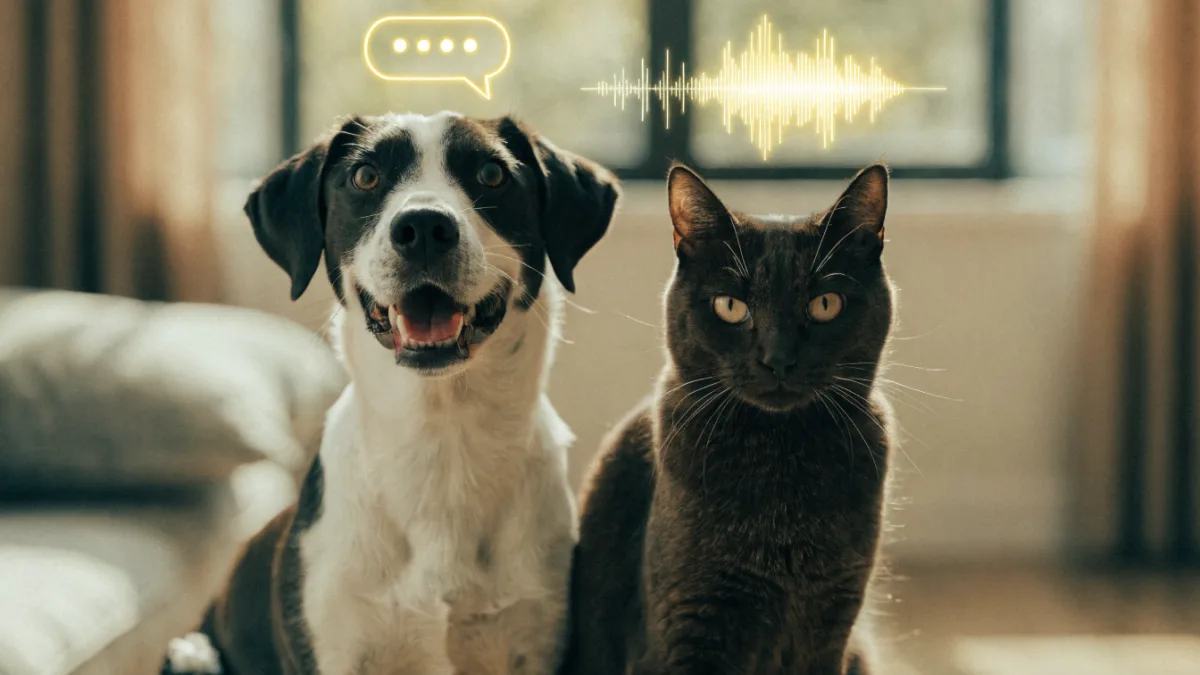
If you’ve ever watched a dog try to play with a cat, you already know that interspecies communication is mostly a high-stakes game of charades where nobody knows the rules. Take my dog, Barnaby, and my roommate’s cat, Mochi. Barnaby sees Mochi lying on the floor, belly exposed. To Barnaby, this is a universal, hard-coded invitation for a wrestling match. To Mochi, this is a combat-ready stance, all four sets of claws primed and ready to disembowel a snout. It is a total breakdown in translation. Watching them navigate each other’s social cues made me realize how much we take for granted when it comes to animal behavior. Dogs and cats don’t just speak different languages; they live in entirely different communicative realities.
The Vocal Gymnastics of Cats vs. the Canine Bark Machine
When we think about our pets talking, we usually think about the noises they make. But the vocal gap between dogs and cats is massive. According to behavioral research,,[1] ranging from trills and chatters to full-bodied yowls. Dogs, on the other hand, are working with a much smaller playlist of about ten distinct sounds—mostly variations of barks, growls, whines, and howls.
You’d think having a larger vocabulary would make cats easier to understand, but you’d be wrong. Dogs use their limited sounds to broadcast their emotions to the group. A sharp bark means “alert!” A high whine means “I want that.” Cats, however, developed their massive vocal repertoire for highly specific, close-range communication.
The most fascinating part? Adult cats rarely meow at other cats. The classic “meow” is an evolutionary adaptation developed almost exclusively to communicate with humans. They literally developed a specific accent just to manipulate us into topping off their food bowls. Mochi has a specific, broken-pitched squeak she uses only when she wants me to open a door, and a demanding, operatic yowl for treats. I’m basically a well-trained servant responding to highly specific audio cues.
Evolutionary Baggage: Why They Speak Differently
To understand why dogs and cats misread each other so spectacularly, we have to look at their ancestors. According to,[2] both species use three primary channels to communicate: visual signals (body language), vocal signals, and olfactory communication (scent marking). But how they prioritize these channels depends entirely on their evolutionary history.
The Pack Animal
Dogs evolved from wolves, highly social pack animals that needed to work cooperatively to hunt and survive. Because they live in groups, dogs developed highly expressive, almost exaggerated body language. A wagging tail, a play bow, or exposed teeth are all meant to be clearly read from a distance by other members of the pack. They want their intentions to be obvious.
The Solitary Assassin
Cats, by contrast, evolved as solitary hunters. They didn’t need to coordinate with a pack to bring down a mouse. Because they hunt alone and are both predators and prey, feline body language is incredibly subtle, fluid, and designed to avoid attracting unwanted attention. A cat’s body language is nuanced—a slight backward flick of an ear or a millimeter shift in pupil dilation can speak volumes to another cat, while completely flying under the radar of a clumsy, exuberant dog.
The Classic Misinterpretations
Because dogs are loud billboards and cats are silent ninjas, their interactions are ripe for comedic—and sometimes painful—misunderstandings. Here are the classic breakdowns in their translation matrix:
- The Tail Wag: If Barnaby wags his tail, he is genuinely happy or excited. If Mochi swishes or thumps her tail, she is annoyed, overstimulated, or preparing to strike. A dog seeing a thumping cat tail thinks, “Friend!” A cat thumping its tail is actually thinking, “One more step and I will ruin your day.”
- The Belly Flash: As mentioned, a dog rolling over is usually showing submission or asking for affection. When a cat rolls over and exposes its belly, it’s showing “defensive trust.” They are showing you their most vulnerable area, but they are absolutely not inviting you to touch it. They are essentially loading their weapons. When a dog goes in for the belly rub, the cat deploys the claws.
- The Play Bow vs. The Bum-Up: A dog’s play bow (front down, back up) is an invitation to chase or wrestle. A cat’s version of “let’s play” is usually dilated pupils, a twitching butt, and a silent pounce. When a dog tries to join in a cat’s solo hunt-the-mouse-toy session, the cat usually views the dog as an irritating, heavy-footed interruption.
Do They Actually Understand Us, or Are They Just Humoring Us?
There is an ongoing, sometimes heated debate among pet owners and ethologists: who understands us better? Dogs seem to hang on our every word. They learn dozens of commands, respond to their names, and famously perk up at the word “walk.” Cats, notoriously, will stare at you blankly when you call their name, leading many to assume they just aren’t as intelligent.
The Canine Brain on Human Speech
Recent developments in neuroscience—specifically,[2]—prove that dogs process human language very similarly to how we do. They process meaning in the left hemisphere of the brain and intonation (tone of voice) in the right hemisphere. They aren’t just reading our body language; they are actually parsing our vocabulary.
The Feline Veto
But feline behaviorists are quick to point out that this isn’t a matter of intelligence; it’s a matter of domestication and motivation. Dogs were bred to work alongside humans, to follow commands, and to please us. Cats, largely speaking, domesticated themselves. They moved into our barns and granaries because we attracted tasty rodents.
Modern “cat-friendly” cognition studies done in homes (because cats are impossible to train in sterile labs) reveal that cats absolutely recognize their owners’ specific voices. They just possess a charming evolutionary lack of drive to obey or react on command. As feline behaviorists often note, cats understand us perfectly well. They simply reserve the right to decline the invitation.
The Guilt Trip
This brings up another fascinating debate: anthropomorphism. We love projecting human emotions onto our pets. If a dog looks “guilty” after tearing up a sofa cushion, we assume they feel remorse. But researchers argue the dog isn’t feeling guilty at all—they are simply displaying submissive, appeasing body language in response to the angry, tense tone of your voice. They aren’t sorry they ate the couch; they are just trying to defuse your bad mood.
Lost in Translation: Can They Learn Each Other’s Languages?
If dogs and cats are speaking entirely different languages, how do multi-pet households ever survive without turning into a 24/7 wrestling ring? The truth is, with time, proper introductions, and a lot of patience, they can learn each other’s dialects.
According to [3] cats and dogs can absolutely learn to read each other’s visual and scent cues to coexist peacefully. Mochi and Barnaby eventually figured it out. Barnaby learned that Mochi’s twitching tail meant “back off,” and Mochi learned that Barnaby’s play bow was harmless, if incredibly annoying. They never became the snuggling, Instagram-perfect pair I secretly wanted them to be, but they established mutual boundaries and a healthy respect for each other’s space.
If you’re navigating this in your own home, the key is management and observation rather than forcing a friendship. Let them communicate on their own terms, interrupt the play before it tips into overstimulation, and always provide high escape routes for the cat. (If you’re looking to actually train the dog to give the cat space, you’ll have to defer to Jake’s expertise—I’m strictly here to translate the feline side of the equation).
Ultimately, bridging the communication gap between species requires patience, a good sense of humor, and realistic expectations. Our pets aren’t tiny humans in fur coats; they are brilliantly complex creatures with their own rich, ancient languages. Learning to read those signals—rather than forcing them to speak ours—is what makes living with them so endlessly fascinating.
And while we’re talking about giving animals the space to be their natural, wild selves, it’s worth remembering that this communication gap doesn’t just exist in our living rooms. Feral cats and free-roaming dogs interact with local wildlife using those exact same instincts. Keeping our cats safely indoors, or providing them with secure outdoor enclosures (often called “catios”), and ensuring our dogs are leashed in natural areas doesn’t just protect vulnerable local bird and small mammal populations from our expert hunters—it keeps our fiercely independent felines safe from the unpredictable language of the wild.
Sources
- cats can make over 100 different vocal sounds — facebook.com
- animal behavior experts — vettechcolleges.com
- behavioral observations on interspecies communication — quora.com