

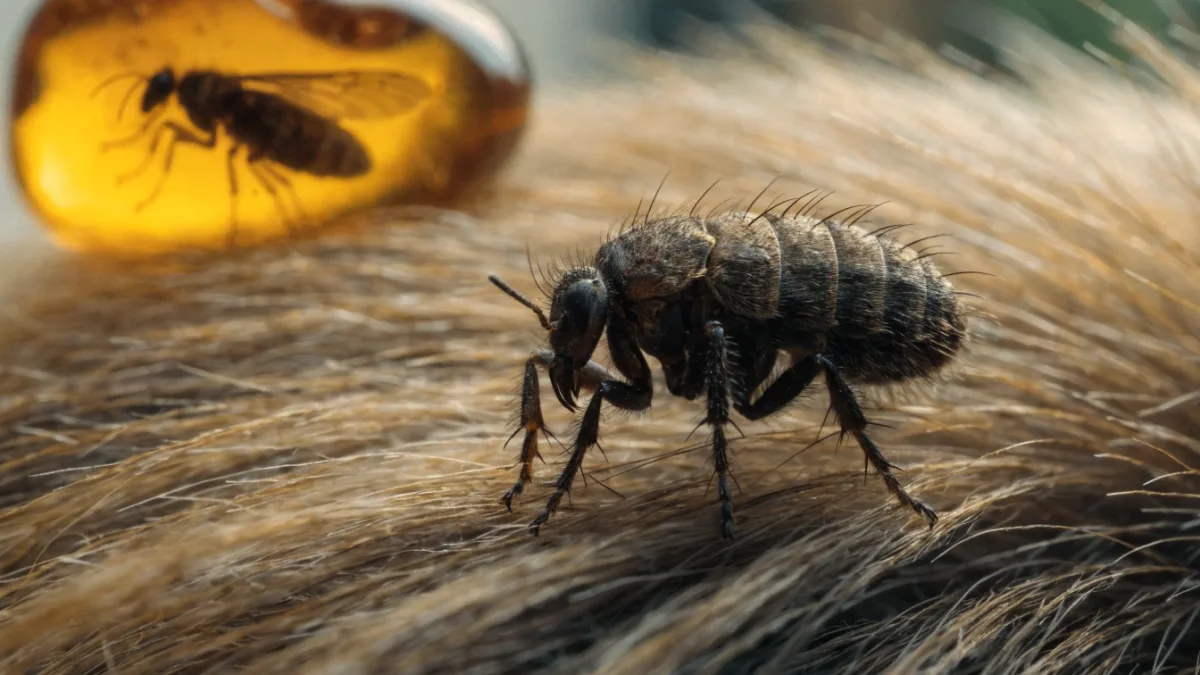
Picture a spring appointment: an owner named Margot brings her three-year-old Border Collie, Jasper, into the clinic. Jasper had been scratching relentlessly, and Margot was frustrated. “I don’t understand it,” she said, gesturing at the tiny dark specks she’d combed off his back. “We live in a high-rise, he barely touches grass, and somehow he’s got fleas.” The diagnosis—Ctenocephalides felis, the common cat flea, which despite its name happily infests dogs—comes with an explanation that surprises most owners. These tiny, maddening insects have been perfecting their craft for roughly 150 to 200 million years. They’ve survived mass extinctions, outlived dinosaurs, and adapted to an almost unimaginable variety of hosts. Ask why they’re so hard to get rid of, and the answer is genuinely evolutionary. The flea on Jasper’s back is the product of an ancient and remarkably successful biological story.
When Fleas Weren’t Fleas at All
To understand how fleas became the parasites we know today, you have to travel back to the Jurassic or early Cretaceous period. The ancestors of modern fleas weren’t bloodsucking parasites—they were free-living insects called scorpionflies (order Mecoptera), and they looked very different from the flattened, wingless pests we find on our pets.
Scorpionflies are still around today. They’re slender, winged insects that typically feed on dead insects, nectar, or decaying organic matter. Some species even have an interesting habit of hanging around animal nests and dens, scavenging on shed skin, hair, and other debris. Scientists believe this nesting association was the gateway to parasitism. Early flea ancestors likely started visiting animal nests for food, and over thousands of generations, some began feeding directly on the animals themselves.
What’s fascinating is the transitional path. These insects didn’t jump straight from scavenging to blood-feeding. Research suggests there was a prolonged “hitchhiker” phase, where early proto-fleas used small mammals primarily for transport—climbing aboard to move from one location to another. Over time, the host stopped being just a vehicle and became a food source. Blood is nutrient-rich and always available if you’re already living on the animal providing it. This reliable, concentrated food supply drove the evolutionary changes that eventually produced true fleas.
The Great Dinosaur Debate
Here’s where paleoentomologists get into spirited arguments. For decades, the accepted view was that fleas originated on early mammals and only later expanded to birds. But in recent years, extraordinarily well-preserved fossil fleas from the Mesozoic era have emerged from China, and some of these ancient specimens were enormous—up to ten times the size of modern fleas, with robust mouthparts designed to pierce thick skin.
Some researchers argue these giant fleas fed on feathered dinosaurs or pterosaurs, which would push the origins of flea parasitism further back and complicate the mammal-first narrative. Others maintain that these giant forms represent a separate, now-extinct lineage and that the fleas ancestral to modern cat and dog fleas still emerged primarily on small mammals. The debate is ongoing, and as someone who finds this history endlessly fascinating, I think the truth likely involves some overlap—early fleas may have exploited multiple host types during the chaotic ecological reshuffling of the Mesozoic.
How Fleas Found Our Dogs and Cats
The fleas on modern canids—dogs, wolves, foxes, jackals—don’t come from a single evolutionary lineage. This is one of the most surprising things I learned when I first dug into the parasitology literature. Research compiled on fleas as parasites of the family Canidae.[1] The flea species found on wild and domestic canids originated from multiple prehistoric host groups, including rodents, birds, insectivores like shrews and moles, and other carnivores.
What happened was host-switching, and it’s a defining feature of flea evolution. When prehistoric carnivores crossed paths with rodents in shared dens, or when birds nested in the same areas as early dog-like predators, fleas seized opportunities. A flea that had been feeding on a vole would hop onto a passing fox, find the blood equally nutritious, and establish a new lineage on a new host. Over evolutionary time, these opportunistic jumps accumulated. The flea population on any given canid species today carries the genetic echoes of dozens of ancient host associations.
I think about this when clients are surprised that their indoor cat has fleas. The cat flea, Ctenocephalides felis, is one of the most adaptable parasites on the planet. It doesn’t strictly need cats—it infests dogs, raccoons, opossums, foxes, and dozens of other mammals. That flexibility is exactly what millions of years of host-switching produced. The flea doesn’t care whether it’s on a pampered Persian or a feral opossum. It cares about warm blood and dense fur.
Built to Hold On: The Anatomy of a Fur Survivor
When you look at a flea under a microscope—and I’ve spent more time doing this than I’d like to admit—you notice something remarkable. Cat and dog fleas are covered in thick, backward-pointing bristles, and they possess specialized enlarged combs called ctenidia on their heads and bodies. There’s typically one comb on the head (the genal comb) and another behind the first pair of legs (the pronotal comb).
These combs aren’t decorative. They’re evolutionary engineering. Think about the challenge a flea faces: it lives on an animal that is constantly moving, scratching, biting, and grooming. The host’s immune system wants it gone. The host’s teeth and claws are designed to remove foreign objects from fur. A parasite that gets easily dislodged doesn’t survive to reproduce.
The ctenidia function like anchors. When a host tries to scratch or bite at a flea, the combs catch in the fur and resist the pulling force. The backward-pointing bristles mean the flea slides easily forward through the hair but resists being dragged backward—the direction a grooming animal would pull. This adaptation is a direct evolutionary response to the grooming behavior of mammalian carnivores. Cats are particularly fastidious groomers, which is why the cat flea has evolved some of the most pronounced ctenidia of any flea species. The arms race between host grooming and flea anchoring has been running for tens of millions of years.
Evolution in Real Time
Here’s what I tell clients who feel defeated when a flea treatment doesn’t work as expected: you’re witnessing evolution in real time. A [2] documents increasing genetic resistance in flea populations to common preventative medications, including oral isoxazolines and topical treatments that were highly effective just a decade ago.
This shouldn’t surprise us. Fleas have short generation times and produce enormous numbers of offspring. A single female cat flea can lay 40 to 50 eggs per day. When you have millions of fleas reproducing rapidly under selective pressure from a pesticide, the few that carry resistance genes survive and pass those genes forward. This is natural selection happening on a timescale we can actually observe—usually within five to ten years of a new treatment becoming widely used.
There’s also a broader ecological shift happening. As climate change alters the ranges of wild canids like coyotes and foxes, and as feral cat populations expand into new territories, the fleas these animals carry are bringing pathogens—Rickettsia bacteria, tapeworms, and in some regions even Yersinia pestis, the bacterium responsible for plague—into closer contact with domestic pets. The evolutionary story of fleas isn’t just history. It’s still being written, and our pets are part of it.
The Taxonomic Shake-Up
One more nerdy detail I find delightful: for decades, scientists couldn’t agree on where fleas belonged in the tree of life. Their bodies are so modified for parasitism—wingless, flattened, with specialized mouthparts—that they barely resemble any other insect group. They were given their own order, Siphonaptera, and treated as a separate evolutionary branch. Modern molecular phylogenetics has changed that. DNA analysis confirms that fleas are actually a highly specialized lineage [3]—the scorpionflies. Some taxonomists argue we should drop Siphonaptera entirely and classify fleas as a family within Mecoptera. I’ve changed my own thinking on this as the evidence has accumulated. Nature doesn’t care about our categories, and the genetic story is clear: fleas are scorpionflies that took a very peculiar evolutionary turn.
Why This Ancient History Matters Now
I understand the impulse to just want fleas gone—and believe me, after treating thousands of uncomfortable, miserable patients over the years, I’m not romanticizing them. They cause genuine suffering: allergic dermatitis, secondary skin infections, anemia in severe infestations, and disease transmission. Working with your veterinarian on evidence-based prevention and treatment is essential, and I always recommend consulting your vet before starting or changing any flea medication, since dosing depends on your pet’s weight, health status, and individual needs.
But I also think there’s value in pausing to appreciate what fleas represent. They’re one of the oldest parasite lineages on Earth, and their success is a testament to the power of evolutionary adaptation. In wild ecosystems, fleas play roles we rarely consider—they’re food for other insects, and the constant pressure they exert on wild animal immune systems has shaped the evolution of mammalian immunity itself. When we eradicate them from our pets, we’re pushing back against an ancient, deeply entrenched biological relationship.
That doesn’t mean we shouldn’t push back. Jasper the Border Collie went home flea-free, and Margot learned to maintain prevention year-round. But the next time you find one of these tiny insects on your pet, I hope you’ll see it not just as a pest to be eliminated, but as a survivor from the age of dinosaurs—a creature whose ancestors outlasted extinction events and adapted to nearly every furry host the planet has produced. We don’t have to like them. But after 200 million years of evolution, they’ve certainly earned our grudging respect.
Sources
- reveals an incredibly diverse ancestral picture — pmc.ncbi.nlm.nih.gov
- growing body of veterinary research — canineculture.ca
- within the Mecoptera — britannica.com