

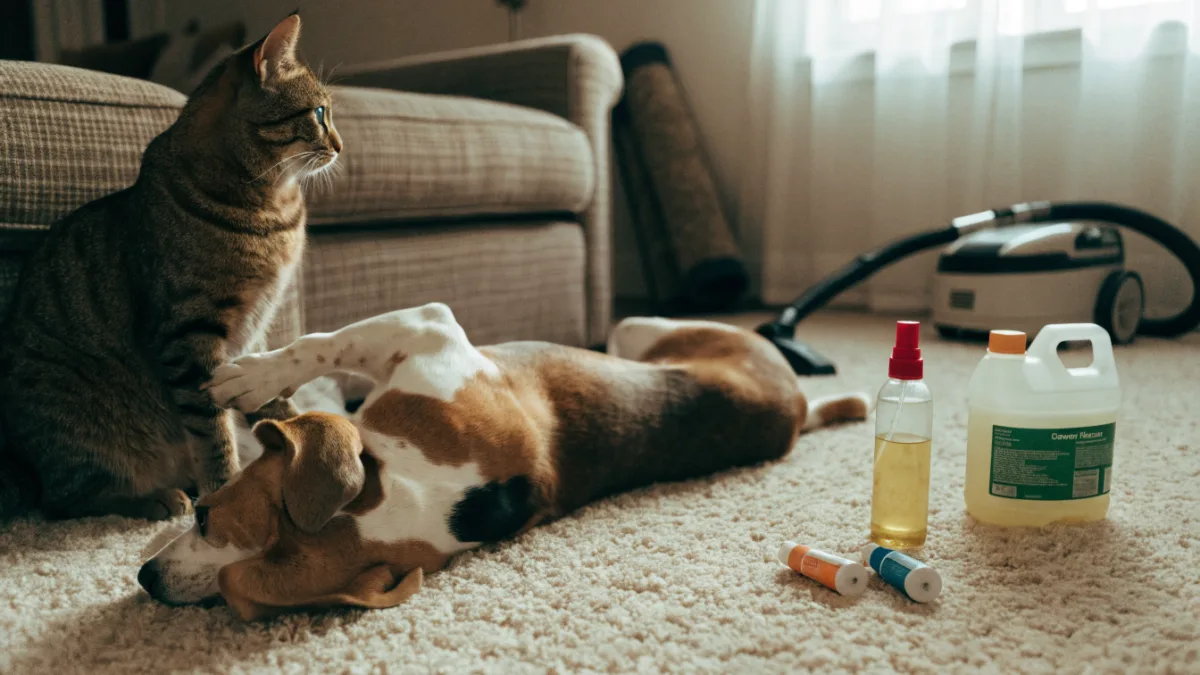
The flea infestation in my home started the way most slow-motion disasters do: with one flea on Biscuit, the dog, a single dose of treatment, and me declaring victory on a Tuesday. Three weeks later my ankles looked like a connect-the-dots puzzle, and Cricket — my strictly indoor cat, a cat who has never voluntarily touched grass — was scratching behind her ear with the grim focus of someone drafting a formal complaint. That’s when I finally understood what every multi-pet household eventually learns: fleas on dogs are a symptom. A flea infestation in the home is the actual disease, and treating only the pet is like bailing a boat without patching the hole.
The Iceberg Problem: Why Treating Only the Pet Fails
Here’s the statistic that rearranged my brain: at any given moment, only about 5% of the fleas in your house are on your pets. The other 95% — roughly 50% eggs, 35% larvae, and 10% pupae — is living in your carpet, your couch cushions, and the gap under the baseboards. Your itchy dog is just the visible tip of a much grosser iceberg.
And the iceberg grows fast. A female flea starts laying eggs within a day or two of her first blood meal and can produce 40 to 50 eggs per day — up to around 2,000 in her lifetime. The eggs aren’t sticky, so they roll off wherever your pet sleeps, walks, or dramatically flops over. Every untreated pet is essentially a walking salt shaker of future fleas.
Warm-climate readers, I have news: fleas do their best work at 70–85°F with about 70% humidity, so if your winters are a rumor, you have flea season all year. And one twist — the “cat flea” (Ctenocephalides felis) is the species infesting most dogs and cats in North America. There is no separate dog problem and cat problem in a multi-pet home. There’s one shared flea economy, and everyone’s enrolled.
Week One: Shock and Awe
Treat every pet — yes, even the indoor cat
Every dog and cat, on the same day, with a vet-approved product. Every 30 days. No exceptions — and the indoor-only cat is not an exception.
Cricket getting fleas despite never leaving the house was my proof: indoor cats share the environment, and fleas are spectacular hitchhikers. Treating one pet and not another doesn’t slow the infestation — it gives fleas both a safe harbor and a snack bar.
The usual strategy is two-layered: a fast-kill oral adulticide for immediate relief (nitenpyram starts killing adult fleas within about 30 minutes) plus a longer-acting monthly preventative. Which product suits which pet depends on species, size, age, and health, so this is a “call your vet” moment, not a “grab whatever’s shiny at the store” moment.
One thing I will be bossy about, because it’s safety: some dog flea products contain permethrin, which is genuinely toxic to cats. Cats groom constantly, so anything on their coat ends up in their mouth. In a mixed household, tell your vet exactly who lives with you.
The same-day deep clean
When the pets get treated, the house gets treated the same day — otherwise newly hatched fleas simply board the next warm body. The advice from,[1] and multi-pet guides like [2] lines up with what worked for me:
- Wash everything washable — your bedding, pet bedding, the blanket your dog has secretly claimed — on the hottest cycle it survives. Flea eggs and larvae die at high heat.
- Anything unwashable (that ancient stuffed pet bed, I’m looking at you) is a candidate for the trash. It was Biscuit’s favorite. It was also a flea nursery.
- Vacuum everything, then take the bag or empty the canister outside immediately. A sealed bag left indoors is just flea daycare.
Weeks Two and Three: The Pupal Counterattack
Just when you’re feeling smug, the counterattack arrives. Flea pupae encase themselves in sticky, nearly indestructible cocoons that insecticides barely touch, and they can sit dormant for months. They hatch in response to vibration, warmth, and carbon dioxide — which is why infestations famously flare the moment a family returns from vacation and the house starts breathing again.
Here’s the part nobody warns you about: even a perfect treatment produces new adults for two to four weeks, because already-cocooned pupae are unkillable and on their own schedule. Seeing fleas in week three doesn’t mean you failed. It means the stragglers are emerging into a world where every pet is now a poison trap instead of a buffet.
Keep vacuuming — daily if you can, every other day if you can’t. An Ohio State University study found vacuuming killed 96% of adult fleas and 100% of younger stages in carpet, and the vibration coaxes stubborn pupae into hatching early, which is exactly what you want. Veterinary parasitologists like Dr. Michael Dryden at Kansas State argue that consistently treated pets become “living vacuums” that clear a home over two to three months. My take, especially in a warm climate with a heavy infestation: do both.
The Room-by-Room Battle Plan
Carpets, rugs, and floors
The front line. Vacuum daily to every other day for two to four weeks — slow, overlapping passes, including the edges, because eggs and larvae collect along baseboards. Wash small rugs hot. For a deeply infested wall-to-wall carpet, a steam clean reaches fibers and crevices vacuuming can’t.
Furniture and dark corners
Flea larvae avoid light, so they’re not hanging out in the middle of your kitchen tile. They’re under couch cushions, under the couch itself, under beds, and in floorboard cracks. Run the vacuum’s crevice tool along every baseboard and beneath every piece of furniture that has ever been warm and dark — including under the bed, which in my house is Cricket’s summer palace.
The yard: fight the shade, not the lawn
Fleas dry out and die in open sun; their strongholds are shaded, humid spots — under the porch, beneath shrubs, the doghouse, the damp dirt where your dog naps. Keep grass short, rake leaf litter, and power-wash patios and hard surfaces, a tactic that came up repeatedly in [3] along with isolating pets in a clean room during the heaviest treatment days. For garden areas, beneficial nematodes — microscopic worms that hunt flea larvae in soil — can be watered into shaded spots and actually earn their keep.
Day 30: Victory Conditions
Day 30 isn’t the finish line; it’s the end of the intensive assault phase. Many vets recommend keeping every pet on preventatives for at least three months to catch pupae still lurking in dormancy, because cocoons don’t read calendars. And the uncomfortable truth about “treatment failure” is that missed or late doses are usually the real culprit — gaps in the schedule hand the infestation a restart button.
Skip the flea bombs, by the way. Foggers are widely considered ineffective: they don’t reach under furniture, leave no residual action, and spread chemicals everywhere except the dark crevices where larvae actually live. And since fleas are more than an itchy annoyance — they transmit tapeworms and the bacteria behind cat scratch disease, and flea allergy dermatitis is among the most common skin conditions in dogs and cats — any pet who’s scabby or miserable gets a vet visit, not just more vacuuming. One honest note on modern options: long-acting oral preventatives (some last up to 12 weeks, a gift for multi-pet compliance) are highly effective, and their labels note rare neurologic events — a reason to have the product conversation with your vet rather than guessing.
Thirty-one days after my siege began, Biscuit was flea-free, Cricket had forgiven me (mostly), and I’d developed a personal relationship with my vacuum. Fleas are parasites with no fan club and no spot on any endangered list — nobody is building them a sanctuary — but I’ll admit grudging respect: a creature that senses carbon dioxide across a room and outproduces a printing press is a genuinely impressive piece of evolution. You don’t beat that with one dose and optimism. You beat it by understanding the life cycle, treating every pet on the same day every month, and attacking the environment the other 95% calls home. With warmer climates stretching flea season into a year-round engagement almost everywhere, the old calendar-based approach to cat flea control is officially retired. Consistency isn’t glamorous. It’s just the thing that works.
Sources
- PetMD — petmd.com
- this one from HardyPaw — hardypaw.com
- owner threads about persistent infestations — facebook.com