

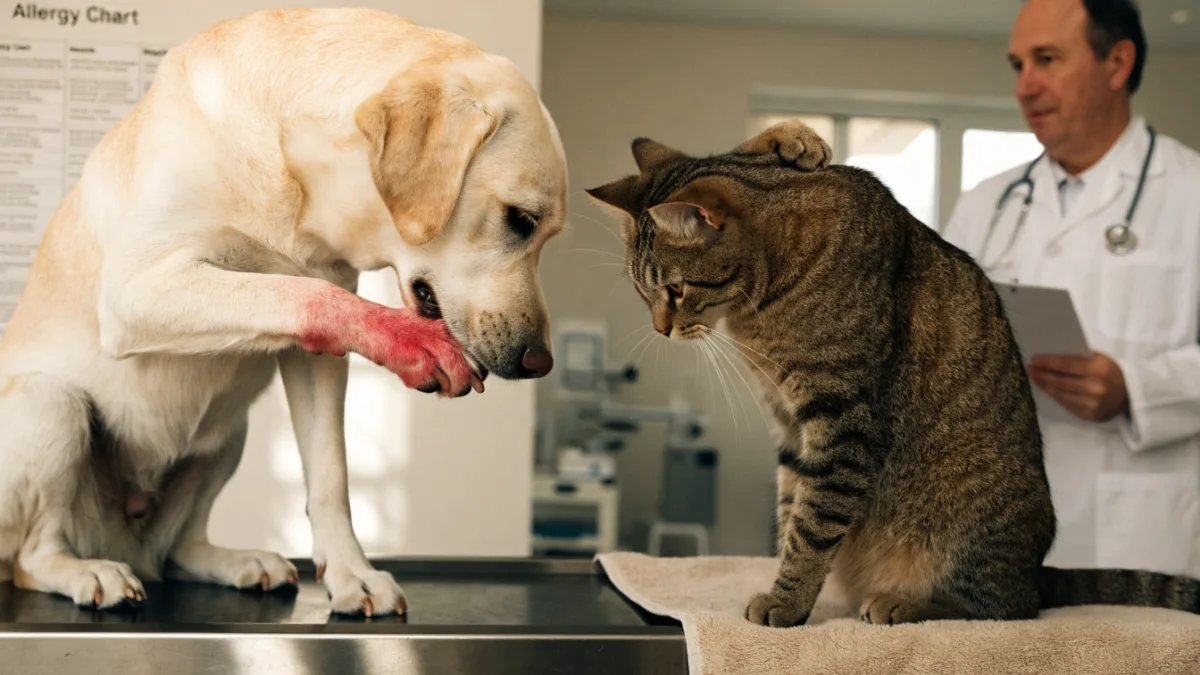
Not long ago, I had a new patient named Cooper, a three-year-old Golden Retriever with ruby-red paws. His owner, Mark, looked exhausted and told me they hadn’t slept through the night in weeks because Cooper was constantly chewing at his feet. That same afternoon, I saw Luna, a five-year-old domestic shorthair cat who had licked her belly entirely bare and created raw patches on her neck. Both owners asked me the exact same question: “What is making my pet so itchy, and is it their food?”
Itching—what we call pruritus in the medical world—is one of the most common reasons pets end up in my exam room. But figuring out the root cause of the itch requires playing detective. We generally group allergies into two main categories: food allergies and environmental allergies (atopy). To complicate things, dogs and cats often present these conditions entirely differently. Let’s break down the itch equation and look at how food allergies in dogs differ from environmental allergies in our feline friends.
The Itch Distribution: Paws and Ears vs. Faces and Necks
When I’m trying to solve an allergy mystery, the first clue is always where the pet is scratching. Dogs and cats tend to follow very different patterns.
In dogs like Cooper, environmental allergies and food allergies often both target the feet and ears. If a dog comes in with recurrent ear infections and is chewing their paws until they are raw, allergy is at the top of my differential list. The constant licking creates a warm, moist environment between their toes, which is the perfect breeding ground for secondary yeast or bacterial infections.
Cats, on the other hand, are notorious for what I call the “head and neck” presentation. When a cat has an environmental allergy—triggered by things like pollen, dust mites, mold, or even flea saliva—they often develop severe, intense itching around their face, ears, and neck. Luna, for example, had created nasty scabs (miliary dermatitis) all under her chin. Cats will also often groom their bellies and hind ends obsessively, sometimes to the point of removing all the hair, leaving owners wondering if the cat has a behavioral issue rather than a physical one.
To quantify the severity, I always ask owners to grade their pet’s itchiness on a scale from 0 to 10. A 1 or 2 is normal scratching. If we are hitting a 7 or 8, we know we are dealing with a severe, mind-consuming itch that requires immediate medical intervention. You can read more about the specific differences in allergy triggers through resources like.[1]
The “Grain-Free” Myth and True Dietary Culprits
What Actually Causes Food Allergies
Whenever I suggest a food allergy, without fail, an owner will say, “But I feed a grain-free diet!” I completely understand the impulse. We’ve been heavily marketed the idea that corn, wheat, and soy are the enemies of pet health. But I’ve changed my mind on this over the years as the research evolved.
The veterinary consensus is clear: food allergies in pets are almost always triggered by animal proteins, not grains. The most common dietary culprits are beef, dairy, chicken, and fish. Pets are exposed to a wide variety of processed food proteins, flavorings, and colorings in commercial diets. Over time, the immune system can mistakenly flag one of these proteins as a dangerous invader, mounting an allergic response that results in severe, non-seasonal itching.
In fact, food allergies only account for about 10% of all skin allergies in companion animals. That means nine times out of ten, the itch is environmental. However, for that 10%, the relief they find from changing their diet is life-changing.
Seasonal vs. Year-Round
One of the best ways to distinguish between food and environmental allergies is to look at the calendar. Environmental allergies are often highly seasonal. If your dog only chews their paws in September, we are likely looking at a ragweed or pollen allergy. Food allergies, however, are non-seasonal. The dog or cat itches in January just as intensely as they do in July.
Playing Detective: Why We Trust Elimination Diets
If you’ve spent any time researching pet allergies online, you’ve probably seen ads for mail-in saliva or hair tests that claim to diagnose allergies. I strongly advise saving your money. Most veterinary dermatologists consider these diagnostic tools highly unreliable. I’ve seen them come back telling owners their dog is allergic to “distilled water” or “sunlight”—which simply isn’t scientifically possible.
Diagnosing a food allergy requires a strict 8-to-12-week dietary elimination trial. There is no shortcut, no simple blood test that can definitively diagnose a food allergy. For those two to three months, the pet must eat nothing but a specially formulated hypoallergenic or novel-protein diet. No flavored toothpaste, no dropped cheese from the kitchen floor, no chewable heartworm medication flavored like beef.
I always recommend prescription diets for these trials rather than over-the-counter “limited ingredient” diets. Studies have shown that many commercial diets marketed as limited ingredient are often cross-contaminated with trace amounts of unlisted proteins during the manufacturing process. If a food is accidentally contaminated with a trace of chicken, and your dog is allergic to chicken, the trial fails, and we are back to square one. You can read more about the strict requirements of.[2]
The Modern Medicine Cabinet: Biologics and Immunotherapy
Years ago, if a pet came in with severe environmental allergies, our only real weapon was corticosteroids. While steroids stop the itch, they come with a host of side effects like increased thirst, urination, and long-term organ stress. Thankfully, veterinary medicine has experienced a revolution in recent years.
We now have targeted injectable medications known as biologic therapies (monoclonal antibodies). For dogs, these targeted injections specifically neutralize IL-31—the exact itch-inducing molecule in the bloodstream. It’s like turning off a light switch; the itch signal never reaches the brain, and it does so without the side effects of traditional steroids. We are seeing incredible breakthroughs in this space for cats as well.
For environmental allergies, we can also offer immunotherapy. For cats especially, Sublingual Immunotherapy (SLIT) drops or injections are becoming increasingly refined. We test the cat for specific environmental allergens (like dust mites or specific pollens) and then create a customized “vaccine” that slowly desensitizes their immune system. Instead of just masking the symptoms, we are actually retraining the immune system not to overreact. You can explore more about how these conditions are diagnosed and treated at.[3]
Breaking the Vicious Cycle of Secondary Infections
Whether the root cause is a chicken allergy or a dust mite sensitivity, the outcome is the same: scratching. And scratching damages the skin’s natural protective barrier. Once that barrier is broken, naturally occurring bacteria and yeast on the skin seize the opportunity to multiply.
This results in secondary bacterial or yeast skin infections. These infections are incredibly painful and itchy on their own, creating a vicious cycle where the pet itches, gets an infection, and itches even more. When I see a patient for allergies, managing these secondary infections is just as critical as addressing the underlying allergy. We often use medical-grade medicated shampoos, wipes, or oral antibiotics to clear up the infection before we can truly assess how much of the remaining itch is coming from the allergy itself.
One Health: Our Pets and the Planet
As we wrap up the itch equation, it’s worth taking a step back to look at the bigger picture. The rise in environmental allergies in our pets mirrors the rise in human allergies. As our environment changes, urbanization increases, and exposure to chemicals and pollutants rises, our immune systems—and those of our pets—are forced to adapt. This concept, known as “One Health,” highlights the deep connection between human health, animal health, and our shared ecosystem.
While our domesticated dogs and cats are incredibly lucky to have access to advanced dermatology and hypoallergenic diets, their wild counterparts rely on pristine environments to thrive. The very allergens that trouble our pets—pollens, molds, and dust mites—are natural parts of the ecosystem. Protecting natural habitats ensures that wild canids and felids have balanced environments where they can thrive without the stressors of artificial pollutants or degraded ecosystems. By understanding our pets’ health on a microscopic level, we become better stewards of the planet we all share.
Sources
- Lollypop Farm's guide to environmental vs. food allergies — lollypop.org
- food allergies in dogs and cats via the Veterinary Partner network — veterinarypartner.vin.com
- Small Door Veterinary's allergy resource center — smalldoorvet.com