

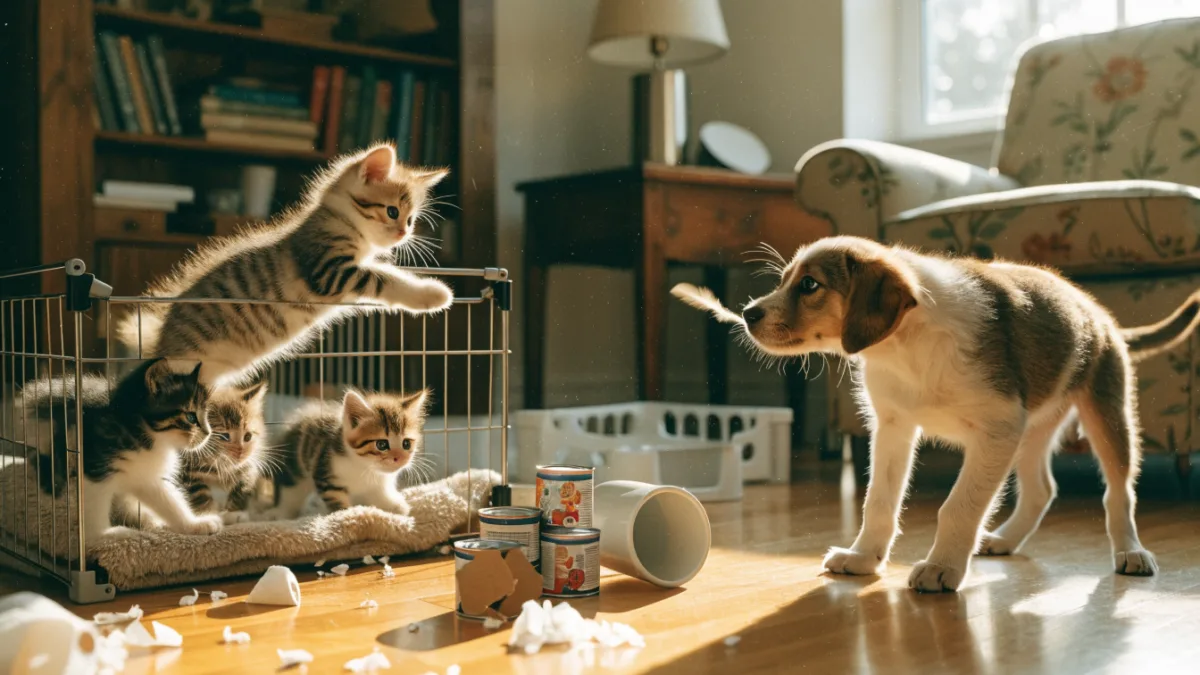
Fostering might be the closest thing to a superpower that exists in the animal welfare world. You take a fragile, terrified, or sick animal into your home for a few weeks, socialize them, and then hand back a confident, healthy pet who is ready to be adopted. The shelter handles the medical care and usually sends you home with a starter kit of food, bedding, and medications. All you provide is the time, the space, and a willingness to have your sleep schedule completely wrecked.
But here’s what nobody tells you until you’re standing in your living room with a carrier full of fuzz: preparing for a litter of kittens is a fundamentally different project than preparing for a rescue puppy. I’ve done both, and I have the chewed baseboards and underwear-drawer cat nests to prove it.
The Real Cost of Fostering (Spoiler: It’s Mostly Emotional)
Let’s clear up the money thing first, because it stops a lot of people from ever signing up. Most reputable shelters and rescues provide everything. Food. Formula. Bottles. Litter. Medications. A crate or playpen. You name it, they hand it to you in a brown paper bag at pickup. The Humane Society of Silicon Valley and organizations like Best Friends Animal Society operate this way, and local rescues generally follow the same model because they need fosters to function.
The actual cost is your sanity and your schedule. Neonatal kittens—those under four weeks old who still need bottle feeding—eat every two to four hours. Around the clock. Yes, that includes 2 AM. Yes, that includes when you have work the next morning. Puppies aren’t quite as demanding on the clock, but they make up for it by being physically destructive in ways that make you question your interior design choices.
Preparing for Kittens: Tiny Ninjas with Zero Self-Preservation
Containment Is Non-Negotiable
Kittens are small enough to fit inside a Pringles can and stupid enough to try. Your first job is to create a space they cannot escape and cannot hurt themselves in. A spare bathroom is the gold standard. It’s small, it’s easy to sanitize, and there are limited hiding spots. A playpen works too, but I’ve watched a three-week-old kitten scale the side of one like a furry little mountaineer, so choose wisely.
What you absolutely cannot do is give them free roam of your house. Not yet. Not until they’re bigger, coordinated, and have enough sense to not wedge themselves behind your refrigerator.
The Hazard Hunt
Walk into your kitten room and look at it from the perspective of something that weighs twelve ounces and explores the world with its face. Now remove everything that could kill it.
- Electrical cords are basically chew toys. Get cord protectors or unplug and hide everything you can.
- Toxic plants need to leave the premises entirely. Lilies will kill a cat. Not “might make them sick”—kill them. If you’re not sure whether a plant is safe, assume it isn’t.
- Gaps and crevices are the enemy. Block off under beds, behind appliances, inside reclining furniture (recliners are genuinely dangerous—kittens love to crawl into the mechanism), and anywhere a tiny body could get stuck.
Temperature Matters More Than You Think
Here’s something that surprised me the first time I fostered neonatal kittens: they can’t regulate their own body temperature. You’re not just feeding them. You’re being their thermostat. You’ll need a safe heat source—a heating pad on a low setting designed specifically for pets, with a non-heated area nearby so they can crawl away if they get too warm. I learned this the hard way when my first litter kept piling into a corner and crying, and I couldn’t figure out why until I realized the room was too cold for them even though it felt fine to me.
Preparing for a Rescue Puppy: A Wrecking Ball with Whiskers
Puppy-Proofing Goes Beyond Baby-Proofing
Babies eventually learn not to eat shoes. Puppies take considerably longer, and in the meantime they’ll destroy things you didn’t even know were destructible. I came home once to find a foster puppy had systematically dismantled a throw pillow into what can only be described as a indoor snowstorm. The stuffing was everywhere. He was thrilled.
For puppies, the preparation is more about containment and management than creating a sterile bubble. You need:
- Secure trash cans with lids that latch, or keep them behind closed doors.
- Shoes, socks, and children’s toys picked up and stored out of reach. Always. No exceptions.
- Household chemicals locked away—under the sink, in the garage, anywhere curious mouths might explore.
- A crate that’s the right size. Not too big, not too small. The crate is your sanity saver when you can’t directly supervise.
I’ll defer to dog trainers like Jake for the actual crate training methodology, because that’s a whole skill set unto itself. But having the crate set up and ready before the puppy arrives is essential.
Yard Safety Check
If you have a yard, do a sweep before the puppy arrives. Check fencing for gaps—dogs will dig under, squeeze through, or find the one loose board you’ve been meaning to fix for two years. Remove any toxic plants, check for mushrooms (especially after rain), and clean up any animal feces left by other creatures. Your yard should be boring and safe, not an obstacle course of potential gastrointestinal emergencies.
The Socialization Window: Your Real Job
Here’s where fostering gets scientifically interesting. Both puppies and kittens have a critical socialization period—roughly three to fourteen weeks for puppies and two to seven weeks for kittens—when their brains are uniquely primed to accept new experiences as normal. Positive exposure to different people, sounds, textures, and handling during this window literally shapes how confident and adaptable they’ll be as adults.
For kittens, this means gentle handling, exposure to normal household sounds, and introducing them to a variety of people. For puppies, it means all of that plus careful, positive exposure to the world outside your home—surfaces, other vaccinated dogs, car rides, different environments.
What you’re doing during those few weeks isn’t just keeping them alive. You’re building the foundation for the rest of their lives. A well-socialized foster animal is dramatically less likely to end up back in the shelter with behavioral issues.
The Emotional Reality
People always ask how I can give them back. The honest answer is that it’s hard every single time, and it gets easier and harder simultaneously. Easier because you trust the process. Harder because you remember each one.
There’s a running joke in rescue circles about “foster fails”—when you end up adopting your foster because you can’t bear to let them go. It’s funny and it happens, but shelters gently discourage it when they can. Every foster home that becomes a permanent home is one less foster home available for the next litter coming in. The goal is to save as many as possible, and that means saying goodbye so you can say hello to the next one.
There’s also the harder truth that not every foster makes it. Fading kitten syndrome, parvovirus, panleukopenia—these are real risks, especially with animals pulled from shelters where disease spreads easily. Shelters prepare you for this possibility, and it’s devastating when it happens. But even the ones you lose were loved and cared for in their final days, which matters more than most people realize.
Why Fostering Matters More Than Ever Right Now
Roughly 6.3 million companion animals enter US shelters every year, and about 920,000 are euthanized. Those numbers have gotten worse since the pandemic. Adoption rates dropped as inflation squeezed household budgets, veterinary staffing shortages stretched resources thin, and surrender rates climbed as people returned to offices. Meanwhile, warming temperatures have extended “kitten season”—that annual flood of underage kittens pouring into shelters—making it longer and more intense than ever.
Fostering is the bottleneck fix. Shelters physically cannot house and hand-raise every neonatal kitten or puppy that comes through their doors. They need people willing to open their homes for a few weeks, do the messy work of early care, and then send these animals off to their forever families.
If you’ve been on the fence about fostering, call your local shelter. They’ll walk you through it, supply you, and match you with an animal that fits your experience level. You don’t need to be perfect. You just need to be willing. The mess is temporary. The impact lasts a lifetime—for them, and honestly, for you too.