

There is a local hardware store near my house that sells exactly zero things I need on a regular basis. Yet, I find myself wandering its aisles at least twice a week. Why? Because there is a massive, slightly overweight Golden Retriever named Leo who holds court next to the paint supplies. I have spent actual money on sandpaper I didn’t need just to justify standing there petting him for ten minutes. Animals in businesses aren’t just cute anomalies; they are powerful, tail-wagging, purr-inducing economic engines. But it goes far beyond a dog napping by the register. We are in an era where library cats, office kittens, and even reptiles are completely reshaping how we interact with our local spaces, and honestly, it’s the best workplace revolution we could ask for.
From Pest Control to Public Relations
The concept of an animal in a public space isn’t new. Historically, the classic “library cat” was hired for strictly practical, highly unsentimental reasons: to hunt the mice that were chewing through the rare book collections. They were employees of the pest control variety, paid in room and board.
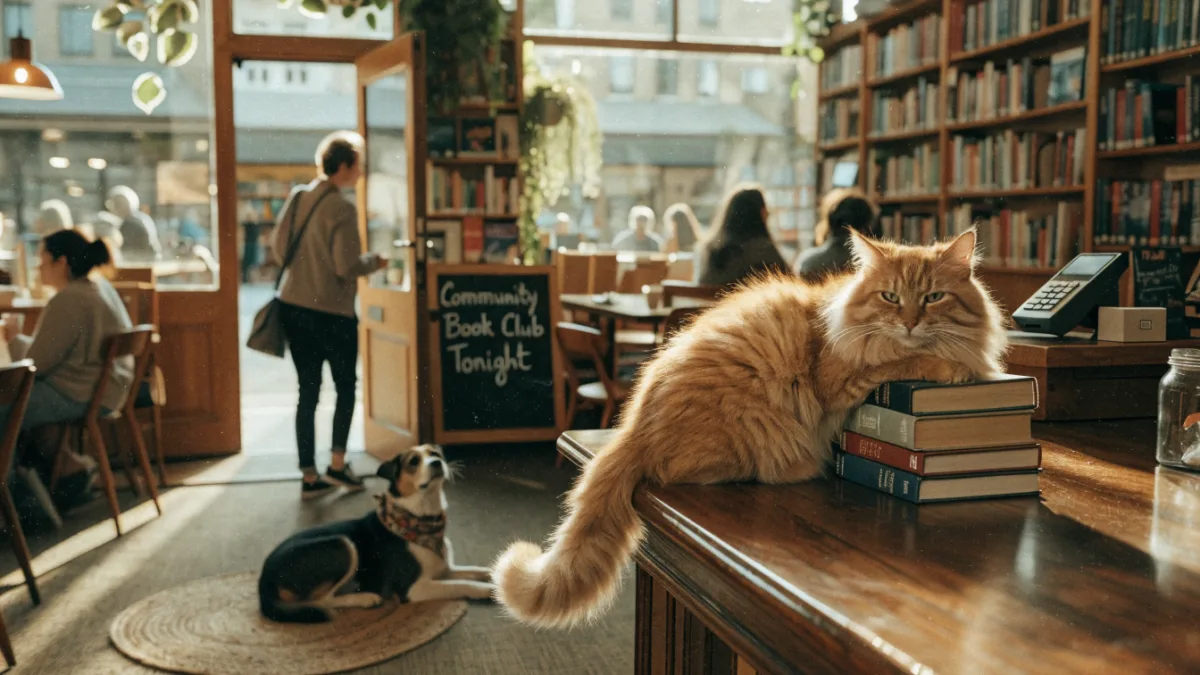
Today, the job description has changed dramatically. Modern libraries have realized that to stay relevant, they need to be community hubs, and nothing builds community quite like a resident animal. I’ve watched my own cat, Barnaby, completely transform the energy of my home office just by existing in the background. Libraries have taken this concept and scaled it up. A resident library cat provides a moment of stress relief for stressed-out college students. Even better, many libraries have,[1] moving from mousers to full-time public relations ambassadors. They are the furry glue holding the community together.
“I’d Like to Check Out a Spreadsheet, and Also a Kitten”
If you thought library cats were the peak of animal integration, wait until you hear about the corporate office “Cat Library.” Yes, this is a real thing. Some modern offices have essentially set up an internal foster system where employees can literally “check out” a kitten to take to their desks for temporary companionship.
When I first,[2] I laughed out loud. But then I thought about the reality of the modern workday. The post-pandemic push to get people back into physical office spaces has been… awkward. Companies are desperate for ways to lure people out of their sweatpants and away from their home setups. Enter: the desk kitten.
Research from places like Virginia Commonwealth University has shown for years that pets in the workplace significantly reduce employee stress and increase job satisfaction. But beyond the science, there is just the fundamental reality that work is boring, and a tiny fuzzy creature attacking your cursor makes a tedious Tuesday drastically better. The kittens get socialized for future adoption, the employees get a mental health break, and the office actually feels alive. It’s a chaotic, brilliant system. If my cat Barnaby could survive the commute, I’d absolutely be checking him out for desk duty. (Though, knowing him, he’d unplug the office router within ten minutes.)
The Economics of a Store Dog
Let’s talk about the actual financial impact of a store pet. If you run a local business, a resident animal is essentially a low-cost, high-return marketing department. I will freely admit that I have mapped out my weekend errands purely based on which establishments have a dog I can pet. I’ve bought overpriced candles at a boutique just to say hi to the store pug.
Store dogs—and resident cats—drastically increase foot traffic and dwell time. People stay longer. They browse more. They pull out their phones, take photos, and post them on social media, giving the store free organic advertising. I leave the specific obedience training to the experts like Jake, but I will say this: a well-socialized, mellow dog lying on a dog bed next to the checkout counter creates an atmosphere that no amount of expensive storefront lighting or curated playlists can replicate. It signals that a business is welcoming, relaxed, and run by actual humans.
Navigating the Multi-Species Meet-and-Greet
Things get particularly fascinating when businesses and libraries start mixing species. Public spaces are increasingly partnering with local animal organizations to turn their facilities into hubs for both human and animal welfare. For example, the [3] to host socialization and adoption events, inviting the public in to interact with the animals.
But how do you do that safely when you’re bringing naturally opposing animals—or just wildly different species—into the same room? It’s not as simple as throwing a bunch of puppies and kittens on a rug and hoping for the best. Facilities are getting incredibly smart about controlled socialization. They use physical tools like tarps to visually separate dogs and cats while still allowing them to safely co-exist and smell each other in the same room. It allows for behavioral socialization without triggering prey drives or overwhelming a nervous rescue.
It’s Not Always Sunbeams and Purring
I know what you’re thinking: Surely this can’t work for everyone. And you’re right. As much as I love the idea of a cat rubbing against my leg while I browse for novels, we have to talk about the realities of mixing animals with the general public.
Allergies and Accessibility
The biggest hurdle for libraries and retail stores is severe allergies. A business has to weigh the therapeutic benefits of a resident animal against the comfort and accessibility of all patrons. While a store dog might draw me in, it might completely exclude someone with a severe pet dander allergy. Balancing the joy these animals bring with the need to keep public spaces accessible under laws like the Americans with Disabilities Act is a real, constant tension.
Phobias and Animal Welfare
Then there are the phobias. Cynophobia (fear of dogs) and ailurophobia (fear of cats) are very real. A giant, friendly lab bounding up to a customer can be a disaster if that customer is terrified. And finally, we have to consider the animals themselves. Is a busy, noisy retail floor a low-stress environment for a cat? Debates about animal welfare frequently pop up, which is why it’s crucial for any business with a resident pet to provide proper “off-duty” spaces—a quiet back room where the animal can retreat when they’ve had enough of being a mascot. If your store cat can’t take a break, they aren’t a pet; they’re a prop.
Still, when done right—with proper boundaries, safe spaces for the animals, and consideration for the community—the presence of pets in our local businesses is a beautiful evolution. And there’s a beautiful deeper layer to this trend: so many of these library cats and store dogs are rescues. Their “employment” is often a lifelong rescue, pulling them out of shelters and giving them a purpose, a warm bed, and a community that adores them.
So, the next time you walk into your local bookstore and see a cat lounging on the checkout counter, don’t just take a photo and walk out. Recognize that this animal is doing heavy lifting—acting as a stress-reliever, an economic draw, and an ambassador for local animal welfare. And if your local hardware store happens to have a dog by the paint section… well, maybe you don’t need the sandpaper, but buy it anyway. It’s the least you can do for the emotional support.
Sources
- expanded their staff to include dogs, cats, and other critters — libbylife.com
- saw this trend making the rounds — tiktok.com
- Fayette County Library partnered with their local animal shelter — facebook.com