

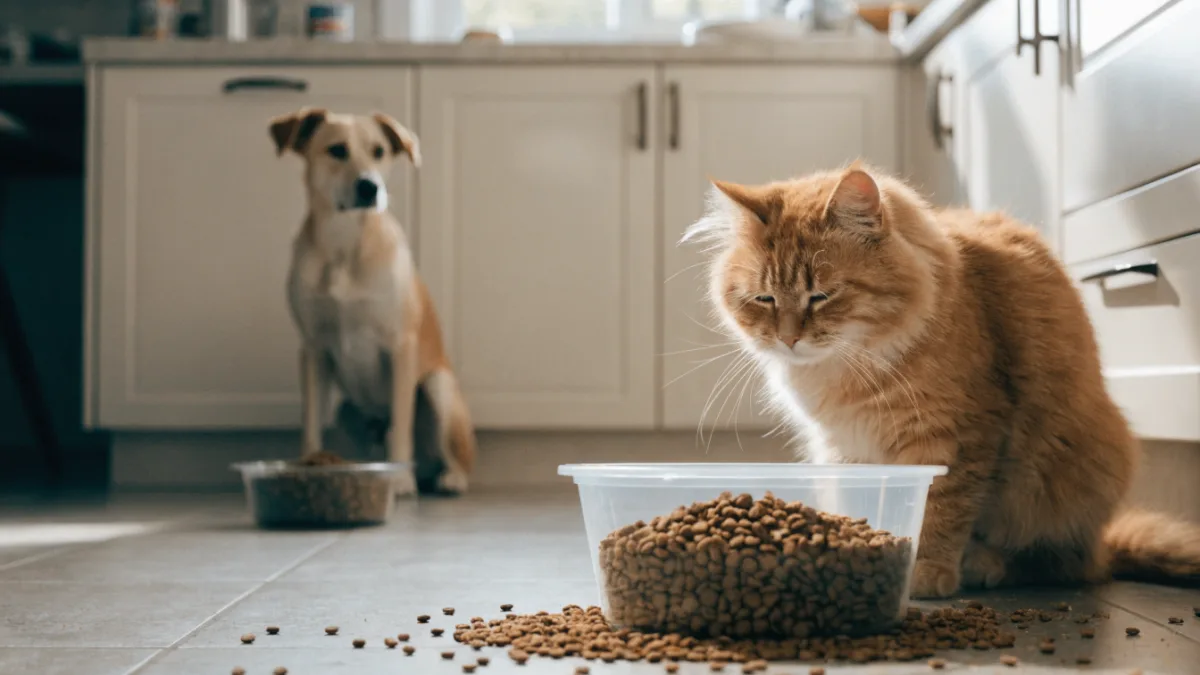
Picture a 7-year-old orange tabby named Marmalade arriving at a clinic last spring, his owner Karen baffled. “I don’t understand it,” she said, gesturing to the cat draped over her arms like a furry sandbag. “He just grazes all day. I thought cats self-regulated.” Marmalade weighed in at 18 pounds. His bowl, Karen admitted, was never empty. She’d refill it every morning before work, and it was always there waiting for him—a bottomless buffet of dry kibble.
I hear some version of this story almost every week. Free-feeding—leaving dry food out continuously so pets can eat whenever they want—is wildly popular, and I completely understand why. It’s easy. You fill the bowl, you walk away, you’re done. But as I told Karen that afternoon, what’s convenient for us isn’t always what’s best for the animals we love. And the calculus shifts depending on whether we’re talking about cats or dogs.
How Cats and Dogs Experience Food Differently
To understand why feeding strategy matters so much, it helps to step back and look at how these two species evolved to eat. Cats are what nutritionists call obligate carnivores—animals that biologically require animal protein to survive. Their wild ancestors hunted small prey like mice and voles, catching somewhere between.[1] Their entire metabolic system is built around frequent, tiny portions of protein-rich food.
Dogs, on the other hand, evolved from wolves—pack animals that hunted larger prey and consumed big meals in sittings, sometimes gorging after a kill and then fasting for days. Their digestive systems handle larger, less frequent portions far more comfortably. Most dogs do well on two meals a day, and many actually prefer the rhythm of knowing when food is coming.
“Cats are natural grazers in the wild—but what they’re grazing on is live prey they had to work to catch, not a bottomless bowl of calorie-dense kibble.”
Here’s where things get interesting. That natural feline grazing instinct is exactly what makes free-feeding seem like a natural fit for cats. And in a perfect world, it might be. But there’s a massive difference between a cat catching ten mice across a 24-hour period and a cat waddling over to an overflowing bowl of dry food every two hours. The activity level, the caloric density, and the mental engagement are completely different.
The Appeal—and the Reality—of the Always-Full Bowl
Why Owners Love Free-Feeding
I’m not going to pretend I don’t get the appeal. Free-feeding fits modern life. Between commutes, work schedules, kids, and everything else, the idea of filling a bowl once and being done is deeply tempting. [2] are either free-fed or fed on a loose twice-daily schedule, and convenience is the number-one reason owners cite.
There’s also a genuine belief among many pet parents that animals will self-regulate—that they’ll eat when they’re hungry and stop when they’re full. It’s a comforting thought. And for a small minority of pets with naturally low food drive, it occasionally works. I had a client with a whippet named Ghost who could be free-fed indefinitely without gaining an ounce. But Ghost is the exception, not the rule.
The Self-Regulation Myth
Here’s what the research actually shows: free-feeding is significantly more common among obese cats than among cats at a healthy weight. That’s not a coincidence. Domestic dogs and cats, by and large, do not reliably self-regulate their caloric intake. When highly palatable, calorie-dense dry food is available constantly, most animals will overeat.
I’ll be honest—I used to be more lenient about free-feeding cats. Early in my career, I told owners it was fine as long as the cat wasn’t gaining weight. But after years of seeing what constant access to food does to portion control, behavioral health, and my ability to monitor intake, I’ve changed my approach. The research on feline obesity and its connection to free-feeding is just too consistent to ignore.
What Gets Lost When the Bowl Is Never Empty
One of the biggest problems with free-feeding is something most owners never think about: you lose track of how much your pet is actually eating. When Marmalade’s bowl was always full, Karen had no idea whether he was eating a half-cup a day or two cups. And that matters enormously, because changes in appetite are often the first sign of illness. A cat who suddenly stops eating could have dental disease, kidney problems, or any number of serious conditions. But if the bowl is always full and always looks “about the same,” that critical early warning sign disappears.
Then there’s the behavioral dimension. A [1] marked an important shift in how veterinary behaviorists think about feeding. They argue—and I agree—that how a pet eats is just as important as what a pet eats when it comes to mental well-being.
Cats who hunt in the wild are engaged. They’re stalking, pouncing, problem-solving, and working for every calorie. Cats who eat from a never-empty bowl are… bored. And bored cats are the ones who overeat, become lethargic, and develop behavioral issues like excessive vocalization, destructive scratching, or aggression.
The Multi-Pet Household Problem
If you have both cats and dogs, you already know where this is going. Dogs will eat cat food. They will eat it every single time. Cat food is higher in protein and fat than dog food, which makes it irresistibly tasty to dogs, and leaving it out unattended is essentially an open invitation. I’ve seen dogs gain significant weight from sneaking cat food, and I’ve seen cats lose weight because the dog got there first. In multi-pet households, scheduled feeding isn’t just a preference—it’s practically a necessity.
Better Approaches: Scheduled Meals and Enrichment Feeding
So if free-feeding isn’t ideal, what should you do instead? For most cats, the sweet spot is somewhere between scheduled meals and what behaviorists call foraging enrichment—making them work a little for their food.
For cats, I typically recommend dividing their daily portion into four to six small meals throughout the day. If you work full-time, that might mean two meals before work, one when you get home, and one before bed. You can also use puzzle feeders, food-dispensing toys, or even hide small portions of kibble around the house for your cat to “hunt.” This mimics their natural feeding behavior, provides mental stimulation, and slows down their eating all at once.
For dogs, two measured meals per day works well for most breeds. Some working or highly active dogs may do better with three smaller meals. The key is measuring portions carefully—use an actual measuring cup, not a coffee mug—and feeding at consistent times.
What About Grain-Free Diets?
Since the topic of kibble often leads to questions about ingredients, I want to address the grain-free debate briefly. There’s been significant concern about grain-free dog foods and their potential link to dilated cardiomyopathy (DCM), a serious heart condition. FDA investigations and ongoing veterinary research have prompted many to reconsider whether grain-free is actually healthier—or whether it’s a marketing trend that outpaced the science. For dogs, I generally recommend diets that include wholesome grains unless there’s a diagnosed allergy requiring otherwise.
For cats, the grain-free conversation is somewhat different since cats have less dietary need for carbohydrates overall, but the bigger point is this: the ingredient profile matters far less than the overall nutritional balance, portion size, and feeding strategy. Don’t let the grain-free label distract you from the more fundamental questions about how you’re feeding.
And as always—talk to your own veterinarian before making significant changes to your pet’s diet. Every animal is an individual, and what works for one may not work for another.
Wrapping Up: Rethinking the Bowl
Karen took Marmalade’s free-feeding bowl away that week. We put him on a measured portion split into five small meals, and she started putting two of those portions in a puzzle feeder she found online. Within six months, Marmalade had lost three pounds. More importantly, Karen told me he was more active than he’d been in years—chasing the puzzle ball around the living room, actually playing with his toys again, and seeming genuinely engaged at mealtime instead of just drifting past an endless food supply.
That’s what I want for every pet. Not just adequate nutrition, but an feeding experience that respects how they evolved to eat—mentally and physically. We domesticated cats and dogs, brought them into our homes, and made them entirely dependent on us for their needs. In return, we owe them more than a full bowl and a pat on the head. We owe them feeding routines that keep their bodies healthy and their minds engaged. That’s not just good medicine. It’s a fundamental part of the responsibility we took on the day we brought them home.
Sources
- 10 and 20 small meals per day — pmc.ncbi.nlm.nih.gov
- Studies suggest that 40 to 60 percent of cats — embracepetinsurance.com