

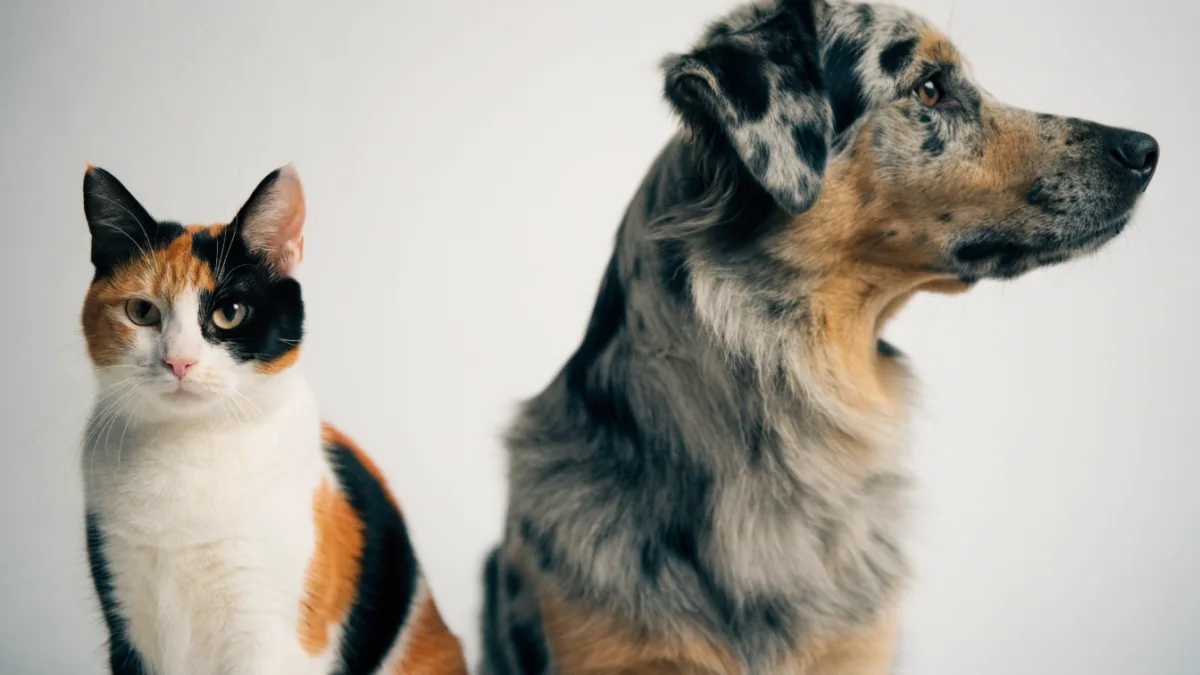
I had a conversation at a dog show last spring that stuck with me. A woman was admiring a blue merle Australian Shepherd and asked the handler if there were such things as “calico dogs.” The handler laughed it off, but the question is actually more interesting than most people realize. The answer gets at something fundamental about how genetics actually work — and why two patterns that look vaguely similar (patchy, multicolored coats) come from completely different genetic machinery.
The Calico Problem: It’s All About the X
Here’s the basic fact that starts everything: about 99.9% of calico cats are female. That’s not an accident or a statistical quirk. It’s built into the mechanism.
In cats, the gene that determines whether coat color is black or orange sits on the X chromosome. Not on a regular chromosome — specifically on the X. Females have two X chromosomes (XX), males have one X and one Y (XY). This matters enormously.
Now, a true calico has three colors: white, black, and orange. The white comes from a completely separate gene that blocks pigment production in patches — that’s the easy part. The black and orange? That’s where it gets interesting.
Imagine a female cat with one X chromosome carrying the black gene and the other carrying the orange gene. She has both. But here’s the problem: a cell can only read one X chromosome at a time. Having two active X chromosomes would produce way too much genetic material, so early in embryonic development, each cell randomly shuts down one of the two X chromosomes. This process is called lyonization, after Mary Lyon, the British geneticist who described it in 1961.
Once a cell picks an X chromosome to silence, all of its descendant cells stick with that choice. So you end up with patches of skin where the black gene is active and patches where the orange gene is active. The fur growing from those patches matches. That’s your calico.
Why Males Are Left Out
Male cats have one X chromosome. Just one. They get either black or orange from that single X, and that’s it. They can’t carry both. So a standard male cat is genetically incapable of being calico. He could be black. He could be orange. He could have white patches alongside whichever color he got. But he cannot produce both black and orange patches simultaneously.
This is why every calico you’ve ever met has been female — or almost every one. We’ll get to the exceptions.
The One in Three Thousand
Male calicos do exist. They appear at a rate of roughly 1 in 3,000 calico cats. When I first heard this number, I assumed it was exaggerated folklore. It’s not. There are documented cases going back decades, and veterinary geneticists have worked out exactly how it happens.
The most common explanation is Klinefelter syndrome. Instead of the standard XY, these cats are XXY. That extra X chromosome means a male cat can carry both black and orange, and lyonization kicks in just like it does in females. These cats are male — they have the Y chromosome — but they’re genetically intersex in a way that allows the calico pattern to express.
The other route is chimerism. This happens when two separate fertilized eggs fuse together very early in development. If one egg carried black and the other carried orange, the resulting cat is a patchwork of two different genetic individuals. Chimeras can be male or female, and they’re genetically weird in ways that go beyond coat color.
Here’s where I get annoyed. Male calicos show up in news stories and social media as “genetic miracles” worth thousands of dollars. They’re rare, sure. But most are sterile, and Klinefelter syndrome comes with a range of health issues. Treating them as collector’s items misses the point entirely. They’re living animals with a genetic anomaly, not winning lottery tickets.
Dogs Do It Completely Differently
So why don’t we call tricolor dogs “calico”? Because the underlying genetics have nothing in common.
Dogs absolutely can have three colors — white, black, and tan or orange. Think of a Bernese Mountain Dog, a Beagle, or a tricolor Border Collie. But in dogs, coat color genes are located on autosomal chromosomes — the regular non-sex chromosomes that both males and females share equally. There’s no X-chromosome roulette involved.
The tricolor pattern in dogs comes from the interaction of separate genes. One gene determines whether a dog has tan points (those reddish markings above the eyes, on the cheeks, and on the legs). Another gene independently controls white spotting. A dog inherits these genes from both parents with no connection to whether it’s male or female.
That’s why tricolor dogs appear in roughly equal numbers across both sexes. There’s no 99.9% skew. A male Beagle is just as likely to be tricolor as a female Beagle. The pattern isn’t tied to sex chromosomes because it doesn’t need to be.
The word “calico” implies that specific sex-linked genetic mechanism. Calling a tricolor dog a calico would be like calling a motorcycle a bicycle because they both have two wheels. Superficially similar, mechanically unrelated.
Merle: A Patchwork of a Different Kind
Merle is the other pattern people sometimes confuse with calico-type coloring, and it’s worth explaining because it’s genetically fascinating in its own right — and because there’s a serious ethical issue attached to it.
The merle gene creates those irregular, mottled patches you see in Australian Shepherds, Shetland Sheepdogs, Dachshunds (where it’s called “dapple”), and several other breeds. A blue merle dog isn’t actually blue — it’s a black dog with patches where the black pigment has been diluted to a grayish-blue.
The mutation that causes this was identified in 2006 by researchers at Texas A&M University. It’s a SINE insertion — essentially a bit of mobile DNA that wedged itself into the SILV gene, which plays a role in pigment production. When this mutated gene is present, it disrupts pigment in some cells but not others, creating the patchy, mottled appearance.
Merle is autosomal dominant. That means a dog only needs one copy of the mutated gene to show the pattern, and it has nothing to do with the dog’s sex. Both males and females can be merle in equal numbers.
The Double Merle Problem
Here’s where this stops being academic. If you breed two merle dogs together, each puppy has a 25% chance of inheriting two copies of the merle gene — one from each parent. These are called double merles, and the results are devastating.
Double merles are predominantly white, and a significant percentage are born deaf, blind, or both. The same gene mutation that dilutes coat pigment also affects the pigment cells in the inner ear and the eyes. When a dog has two copies, the damage extends beyond cosmetics into serious sensory impairment.
I’ve met double merle Aussies in rescue. One was completely deaf and had limited vision in one eye. She was a sweet dog — they usually are — but her life was harder than it needed to be because someone bred two merle dogs together for the sake of producing more merle puppies. There is no excuse for this. Genetic testing is cheap and widely available now. Any breeder producing merle dogs who doesn’t test their breeding stock and avoid merle-to-merle pairings is either ignorant or doesn’t care, and neither is acceptable.
The merle mutation is a single gene with a predictable inheritance pattern. We know exactly how it works. We know exactly what happens when you double it up. Continuing to produce double merles at this point is a choice, not an accident.
What This All Comes Down To
The calico cat and the merle dog look like they might be related phenomena — both patchy, both striking, both the result of genetics doing something unusual. But they’re products of completely different mechanisms. Calico is sex-linked, depends on X-chromosome inactivation, and almost exclusively affects female cats. Merle is autosomal, dominant, and affects both sexes equally. Tricolor in dogs is its own thing entirely, built from separate genes interacting without any connection to sex chromosomes.
I think the reason people find this stuff fascinating is that coat color makes genetics visible. You can literally see X-chromosome inactivation painted across a calico cat’s fur. You can see what a SINE insertion does to pigment production in a merle dog. These aren’t abstract concepts locked in a textbook — they’re walking around in front of us, wrapped around animals we live with every day.
The ethical takeaway is straightforward. We understand these genetic mechanisms now. We know which pairings produce healthy animals and which ones produce suffering. Affordable DNA testing has removed the guesswork from breeding decisions. There’s no reason to produce double merle dogs, and there’s no excuse for marketing rare male calicos as luxury pets while ignoring the health consequences of their genetic anomalies. Understanding the science means we have a responsibility to act on it.
Genetics gave us these patterns. What we do with that knowledge is on us.