

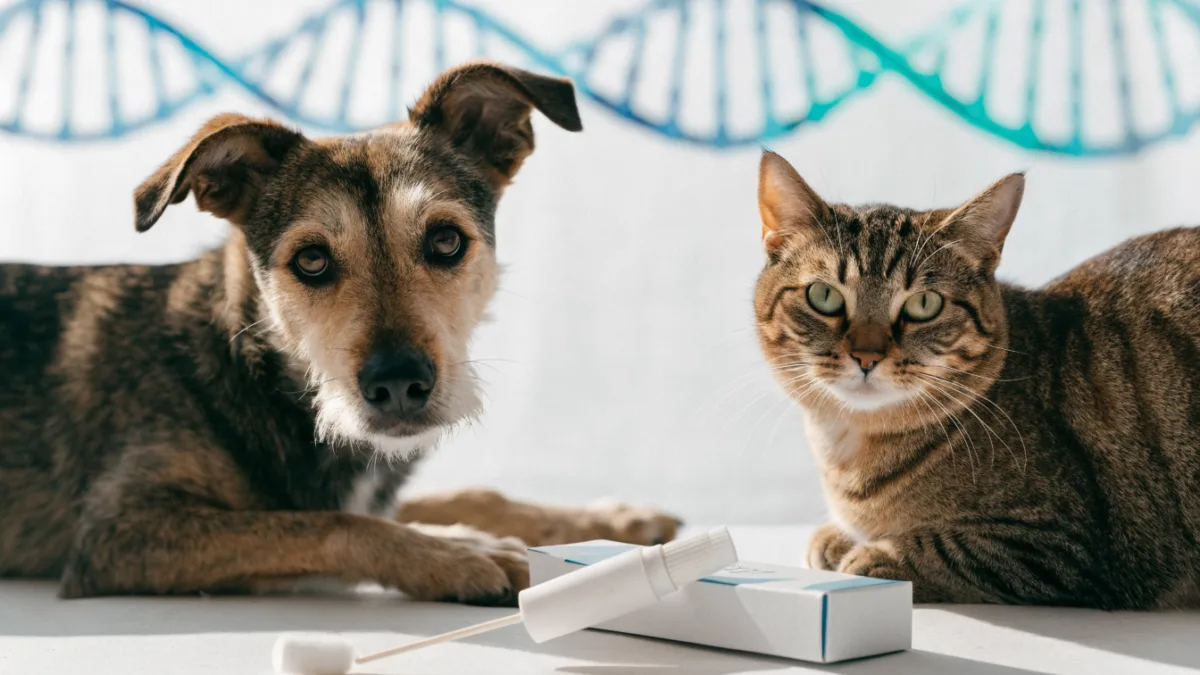
A friend of mine adopted a wiry, 40-pound mystery dog from a shelter in 2018 — one blue eye, a tail that never stopped moving, and a coat pattern that defied description. The shelter paperwork said “husky mix.” Her veterinarian suspected Australian cattle dog. The dog walker was absolutely certain there was border collie in there. So my friend spent $129 on a canine DNA kit, swabbed the inside of the dog’s cheek, mailed it off, and two weeks later learned the truth: 37% German shepherd, 21% chow chow, and the rest a scatter of breeds nobody had guessed. No husky. No cattle dog. No border collie. The dog, it turned out, was a completely different animal than anyone had imagined — and my friend’s entire approach to his exercise routine, grooming, and training shifted overnight.
That’s the promise of pet DNA testing in a nutshell. What started a decade ago as a novelty — a fun way to settle bar bets about your rescue dog’s ancestry — has evolved into something far more sophisticated. Today’s tests screen for hundreds of genetic health conditions, map family trees, and in some cases sequence nearly the entire genome. But here’s what most people don’t realize until they’re holding the results: testing a dog and testing a cat are fundamentally different experiences, rooted in how each species actually evolved alongside us. The swab is the same. What it can tell you is not.
Why Dog DNA Testing Got So Good
Canine DNA testing works as well as it does because humans spent roughly 300 years aggressively documenting every decision we made about dog reproduction. When you create a breed — locking in specific traits through generation after generation of selective breeding — you create genetic bottlenecks. Those bottlenecks leave signatures in the genome. A dog with significant German shepherd ancestry carries recognizable genetic markers clustered in ways that distinguish them from, say, a Labrador or a poodle.
The major testing companies have built enormous reference databases by collecting samples from thousands of verified purebred dogs. Embark, which emerged from Cornell University’s veterinary program and is widely regarded as the gold standard in the industry, uses a database of over 350 breeds and varieties. When your mixed-breed dog’s sample arrives at the lab, the company’s algorithms compare it against those reference panels and identify which breed signatures appear, in what approximate percentages.
The accuracy is genuinely impressive for common breeds. If your dog is 25 percent Labrador, the test will find it. Where things get fuzzy — and where you’ll see lively debates in communities like the Dogspotting Society group on Facebook — is with rare breeds, regional varieties that aren’t well-represented in the database, and dogs from populations that have been mixing freely for generations. A dog adopted from overseas, like the Russian rescue discussed in a recent Reddit thread on r/DogAdvice, may carry genetic signatures from breeds that simply aren’t well-sampled in Western databases. The test will still give you results, but they’re only as good as the reference population behind them.
The Village Dog Problem — and Why It’s Actually Fascinating
There’s a category of dog that breaks the testing system entirely, and it’s one of my favorite topics in all of canine genetics. “Village dogs” are free-ranging dogs that have lived and bred on the fringes of human settlements for thousands of years — not strays, not feral descendants of pets, but genuinely indigenous dog populations. These dogs represent some of the oldest and genetically healthiest canine lineages on earth. When you test a village dog, the results often come back as a bewildering mix of breeds that don’t quite make geographic sense. That’s because the algorithm is trying to fit ancient genetic patterns into modern breed categories. It’s like asking what “brand” of water flows in a river. The question itself misunderstands what you’re looking at.
Cats Are a Completely Different Story
I love watching cat owners open their DNA results, because there’s almost always a moment of genuine confusion. The report doesn’t say “25% Maine Coon, 15% Siamese.” It says something like “Western European breed group” or “Southeast Asian lineage.” Sometimes it just confirms what the shelter already told you: your cat is a Domestic Shorthair. People feel shortchanged.
Here’s why that happens. Dogs have been rigidly controlled by humans for centuries. We decided who mated with whom, documented it meticulously, and created closed studbooks that preserved those genetic boundaries. Cats? Cats did their own thing. Feline domestication was a loose arrangement. Humans provided grain stores that attracted mice; cats showed up to eat the mice. Nobody was keeping studbooks for the barn cats in 17th-century Anatolia. Cats roamed, mixed, and reproduced freely across vast geographic ranges. The concept of a “purebred” cat is far newer and far narrower than most people realize — recognized cat breeds number around 70-80, compared to well over 300 recognized dog breeds, and the vast majority of domestic cats worldwide belong to no breed at all.
So when a cat DNA test identifies “breed groups,” it’s not being lazy. It’s accurately reflecting the reality that most cats carry a blend of regional genetic signatures rather than discrete breed ancestry. The test is telling you something true — your cat’s ancestors probably came from a specific part of the world — even if it’s not telling you what you hoped to hear.
Health Markers: Where the Swab Earns Its Keep
Breed identification is what gets people to buy the kit. Health screening is what actually matters. This is where modern testing has moved from entertainment into something that genuinely changes how we care for animals.
A single cheek swab can now screen for over 200 genetic health conditions in dogs. Some of these are critical. Degenerative myelopathy — a progressive neurological disease that affects dozens of breeds, particularly German shepherds and corgis — can be identified through a single gene mutation called SOD1. If your dog tests clear, you can stop worrying about it. If your dog tests at-risk, you and your veterinarian can begin monitoring for early symptoms and explore interventions like physical therapy that may slow progression. The MDR1 gene mutation, common in herding breeds, causes severe — sometimes fatal — reactions to certain medications. Knowing your dog carries that mutation before they ever need treatment for a parasitic infection or a surgical procedure can literally save their life.
Cat testing has lagged behind, but it’s catching up fast. The most significant feline health marker is for hypertrophic cardiomyopathy — a thickening of the heart muscle that’s the leading cause of heart disease in cats and is especially prevalent in Maine Coons and Ragdolls. A cat carrying the HCM mutation isn’t guaranteed to develop the disease, but knowing the risk allows for regular cardiac screening that can catch problems early. Feline blood typing is another crucial development; cats have naturally occurring antibodies against other blood types, which means a mismatched transfusion can trigger a fatal reaction. Knowing your cat’s blood type before an emergency isn’t a luxury — it’s potentially lifesaving.
Some newer tests have expanded beyond genetics into microbiome analysis, attempting to identify dietary sensitivities and allergic predispositions. I’d treat this particular frontier with caution. The science connecting gut bacteria profiles to specific dietary recommendations is still developing, and I’ve seen owners make dramatic food changes based on preliminary results that their cats didn’t actually need. The DNA portion of these tests is solid. The dietary advice is speculative.
The Gene Is Not the Destiny
Here’s where I want to be direct, because I’ve watched this go sideways. A DNA test that reveals your dog carries a gene associated with a serious disease can provoke genuine panic. I’ve spoken with owners who received results showing their dog was “at risk” for degenerative myelopathy and immediately began grieving for a dog who was, at that moment, perfectly healthy and running around the yard.
Genetics involves a concept called penetrance — the likelihood that carrying a particular gene mutation will actually result in the disease. For some conditions, penetrance is nearly 100 percent. If your dog has the right genetic markers for exercise-induced collapse in Labrador retrievers, they will experience symptoms during intense activity. For other conditions, penetrance is far lower. A dog carrying the SOD1 mutation may live a full life without ever developing degenerative myelopathy. The gene is a risk factor, not a death sentence.
This is why I always tell people: bring your results to your veterinarian before you bring them to Dr. Google. A good vet can distinguish between a finding that requires immediate action, a finding that warrants monitoring, and a finding that’s clinically interesting but practically irrelevant. The Chewy education resources on pet DNA testing emphasize this same point, and they’re right to. Information without interpretation creates anxiety. Information with a plan creates better care.
Who Owns Your Dog’s Genome?
One question that gets asked far less than it should: what happens to your pet’s genetic data after the lab processes it? The answer varies by company, and it matters. Some companies explicitly state that they retain samples and genetic data for research purposes. Some share de-identified data with academic partners studying canine health, which genuinely advances veterinary medicine. Others have vaguer policies that leave room for future commercial use.
I’m not suggesting this should stop you from testing your pet. The research being done with these databases — particularly Embark’s work on the genetics of aging and cancer risk — is producing genuinely valuable science. But you’re handing over your animal’s most intimate biological information to a corporation. Read the privacy policy. Understand what you’re consenting to. If the company’s terms are opaque or change without notice, that’s worth noticing.
What These Databases Mean for the Future
The pet DNA testing industry will cross a billion dollars in annual revenue within the next few years, and that scale matters. Every sample submitted adds to our collective understanding of companion animal genetics. For rare and ancient breeds, this data has real conservation value. Genetic diversity within closed studbooks is a serious problem — many purebred dog populations have effective breeding populations smaller than some endangered wild species. Mapping that genetic diversity is the first step toward preserving it.
The same applies to those village dogs I mentioned earlier. Several research groups are using DNA submitted through consumer testing to study free-ranging dog populations worldwide, documenting genetic lineages that have existed for millennia but are disappearing as modern breeds spread globally. These dogs represent a reservoir of canine genetic diversity that purebred populations have lost. When we test them, even accidentally, we’re contributing to a record that future researchers may depend on.
That’s the real story behind the swab. Yes, it’s fun to find out your rescue is part chow. Yes, the health information can change how you care for your animal. But at scale, millions of people mailing cheek swabs to labs are collectively building the most comprehensive genetic portrait of domestic animals ever attempted. Every mystery mix, every barn cat, every village dog from a shelter in Romania adds a piece to a puzzle that stretches back roughly 15,000 years for dogs and 10,000 for cats — to the moment our species first started shaping theirs. The test in your hand isn’t just about one animal. It’s a small contribution to understanding the entire ancient, tangled, remarkable relationship between humans and the animals that chose to live beside us.