

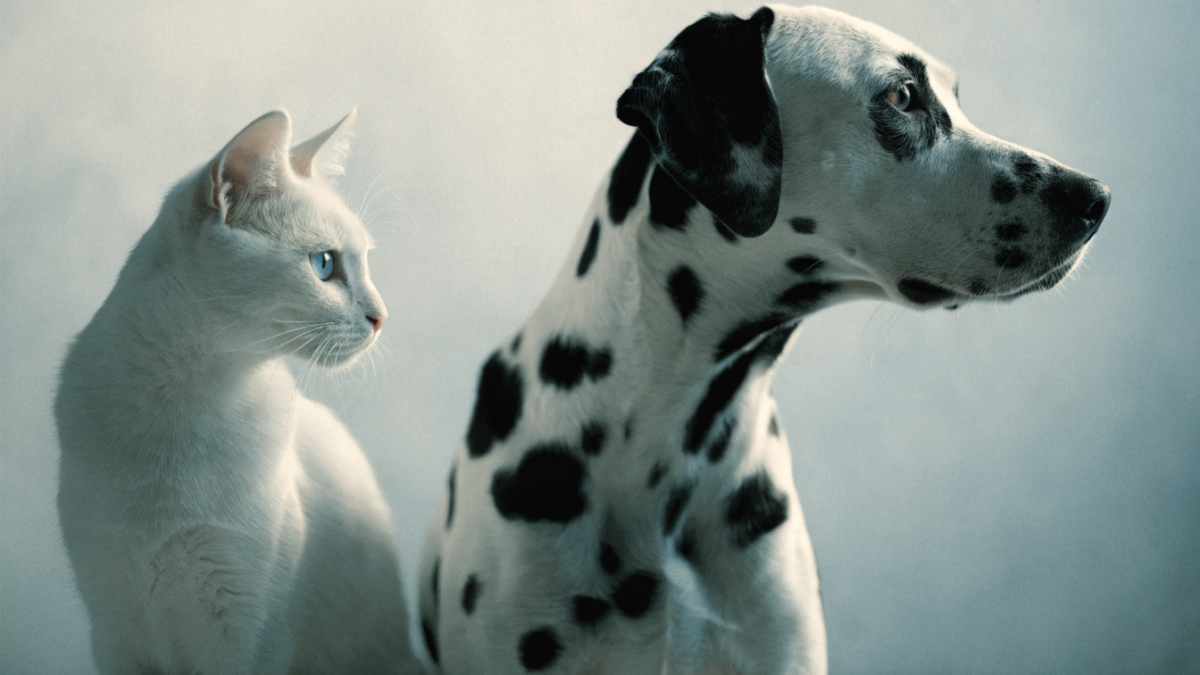
If you stand a pure white cat with piercing blue eyes next to a heavily spotted Dalmatian, you are looking at two entirely different animals that share a striking, hidden connection. They look nothing alike—one is a feline cloaked in a seamless white coat, the other a canine canvas of stark black spots. But if you could peer inside their ears at the microscopic level, you would find the exact same developmental flaw.
Despite the massive gap between a domestic cat and a coach dog, the genetics that paint a cat entirely white and the genetics that give a Dalmatian her spots disrupt the exact same cellular mechanisms in the inner ear. This shared genetic quirk binds these two animals together in ways most people never realize.
The Melanocyte Mystery: How Paint Creates Deafness
To understand why these animals lose their hearing, you have to look at the cells responsible for color. Pigment cells, called melanocytes, do more than just dictate whether an animal’s hair is black, brown, or white. They are also critical structural components in the inner ear.
During embryonic development, melanocytes originate near the neural crest and migrate throughout the body. Some travel to the skin and hair follicles to deposit pigment. Others travel into the inner ear, specifically into a structure called the stria vascularis. This structure is responsible for maintaining the electrical charge in the fluid of the cochlea. Without that electrical charge, the tiny hair cells inside the cochlea cannot convert sound waves into electrical signals for the brain.
The genetic mutations that cause a pure white coat in cats and extreme white spotting in dogs work by suppressing or halting the migration of these melanocytes. The pigment cells simply never reach the inner ear. Without them, the stria vascularis degrades. The cochlea literally collapses on itself shortly after birth. This specific inner ear pathology is known as cochleo-saccular deafness, and the damage is irreversible.
Blue Eyes, White Coats, and Feline Statistics
In the feline world, hereditary deafness is almost exclusively linked to the Dominant White (W) gene. This gene is epistatic, meaning it masks other color genes. It completely suppresses the migration of melanocytes to the hair shaft, resulting in a cat that looks like a living snowdrift.
The W gene also suppresses pigment in the iris. A lack of pigment in the eye leaves the underlying blue color visible. This is why blue eyes and white coats are so frequently linked in cats—but it is crucial to understand that the blue eyes do not cause the deafness. The W gene causes both the blue eyes and the absence of inner ear melanocytes.
I remember meeting a stunning, pure white rescue cat named Luna at a shelter a few years ago. She had one blue eye and one green eye. The staff warned me she was probably deaf. This is a common, understandable misconception. Let’s look at the actual numbers, because they tell a much more specific story:
- White cats with normal-colored eyes (green, gold, copper): Roughly 17 to 22 percent are deaf.
- White cats with one blue eye (odd-eyed): About 40 percent are deaf. In odd-eyed cats, deafness usually occurs on the same side as the blue eye.
- White cats with two blue eyes: Between 65 and 85 percent are deaf.
Luna, the odd-eyed cat from the shelter, had a 60 percent chance of having perfect hearing. She was in the lucky majority. When I clapped my hands behind her, her ears swiveled like radar dishes.
Busting the “All White Cats Are Deaf” Myth
Because blue-eyed white cats are disproportionately represented in deafness statistics, a myth began circulating that all white cats are born deaf. This is demonstrably false. Roughly 20 to 30 percent of pure white cats overall have some degree of hereditary deafness. That is a massive, statistically significant risk factor compared to the general cat population, but it still leaves a substantial percentage of white cats with flawless hearing. You simply cannot determine a white cat’s hearing status just by looking at her.
The Dalmatian Dilemma and the Extreme Piebald Gene
While the Dominant White gene is the culprit in cats, dogs face a slightly different genetic mechanism. Dalmatians carry the extreme white piebald spotting gene (the S locus).
When Dalmatian puppies are born, they don’t have spots. They are born completely white. The ticking gene (which works in tandem with the piebald gene) causes the dark spots to slowly emerge on the skin as the puppy grows over the first few weeks of life. Because the puppy starts life essentially as a blank white canvas, the piebald gene is still actively suppressing melanocyte migration. If those pigment cells are delayed or halted on their way to the inner ear during those crucial early days, the cochlea degrades.
The statistics in Dalmatians are a persistent headache for ethical breeders. About 8 percent of Dalmatians are bilaterally deaf (completely deaf in both ears). More troubling is the unilateral rate: up to 22 percent are deaf in one ear.
Unilateral deafness is practically invisible to the naked eye. A dog who is deaf in one ear still reacts to sounds, still comes when called, and might even localize sound well enough to fool an owner into thinking nothing is wrong. I’ve seen breeders and rescue volunteers swear a Dalmatian has perfect hearing, only to run a Brainstem Auditory Evoked Response (BAER) test and discover the dog is completely deaf on one side.
The BAER Test and Breeding Ethics
The BAER test is the only definitive way to measure hearing in dogs and cats. It involves placing small electrodes on the animal’s head to record the electrical activity in the brain in response to clicking sounds played through headphones. It takes about ten to fifteen minutes and gives a clear, binary reading of hearing function in each ear.
This brings up a highly contentious debate in the veterinary and breeding communities. If we know extreme piebald and dominant white genes carry a high risk of sensory deprivation, is it ethical to intentionally breed for these aesthetics?
I’ve changed my thinking on this over the years. I used to believe that as long as the dog could hear, the breeding was fine. But deliberately breeding animals for a cosmetic trait that carries a documented, high-risk chance of sensory loss feels increasingly difficult to justify. Historically, many breeders euthanized deaf Dalmatian puppies or white kittens immediately upon discovering their deafness. Modern animal advocacy rightfully pushes back hard against this. A deaf animal is not a defective animal.
Responsible Dalmatian breeders now utilize BAER testing religiously. They will not breed a bilaterally deaf dog, and most refuse to breed two unilaterally deaf dogs together. Recent advances in accessible DNA testing for congenital deafness markers allow breeders to make smarter, scientifically informed pairing decisions, slowly chipping away at those percentages with every generation.
Life at Full Volume Without Sound
If you bring a deaf Dalmatian or a deaf white cat into your life, you are not signing up for a tragic, limited existence. These animals do not know they are disabled. They do not sit around mourning the sounds they cannot hear. They interact with the world visually and through vibrations, and they adapt with a speed that puts humans to shame.
Training a deaf dog or cat relies entirely on visual cues and tactile feedback. You use a flashlight to get their attention. You stamp your foot on the floor to create a vibration they can feel through their paw pads. You teach them hand signals for basic commands—some of which are actually easier for a dog to learn than verbal commands, because dogs are incredibly tuned into body language.
I have a friend with a completely deaf Dalmatian named Echo. Echo knows over thirty hand signals, navigates agility courses by watching my friend’s body language like a hawk, and sleeps peacefully through the loudest thunderstorms. The only real environmental adjustment required for a deaf dog is ensuring they are kept on a leash in unfenced areas, because they cannot hear approaching cars or calling voices.
Embracing the Silence
Nature makes trade-offs. The exact same genetic blueprint that gives us the breathtaking visual of a blue-eyed white cat or the iconic, elegant spots of a Dalmatian is the blueprint that occasionally unplugs their ears.
When we choose to share our lives with these animals, we have to accept the whole package. We have to demand that breeders test their litters and place deaf animals in knowledgeable homes rather than discarding them. We have to recognize that while deafness requires us to alter how we communicate, it doesn’t diminish the capacity of the animal to live a rich, deeply connected life. Whether they hear the world at full volume or experience it in total silence, they are still entirely whole.