

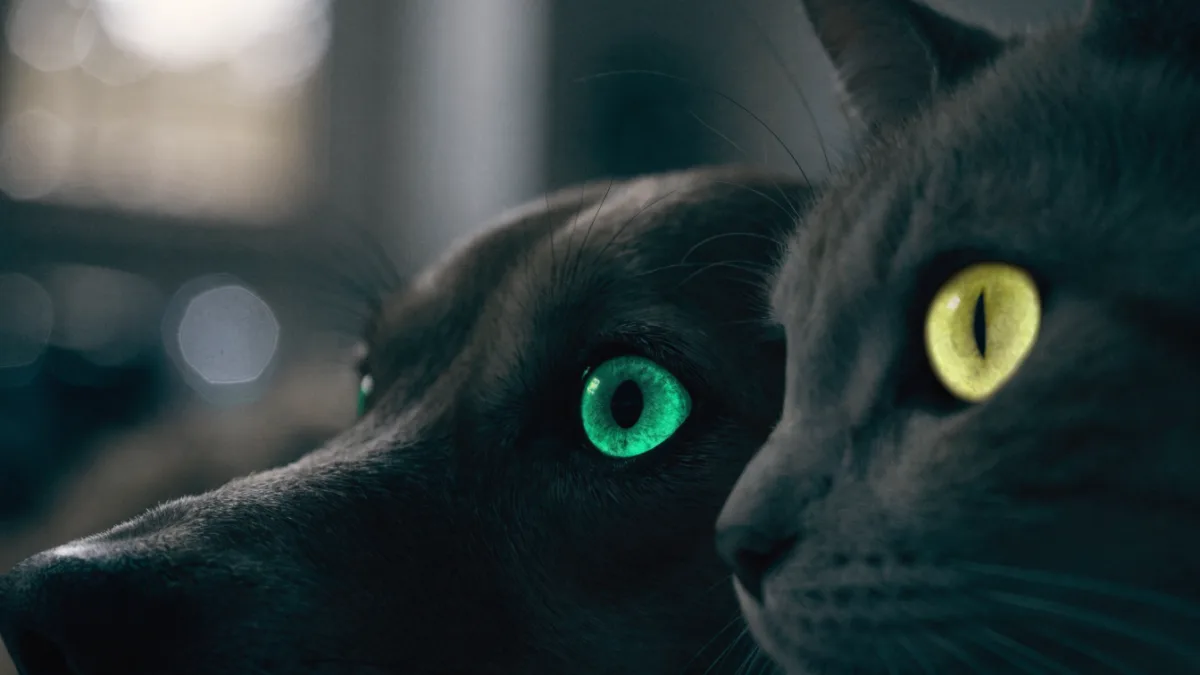
Picture this: It is 11:30 at night, and you are fumbling down the hallway to let your dog out for one last potty break. You haven’t turned on the kitchen lights yet, but as you round the corner, two bright, glowing green orbs suddenly materialize from the shadows. For a split second, your heart jumps into your throat. Then, your eyes adjust, and you realize it is just your loyal companion waiting patiently by the back door.
Whether you are startled by those glowing eyes in your own backyard or wondering how your cat manages to hunt toy mice in a pitch-black living room, you have experienced the magic of the tapetum lucidum at work. It is one of the most fascinating pieces of anatomy in the animal kingdom, and it is the exact reason our pets can navigate the dark so much better than we can. Let’s take a look inside the canine and feline eye to understand the real science behind that eerie nighttime glow.
The Anatomy of the Glow: What is the Tapetum Lucidum?
The phrase tapetum lucidum sounds like a spell from a fantasy novel, but it is actually Latin for “shining layer.” It is a specialized, biological mirror-like layer of tissue located immediately behind—and sometimes within—the retina of the eye.
To understand how it works, think about how a camera captures a photo in a dark room. Light enters the lens, passes through the sensor, and if there isn’t enough light, the photo turns out dark and grainy. The eye works in a remarkably similar way. Light enters through the pupil and passes through the retina, which is packed with photoreceptor cells called rods (responsible for low-light vision and motion detection) and cones (responsible for color vision and fine detail).
In a human eye, any light that misses the rods on the first pass is simply absorbed by the dark tissue at the back of the eye. But in dogs and cats, that unabsorbed light hits the tapetum lucidum. This reflective layer acts like a tiny parabolic mirror, bouncing the light directly back through the retina. This gives the rod cells a “second chance” to absorb the visual information. The result is a massive amplification of available ambient light, granting them incredible vision in dim conditions.
I remember examining a sweet, eight-year-old Border Collie named Jessie who had developed a slight cloudiness in her vision. When I shined my penlight into her eyes, her owner was alarmed because her eyes seemed to “flash” brilliantly. I had to reassure him that this intense reflection was actually the mark of a beautifully healthy, highly functioning tapetum lucidum. It is a feature, not a bug!
Cat Eyes Glowing vs. Dog Night Vision
While both species possess this remarkable shining layer, their visual capabilities in the dark are not exactly identical. Both dogs and cats are crepuscular, meaning they are historically wired to be most active during the twilight hours of dawn and dusk. However, because cats are apex nocturnal hunters, their night vision is on an entirely different level.
The Feline Advantage
When it comes to cat eyes glowing in the dark, you are usually seeing bright, vivid shades of green, blue, or yellow. This eyeshine is the direct result of the camera’s flash—or a passing headlight—bouncing off the tapetum lucidum and reflecting back into your own eyes.
Feline night vision is legendary. A cat requires only about 1/6th to 1/7th the amount of light that a human needs to see clearly. Part of this is due to their highly efficient tapetum lucidum, but they also have a massive advantage in their pupil shape. A cat’s pupil can dilate into a wide, circular opening, far larger than a human’s or a dog’s. This allows the absolute maximum amount of ambient light to flood into the eye and hit those light-hungry rod cells.
Man’s Best Friend in the Dark
Dog night vision is also vastly superior to our own, though slightly less acute than that of their feline counterparts. A dog typically needs about 1/4th to 1/5th the amount of light a human needs to navigate a dark space.
The eyeshine in dogs varies wildly. Depending on the breed, age, and the specific mineral content (like zinc or riboflavin) woven into their tapetum lucidum, a dog’s eyeshine might glow green, yellow, blue, or even a startling bright white or reddish hue. I always warn new puppy owners about this, especially when they are taking flash photography of their young dogs. A young puppy’s tapetum lucidum is still developing, so their eyeshine often glows a bright, fiery red because the camera flash is actually passing through the thin layer and bouncing off the rich blood vessels at the very back of the eye.
The Evolutionary Trade-Off: Why Human Eyes Do Not Glow
You might wonder: if this reflective mirror layer is so beneficial, why did humans lose it? Interestingly, humans are not the only ones missing out; pigs also lack a tapetum lucidum.
Nature is all about evolutionary compromises. While the tapetum lucidum grants incredible light amplification, it comes with a significant trade-off: visual sharpness. Because the light is actively being scattered and bounced around inside the eye, the image the brain receives is slightly blurry. Dogs and cats sacrifice fine detail and visual acuity to gain the ability to see in the dark. Humans took a different evolutionary path. Because we relied heavily on daytime vision for foraging and social interaction, we developed eyes packed with cone cells that give us high-resolution, full-color detail—leaving us practically blind in the dark.
This scattering of light is also the culprit behind a persistent myth I hear in the exam room all the time: the idea that dogs see the world like an old black-and-white television. I used to nod along with this decades ago, but I have completely changed my tune as the research evolved. Dogs do not see in black and white. They have dichromatic vision, meaning they have fewer types of cone cells than we do. They primarily perceive the world in shades of blues and yellows. Their high ratio of rods to cones gives them excellent motion tracking in the dark, but it does limit their color spectrum.
What Eyeshine Tells Us in the Exam Room
In veterinary medicine, that glowing reflection is more than just a cool party trick; it is a vital diagnostic tool. When I examine a patient, I use a technique called the “tapetal reflex.” I will dim the lights in the room and shine a light across both eyes to see how evenly they glow.
If one eye fails to glow, or if the glow is completely asymmetrical, it immediately tells me something is obstructing the light pathway. It can be an early indicator of cataracts, retinal detachment, glaucoma, or even a tumor behind the eye. I once saw a ten-year-old Beagle named Buster whose owner was convinced he was just “slowing down with age.” A quick check of his tapetal reflex showed that his left eye reflected light normally, but his right eye was completely dark. Further testing revealed he had gone blind in that eye due to slowly progressive retinal degeneration. That simple glow saved us weeks of guessing and allowed us to start adapting his environment immediately.
Respecting the Biology of the Dark
Because our pets’ eyes are so highly tuned to picking up ambient light, it is worth considering how our modern, brightly lit world affects them. A growing area of study right now is the impact of Artificial Light at Night (ALAN). Chronic exposure to indoor lighting and urban light pollution is currently being studied to see how it disrupts the natural circadian rhythms and sleep-wake cycles of domestic animals. Just as staring at your phone screen keeps your brain awake, leaving high-intensity lights on all night for your pets can actually overstimulate their highly sensitive eyes. Giving them a truly dark space to sleep in is one of the best things you can do for their neurological health.
It is also humbling to remember that this anatomy isn’t just for our pampered house pets. Wild felids like leopards and tigers, and wild canids like wolves and foxes, share this exact same biology. For them, the tapetum lucidum isn’t just a neat feature; it is the critical tool required for their survival. When we protect dark, natural habitats and reduce unnecessary light pollution in wild spaces, we are helping to preserve the natural hunting and navigational abilities of these incredible nocturnal predators.
The next time you catch your dog or cat staring at you from a dark room, take a moment to appreciate those glowing eyes. They are a beautiful, highly evolved reminder of the wild history our domestic companions carry with them, perfectly designed to see what we cannot.