

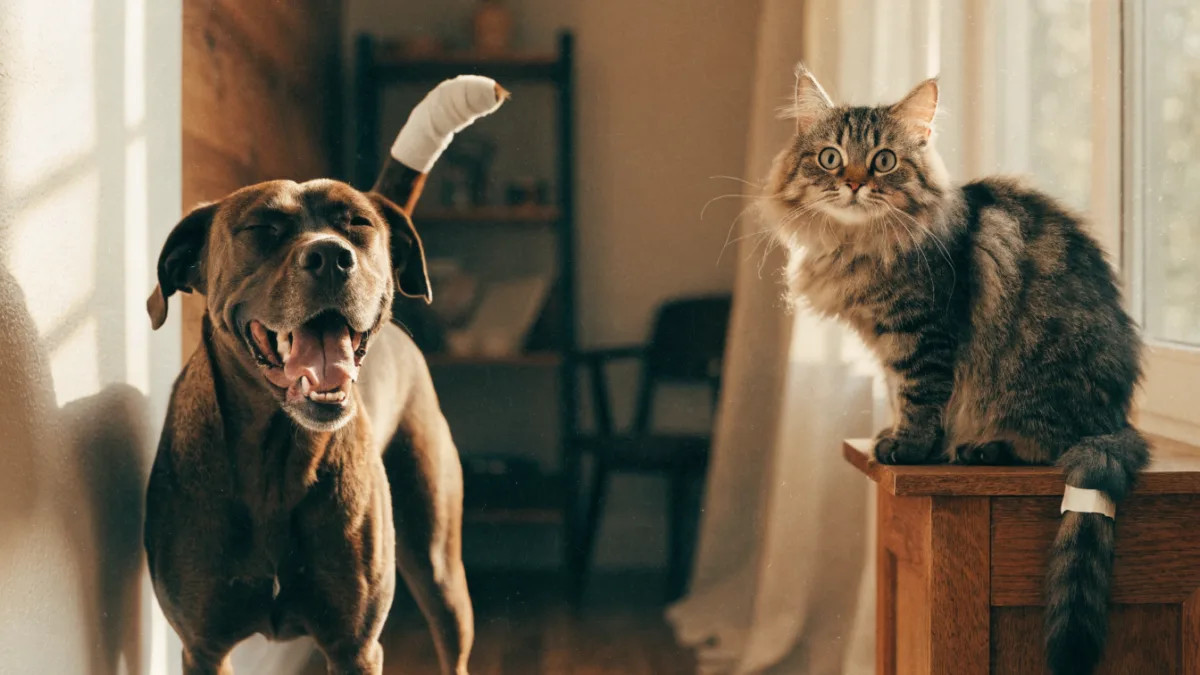
If you have ever owned a large-breed dog with a heavy-duty wag, or a curious cat that likes to squeeze into tight spots, you have probably worried about tail injuries. I will never forget a Wednesday morning last winter when a panicked client rushed in carrying her sweet, four-year-old Labrador Retriever, Buster. Buster was thrilled to be at the clinic, wagging his thick tail so hard that he was splattering blood all over my exam room walls, the floor, and my scrubs. It looked like a crime scene.
An hour later, I was suturing the tail of an indoor cat named Cleo, a sweet tabby who had her tail accidentally slammed in a sliding glass door. Both patients had severe tail injuries, both were incredibly painful, but the underlying causes, the treatments, and the prognoses were entirely different.
Treating tail injuries requires understanding whether we are dealing with repetitive trauma or acute trauma. Let me walk you through how we approach these two very common, very messy scenarios.
The Bloody Mess of ‘Happy Tail’ Syndrome in Dogs
Despite the cheerful name,,[1] is a nightmare to treat. It happens when a dog with a long, powerful tail repeatedly wags it against hard objects like walls, table legs, or the sides of a crate. Because the skin on a dog’s tail is incredibly thin and sits right over the bone, this enthusiastic wagging causes the skin to split open.
The result? A bleeding, splattering mess that drives owners crazy. High-risk dogs are usually large breeds with strong, thin tails—think Greyhounds, Great Danes, Pit Bulls, and Labrador Retrievers. I see it most often in dogs that are kenneled or kept in confined spaces where they just cannot get enough distance between their tail and a solid surface.
The fundamental issue with Happy Tail is that it is a repetitive trauma injury. The cure—resting the tissue—goes directly against the dog’s nature. Every time Buster hears a familiar voice, gets fed, or simply feels happy, he wags. The scab breaks, the wound reopens, and the bleeding starts all over again. His owner was at her wit’s end, having washed her living room curtains three times in a single month.
The Sudden Snap: Fractured Tails in Cats
On the other side of the spectrum, we have fractured tails in cats. While a dog’s Happy Tail is a slow accumulation of micro-traumas, a cat’s tail fracture is an acute trauma injury. It is a sudden, singular impact.
Most feline tail fractures I see are the result of a tail getting caught in a closing door, being accidentally stepped on, falling from a balcony, or, tragically, being hit by a car. A cat’s tail is a direct extension of its spine, made up of a series of small vertebrae called caudal vertebrae. Because the tail is crucial for balance—specifically the feline “righting reflex” that allows them to land on their feet—a break here is intensely painful and neurologically significant.
When Cleo came in with her fractured tail from the sliding door, she was hissing, hiding, and completely lacking her usual grace. Her fracture was near the base, which meant we had to carefully evaluate her nerve function to ensure she still had bladder and bowel control.
Why Improper First Aid Makes Things Worse
If you look up [2] you will often see the advice to “lightly bandage” the tail. I want to be incredibly clear here: improper bandaging is one of the fastest ways to lose a pet’s tail.
I have changed my mind over the years about recommending home bandaging. Early in my career, I would hand clients rolls of adhesive tape and tell them to wrap the tip of the tail. But what happens is that well-meaning owners wrap the bandage too tightly, or they use sticky tapes that contract and act like a tourniquet. This cuts off the blood supply, a condition called ischemia. Within hours, the tissue suffers necrosis (tissue death), turning an otherwise treatable split skin into a mandatory amputation.
If your pet injures their tail before you can get to a clinic, use a clean, sterile cloth or a non-stick pad applied with very gentle pressure. Do not wrap it tightly, and absolutely do not use superglue or human wound sprays.
Modern Treatments: From Lasers to Amputation
When these patients arrive at the clinic, our treatment protocols diverge based on the nature of the injury.
Healing the Happy Tail
For dogs like Buster, treating Happy Tail is a test of patience. The protocol involves:
- Thorough cleaning: We have to flush the wound to prevent infection.
- Antibiotic ointments: Applied to keep the tissue moist and fend off bacteria.
- Professional bandaging: We use a non-adherent dressing covered by a flexible, self-adhering wrap (never sticky tape directly on the fur). We secure it just tight enough to stay put, but loose enough to keep the blood flowing.
- Advanced therapies: Recently, I have had massive success using Class IV Cold Laser therapy. The laser reduces inflammation and accelerates cellular repair, helping those stubborn, chronic wounds finally close.
- Innovative gear: There has been a wonderful rise in specialized protective pet products. Padded tail guards, cushioned “tail sleeves,” and even crate bumpers are saving owners a lot of headaches by preventing the impact in the first place.
However, even with the best care, Happy Tail can be a relentless cycle. This leads to a common debate among owners and veterinarians: when do we stop bandaging and opt for amputation? Some owners view amputation as giving up too soon. But when a dog is constantly bleeding, in pain, and forced to wear the “cone of shame” for months on end, I advocate strongly for a partial amputation. We shorten the tail just enough so it can no longer strike the walls. It is a surgery that vastly improves the dog’s quality of life. They wake up, the pain is gone, and they can wag their little stub just as happily as they did their long tail.
Mending the Feline Fracture
For cats like Cleo, we are dealing with broken bones and potential nerve damage. Treatment depends entirely on where the break is and how severe it is.
If the fracture is stable and low on the tail, strict cage rest and pain management are often enough. The bone will calcify and heal on its own. If the break is unstable, we may need to apply a splint.
But if the tail is severely crushed, if the blood supply is permanently cut off, or if the nerves are severed causing permanent paralysis and loss of sensation, surgical amputation is the only humane option. Cats adapt remarkably well to tail amputations. While their balance might be slightly altered for the first few weeks, they quickly learn to compensate. Cleo ended up needing the distal half of her tail amputated, and within a month, she was scaling her cat tree like a pro.
A Final Thought on Our Shared Lives
It is fascinating—and a little humbling—to realize that neither Happy Tail Syndrome nor indoor feline tail fractures exist in the wild. Wild wolves do not wag their tails bloody against drywall, and wildcats do not get their tails slammed in minivans. These injuries are uniquely tied to domestication.
When we bring animals into our homes, we reshape their environments and their behaviors. We ask them to navigate our hard floors, our heavy doors, and our confined spaces. In return, it is our responsibility to protect them. Whether that means investing in padded crate bumpers for your exuberant dog, or being hyper-aware of where your cat is before you close a door, a little bit of prevention goes a long way in keeping those tails—long or short—happily wagging for years to come.
Sources
- Happy Tail Syndrome — petmd.com
- first aid for tail injuries — vcahospitals.com