
I want to be clear about something most people get wrong: heel is not the same as "walks nicely on a leash." Loose-leash walking means the leash is slack and your dog is somewhere near you. Heel means your dog is in a specific position — left shoulder at your left knee — and maintaining it with attention on you.
Both are useful. They're just different things.
The Position
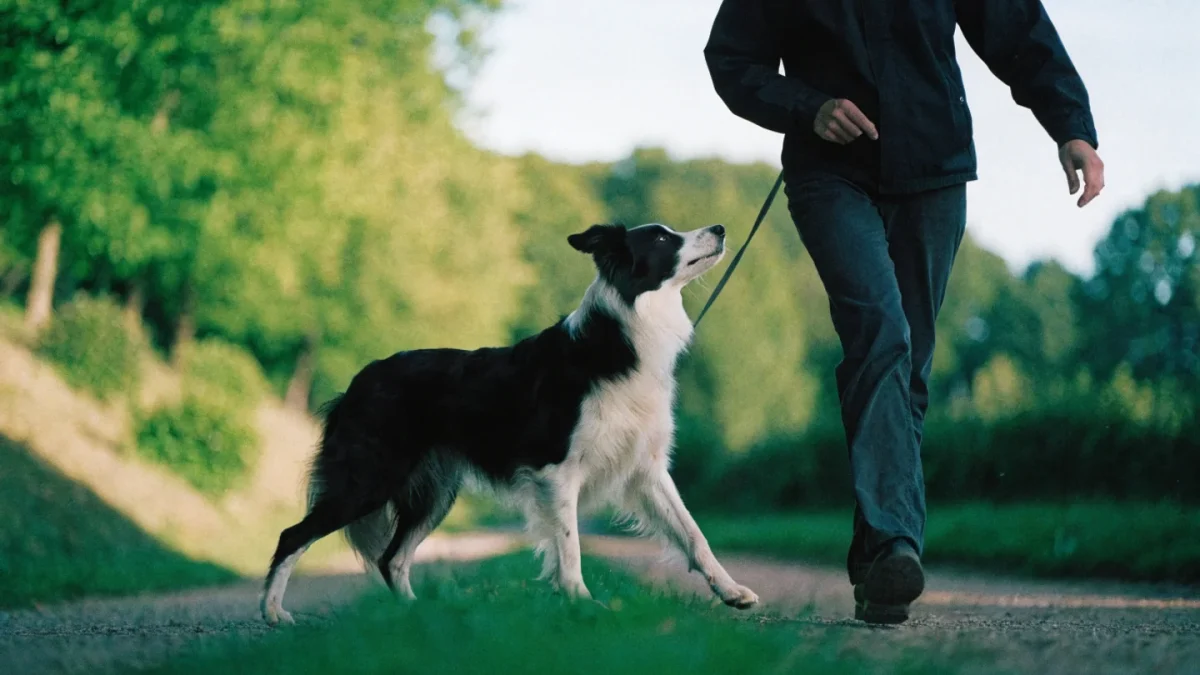
Classic heel position: your dog's left shoulder aligns with your left leg, they're facing the same direction as you, and they're at leg-contact distance or within six inches. Some handlers keep the dog right at the leg; others prefer a hand's width of space. Pick one and be consistent.
The dog's attention should be on you — not glued to your face, but available. They should be aware of your pace, your direction changes, and your signals.
Building the Position
Step 1: Mark the position without movement
Ask your dog to sit at your left side in heel position. Hold a treat at your left hip. The moment they're in position, mark and treat from that position (from your left hand at your left hip, not from in front of them).
Practice this until your dog is enthusiastically moving to your left side and looking up. That enthusiasm is what you're building — position becomes desirable before you add movement.
Step 2: One step
Take one step forward. If your dog maintains the heel position through that step, mark and treat immediately. If they drift out of position, reset to step 1.
One step is the full session for many dogs in the beginning. That's fine.
Step 3: Building duration
Once one step is consistent, go to two steps, then three, then five. Mark and reward while the dog is in position, not after they've broken out of it. You're reinforcing the position, not the stopping.
Step 4: Adding turns
Right turns are easiest — the dog naturally has to adjust their position slightly. Left turns are harder — the dog has to pull back to not get stepped on. About-turns (180°) are hardest.
Practice each type of turn separately. Mark and reward maintaining position through the turn.
Step 5: Pace changes
Speed up (fast), slow down (slow), and stop suddenly. Your dog should adjust. Mark and reward for staying in position through each change.
Adding the Verbal Cue
Once the behavior is solid with the hand lure, add "heel" just before you start walking. After several sessions pairing the word with the behavior, try: "heel" → expect position → walk.
Heel vs. Let's Go
Have two distinct walking modes: "heel" means precise position with attention; "let's go" (or "walk" or any word you choose) means loose-leash walking where your dog can sniff and range somewhat. Use heel when you need precision — crossing streets, passing other dogs. Use let's go for regular walks. (See also: the complete guide to leash training your dog.)
Off-Leash Heel
Off-leash heel follows the same steps but without the leash as a backup. Only attempt this in secure environments once on-leash heel is very reliable. Start in a fenced yard or quiet indoor space.
Start with the position exercise today: dog sitting at your left side, treat at your left hip, mark and reward. Fifty repetitions of that before adding any movement. Build the enthusiasm for position before you add the walking.