

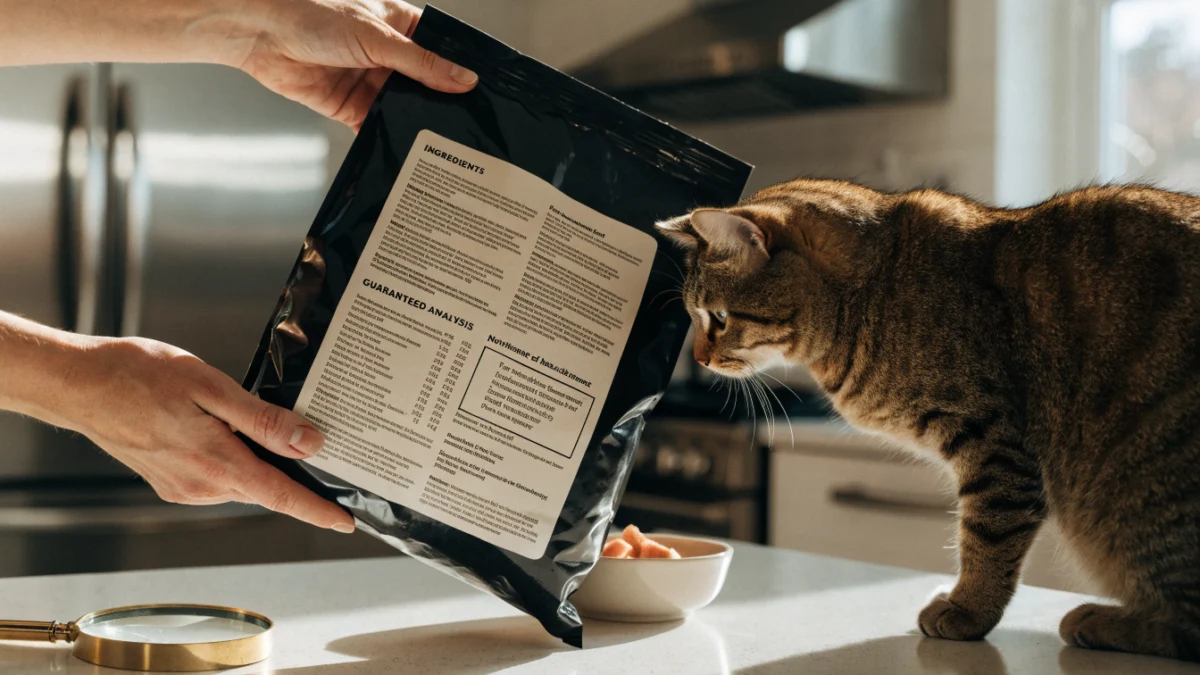
Last spring, a first-time cat owner I’ll call Priya came in with her newly adopted tabby kitten, Mochi, and two photos of food bags on her phone. “One says ‘with salmon’ and one says ‘salmon recipe,'” she told me. “They’re three dollars apart. Which one is actually better for her?” I love that question, because the honest answer is that neither name tells you much. The information that determines whether a food will actually nourish your pet lives on the back of the bag, in small type most people never reach — and the confusion is universal. Scroll through [1] and you’ll find the same overwhelmed question: how do I even read this? Whether you’re working out how to read dog food labels for the first time or decoding a can of cat food, here’s the crash course I give in the exam room. Since Americans spend more than $60 billion a year on pet food, it’s a skill that genuinely pays for itself.
The Name Game: What “Chicken Dinner” Legally Means
Product names aren’t a marketing free-for-all — they follow percentage rules written into the model regulations most U.S. states adopt from AAFCO, the Association of American Feed Control Officials. The rules create a ladder, and every step down requires dramatically less of the ingredient you think you’re buying:
- “Chicken Cat Food” must contain at least 95% chicken, not counting water added during processing (70% if you count the water).
- “Chicken Dinner,” “Entrée,” “Formula,” or “Recipe” needs only 25% chicken — which often shakes out to roughly 10% of the actual product once moisture is included.
- “Cat Food with Chicken” requires just 3% chicken. Three.
- “Chicken Flavor” has no minimum at all — the chicken only has to be detectable.
So much for Priya’s price gap: both bags were playing the name game. One more thing worth knowing — if a bag claims to be “AAFCO approved,” treat that as a small red flag. AAFCO isn’t a government agency, and it doesn’t approve, certify, test, or endorse any food. A manufacturer making that claim either doesn’t understand the rules or is betting you don’t.
The Ingredient List: Where Good Intentions Go to Hide
Everything is weighed raw
Ingredients are listed by weight before cooking. That sounds fair until you realize fresh chicken is roughly 70–75% water, while chicken meal — fresh chicken with the moisture cooked and pressed out — is about 10% water and 60–70% protein. A food listing “chicken meal” first can deliver more actual animal protein than one leading with fresh chicken. This matters most for cats, who are obligate carnivores. When clients ask me about the best cat food ingredients, I tell them to look for named animal proteins — chicken, salmon, turkey — high on the list, and to remember that “meal” isn’t a dirty word. Cats also require taurine, an amino acid that has to come from animal tissue, which is one reason plant-heavy diets are the wrong shape for them.
The splitting trick
Manufacturers can list one ingredient in pieces so each piece falls below the meat. “Ground corn, corn gluten meal, corn bran” is corn, three times — and together those fractions can outweigh the chicken sitting in the top spot. The same move happens with “brewers rice, rice flour, rice bran.” It’s legal, it’s common, and once you’ve seen it, you can’t unsee it.
The by-product myth
Early in my career, I steered everyone away from by-products — including the owner of Gus, a sweet senior Beagle, who left with a by-product-free food that cost forty percent more and, nutritionally, was no better. I’ve since changed my mind. Under AAFCO definitions, poultry by-product means necks, feet, internal organs, and viscera — and it specifically excludes feathers, hides, and hooves except trace amounts. Organs like liver are among the most nutrient-dense tissues in the body; humans pay restaurant prices for them. The honest concern with by-products is variability from batch to batch, not the word itself. From a manufacturer with consistent quality control, a by-product meal can be an excellent ingredient.
The Guaranteed Analysis: Doing the Math the Label Won’t Do for You
That panel of percentages reports minimums for protein and fat and maximums for fiber and moisture — not exact values. A food guaranteeing “26% minimum protein” might actually contain 30%. The bigger problem is that wet and dry foods can’t be compared directly, because moisture dilutes everything. The fix is a two-step calculation you can do right in the aisle:
- Subtract the moisture percentage from 100.
- Divide the protein percentage by that number, then multiply by 100.
Watch it work. A canned cat food listing 10% protein and 78% moisture: 10 ÷ 22 = about 45% protein on a dry matter basis. A dry food listing 26% protein and 10% moisture: 26 ÷ 90 = about 29%. The canned food looked “lower protein” on the label and is actually over 50% more protein-dense. The same math works for fat and fiber whenever you want a true head-to-head.
Nearby you’ll find the calorie statement, listed as kcal per kilogram plus a familiar unit like a cup or a can. Kibble ranges from roughly 300 to over 500 kcal per cup, so two bags at the same price can last very different lengths of time. For budget shoppers, the single most useful number is cost per 1,000 calories — divide price by calories and multiply by 1,000. It’s the only honest way to compare a small premium bag against a giant budget one.
The AAFCO Statement: Two Sentences Worth More Than the Front of the Bag
Clients ask me constantly what the AAFCO statement means, and it’s the most valuable two sentences on any package. Tucked in small print near the ingredient list, it tells you which life stage the food suits — growth, adult maintenance, or all life stages — and how the company knows that. AAFCO’s [2] explains the formats; here’s the short version:
- “Formulated to meet AAFCO nutrient profiles” means the recipe was designed on paper and never fed to a single animal in a test.
- “Animal feeding tests using AAFCO procedures substantiate…” means the food was actually fed to animals — a minimum of eight, for at least 26 weeks in the standard protocol. That’s a modest bar, but it’s higher than paper alone.
Two warnings worth memorizing. First, if the statement says “intended for intermittent or supplemental feeding only,” the food is not complete and balanced — it’s a topper or treat, no matter how hearty it looks. Second, if you’re raising a large-breed puppy headed for an adult weight over about 70 pounds, look for wording that specifically covers large-breed growth, because calcium control matters for those developing joints. And don’t be alarmed if newer bags read differently — labels are transitioning to a clearer “complete and balanced because…” format, so both old and new phrasing will share shelves for a few years. (Outside the U.S.? Europe’s FEDIAF statements follow the same principle.)
Buzzwords, Feeding Charts, and Other Traps
A few front-of-bag terms carry legal weight: “natural” and “organic” have actual definitions. “Premium,” “gourmet,” “holistic,” and “super-premium” mean nothing at all — anyone can print them at any price point. “Grain-free” deserves its own sentence: the FDA spent years investigating possible links between grain-free diets and heart disease in dogs, and closed its investigation in 2024 without establishing a causal relationship, though research continues. In the meantime, “grain-free” functions mostly as a health halo — grains aren’t a problem for the vast majority of pets.
One last trap lives in the feeding directions. Those charts often assume a young, active, unneutered animal and routinely overestimate what a spayed, neutered, or indoor pet needs. I see the fallout constantly — most recently Barney, a four-year-old neutered Labrador Retriever whose owner was feeding exactly what the bag recommended and couldn’t understand why Barney kept gaining weight. Use the chart as a starting point, watch your pet’s body condition, and adjust with your vet’s guidance rather than the manufacturer’s. For a fuller walkthrough of label anatomy, [3] covers the same ground well.
Here’s my takeaway, and it’s simpler than the industry would like: flip the bag. Read the adequacy statement first, run the dry-matter math when you’re comparing, scan the ingredient list for splitting, and ignore almost everything printed on the front. There’s even a conservation angle hiding in all this — by-products are, at their core, upcycling. Using organs and parts that humans won’t eat keeps perfectly good nutrition out of landfills and reduces the pressure to raise more animals for food. Choosing a complete-and-balanced diet that uses the whole animal, and feeding the amount your pet actually needs, is quietly one of the more sustainable choices a pet owner can make. Mochi, for the record, landed on a canned food listing chicken by-product meal second — and at her checkup last month, she had a shiny coat, clean teeth, and a vet-approved body condition. The code isn’t a secret. It’s just printed in small type, on the back, where the marketing can’t reach.
Sources
- any new-cat-owner forum — facebook.com
- consumer guide to reading labels — aafco.org
- this veterinary hospital guide — unionlakeveterinaryhospital.com