

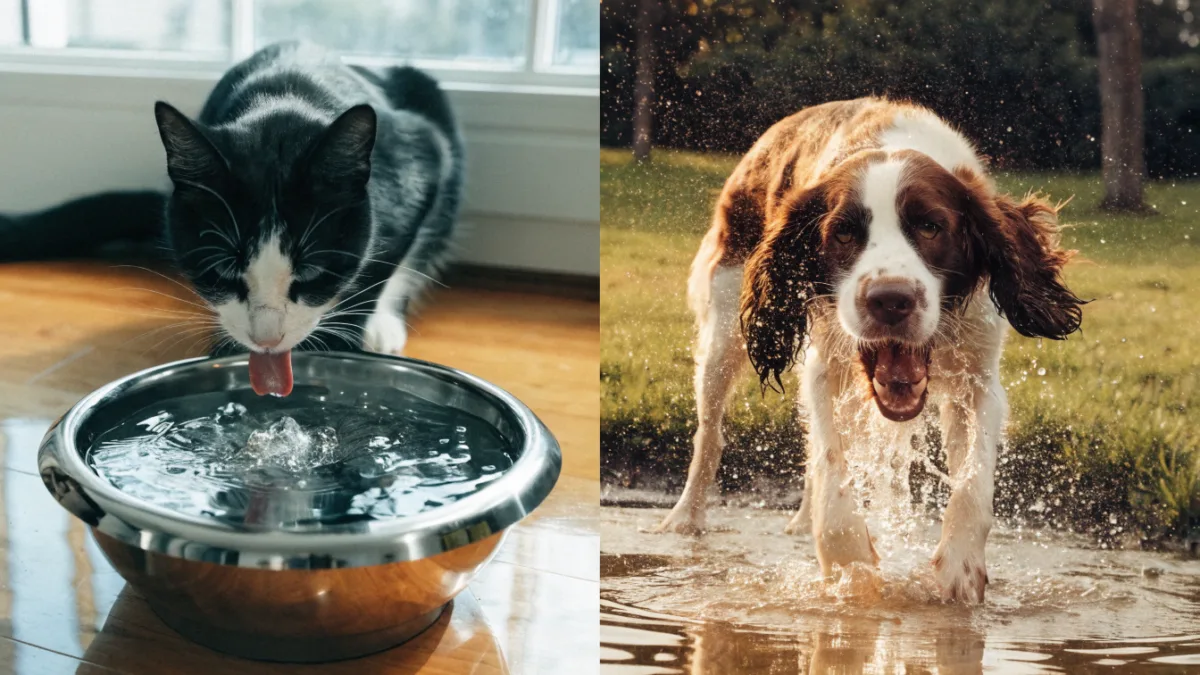
If you have both a dog and a cat living under your roof, you’ve probably noticed a hilarious and slightly gross disparity in how they handle their beverages. My dog, Barnaby, a lovable retriever mix with zero pretense, treats the water bowl like a competitive sport. He drinks with the enthusiasm of a vacuum cleaner, leaving a small ocean on the kitchen floor in his wake. He would happily slurp from a murky, algae-covered puddle in a parking lot if I let him. Then there’s my cat, Mochi. Mochi treats her still water bowl like it’s actively plotting against her. She will dramatically paw at the floor next to it, stare at me with utter disdain, and then march into the bathroom to scream at the sink faucet until I turn it on for her.
This massive difference in drinking behaviors isn’t just quirky pet personality stuff. It’s a fascinating mix of physics, evolutionary biology, and psychology. Scientists actually have a name for it: the hydration gap. Understanding why dogs drink like frat boys and cats drink like sommeliers isn’t just entertaining—it’s vital for keeping our pets healthy and avoiding some very expensive veterinary bills down the road.
The Physics of the Canine Slurp
Dogs are messy drinkers, and we have high-speed cameras to prove it. For a long time, people assumed dogs drank water by scooping it up into their mouths like a furry shovel. They don’t. When researchers used high-speed photography to study the fluid dynamics of how dogs drink, they discovered something entirely different.
Dogs actually curl their tongues backward toward their chins. When they plunge this backward-curved tongue into the water, it acts like a mechanical piston. According to,[1] dogs use brute physical force, punching the water with a larger surface area to create a massive upward surge of liquid. They then snap their jaws shut around that flying column of water before gravity can pull it back down.
It is a violent, inertia-based drinking method. It is incredibly effective for pulling in a large volume of water quickly—which makes sense for an animal that has historically been highly active and prone to overheating—but it is undeniably sloppy. Because dogs rely on this piston-action physics rather than careful precision, they don’t really care about the presentation of the water. Whether it’s a pristine stainless steel bowl or a muddy puddle on the hiking trail, if a dog is thirsty, that piston tongue is going to deploy.
The Feline Phobia of Stagnation
Cats, on the other hand, have an entirely different mechanical and psychological approach to hydration. Physically, cats use a much more delicate method.,[2] cats use a smooth, downward flick of the tongue to gently pull water up using the properties of surface tension and gravity. It’s a remarkably neat, silent process.
But the real difference isn’t in the physical lap; it’s in the mental prerequisites. Cats possess a deeply ingrained, instinctual distrust of stagnant water. To a cat, still water is potentially dead, contaminated, and teeming with invisible pathogens.
This isn’t just Mochi being a diva. In the wild, feline ancestors relied on fresh, moving water sources like streams to avoid illness. Sitting water in the wild often means water tainted with decaying organic matter or animal waste. Even though Mochi lives in a climate-controlled apartment with a HEPA-filtered existence, her brain is still wired for the savanna. As the,[3] this evolutionary quirk is exactly why cats will bypass a perfectly good bowl of tap water to drink from a freshly filled bathtub, a dripping showerhead, or even a puddle forming outside the window.
The Danger of the Dehydrated Diva
Here is where the hydration gap becomes a medical issue. Dogs are generally pretty good at staying hydrated because they will happily drink whatever is put in front of them. Cats are notoriously bad at it. Felines have a naturally low thirst drive because their ancestors got most of their required moisture from the blood and tissue of their prey.
The modern indoor cat eating a diet of dry kibble is at a severe disadvantage. When a cat refuses to drink from a still bowl because it triggers their “this water is dead” instinct, they are putting themselves at a high risk for chronic dehydration. This isn’t something to take lightly. Chronic dehydration forces a cat’s kidneys to work overtime to concentrate their urine, and over time, this constant stress is directly linked to feline kidney disease and severe urinary tract issues. Male cats, in particular, are prone to developing crystals and life-threatening urinary blockages when they don’t consume enough water.
Bridging the Gap: Luxury Gimmick or Medical Necessity?
Because of these urinary and kidney risks, there is a lively debate among pet owners about whether water fountains are a genuine medical necessity or just another ridiculous pet industry marketing gimmick. I have very strong opinions on this: for cats, circulating water bowls are a vital health tool.
Research consistently demonstrates that cats will visibly increase their water intake when the water flows or circulates. The movement signals to the cat’s instincts that the water is fresh, safe, and alive. When I finally caved and bought a pet fountain for Mochi, her water consumption went through the roof, and her constant yowling at the bathroom sink completely stopped. It changed everything. It wasn’t a luxury; it was a bridge over the hydration gap.
What to Look for in a Pet Fountain
The pet tech market has realized this, and the recent boom in pet hydration means you have a lot of options. I never recommend specific product brands because what works for one household might not work for another, but here is exactly what you should look for when shopping for a fountain:
- Material matters: Avoid cheap plastics if you can. Plastic scratches easily, and those microscopic scratches harbor bacteria that can cause feline chin acne. Look for heavy-duty stainless steel or ceramic fountains.
- Filtration systems: Cats hate the smell of chlorine or heavy metals in tap water. Look for a fountain with a multi-stage filter (usually activated carbon) that removes those odors and tastes. If the water smells “clean” to them, they will drink more.
- Easy to clean: A fountain is useless if it’s too complicated to scrub. Algae and biofilm build up incredibly fast. Look for models with dishwasher-safe components and few hard-to-reach crevices.
The Muddy Puddle Reality Check
While we are solving the cat water crisis, we need to have a quick chat about the dogs. Just because Barnaby is biologically equipped to violently slurp down a muddy puddle doesn’t mean he should. While dogs aren’t as sensitive to the presentation of their water, they are absolutely susceptible to what is living inside it.
Veterinarians constantly debate the risks of dogs drinking from standing water in nature. That innocent-looking muddy puddle at the dog park can be a microscopic cocktail of danger. Stagnant, warm water is a prime breeding ground for Giardia, a parasite that causes awful gastrointestinal distress. It can also harbor Leptospirosis, a bacteria spread through animal urine that can lead to severe liver and kidney damage in dogs (and humans). And in warmer months, still water can develop blue-green algae, which is rapidly fatal if ingested by a dog.
I don’t give health advice, but I do defer to common sense: if you wouldn’t drink the water, try to gently redirect your dog away from it. When it comes to teaching a dog a reliable “leave it” command so they don’t dive nose-first into every puddle, I completely defer to professional dog trainers like Jake. It’s one of the most valuable tools you can have in your back pocket. (For serious behavioral leash-pulling or recall issues, definitely find a local positive-reinforcement trainer in your area).
Wild Ancestors in Our Living Rooms
Ultimately, the hydration gap is a beautiful reminder of where our pets came from. Neither the dog nor the cat is “wrong” in how they drink. They are simply responding to the world using hardware and software designed for the wild.
Wolves, roaming vast territories and exerting massive amounts of energy to hunt, needed to be able to gulp down massive amounts of water quickly whenever they found a lake or river, using their brute-force piston tongues to keep moving. Wildcats, stalking prey in arid environments, needed to be hyper-vigilant about water quality to survive, learning to seek out moving, oxygenated streams and getting the rest of their hydration from their fresh kills. When we bring these animals into our homes, we are asking them to adapt to an incredibly artificial environment.
The best thing we can do as pet parents is to honor those ancient instincts. Provide your cat with filtered, moving water to protect their delicate kidneys and satisfy their evolutionary need for safety. Provide your dog with endless bowls of clean, fresh water so they don’t feel the need to use their piston-tongues on the nearest stagnant pond. By understanding the fascinating science behind why they drink the way they do, we can keep them healthier, happier, and significantly less dramatic.
Sources
- research highlighted by the American Physical Society — aps.org
- Unlike the canine piston punch — reddit.com
- Mobile Vet Nurse points out — facebook.com