
The most common mistake people make when getting a second dog is bringing the new one home and letting the existing dog "work it out." Sometimes it works fine. More often, you get a tense first meeting in your home — the resident dog's territory — that sets a bad tone for weeks.
The introduction protocol isn't complicated, but it does require more than thirty seconds of thought. Here's the sequence worth walking through.
Why Neutral Territory Matters
Your existing dog has a concept of home space. Some dogs are casual about it; others are significantly territorial. Meeting a strange dog in that space, especially one that's about to live there, triggers guarding instincts that a neutral location doesn't.
A park, a parking lot, a quiet street — somewhere neither dog has claim to. This isn't just nice-to-have; it's the piece most people skip that causes the most problems.
Step 1: Parallel Walking
Before any face-to-face contact, walk the dogs in parallel — same direction, enough distance that they're aware of each other but not fixating or pulling. You want loose, curious attention, not stiff-bodied staring.
Start at a distance where both dogs are comfortable (not reactive, not pulling hard toward each other), and gradually reduce the gap over 5-10 minutes as body language stays relaxed.
Watch for:
- Loose, wiggly body posture — good
- Soft mouth, easy panting — good
- Stiff body, hard stare, high tail — too much, increase distance
- Hackles up, growling — stop, increase distance significantly, reassess
Parallel walking lets dogs decompress the novelty of each other before any direct interaction.
Step 2: Controlled Sniffing
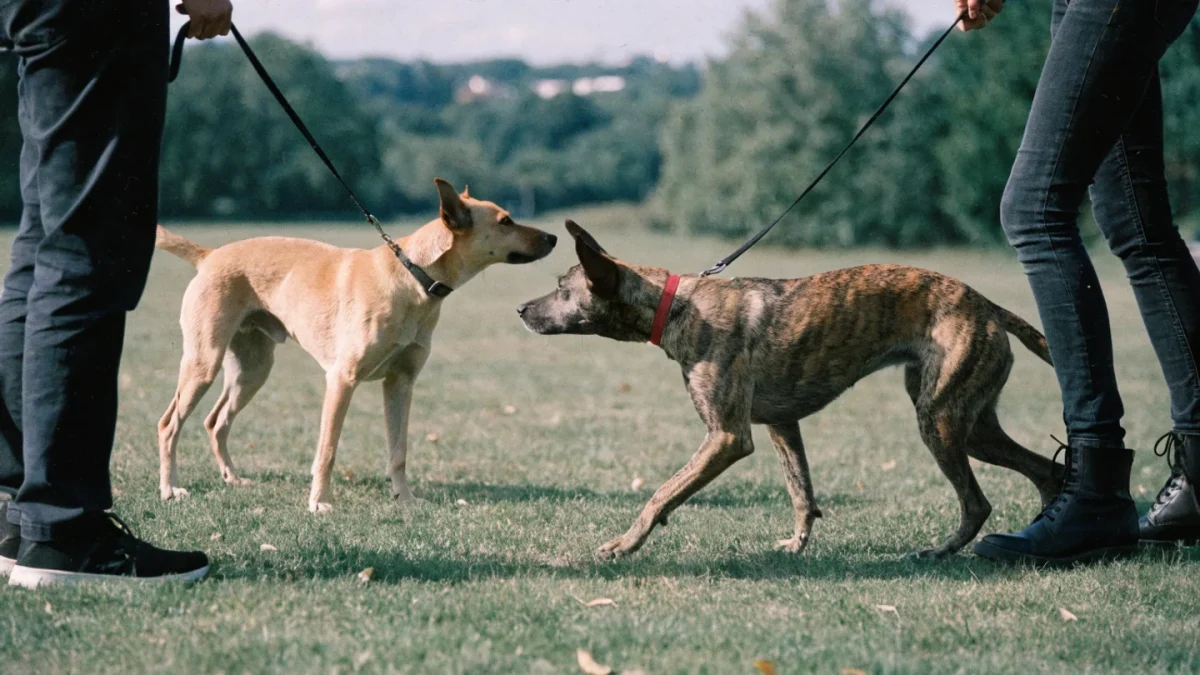
Once both dogs are walking comfortably in parallel at a few feet of distance, allow a brief greeting — 2-3 seconds of sniffing, then separate. Brief greetings prevent a greeting from escalating; dogs that circle each other and sniff continuously can ramp up arousal to a point where any slight communication error turns into a scuffle.
Allow greeting, then call both dogs away, reward, repeat. Keep leashes loose during greeting — a taut leash communicates tension to both dogs.
Step 3: Entering the Home
This is where the protocol matters most. Don't just walk in the door and let them run together. The resident dog is now on their territory.
Enter together but with management:
- Leashes on both dogs initially
- Multiple handlers if possible — one per dog
- Allow the resident dog to investigate first while the new dog is held calmly
- Remove obvious trigger items — food bowls, high-value toys, the resident dog's bed — before entry
Supervised, loose time in a space that's been cleared of resources. Watch body language. Interrupt if postures get stiff.
The First Week
Management over the first week matters more than many people realize. This is when patterns are established.
- Separate feeding, always
- Separate sleeping spaces, especially at first
- Supervised interaction — not free-for-all time in the backyard together while you're inside
- Give the resident dog individual time with you — this matters for their emotional state
Some dogs establish comfort with a new housemate in days. Others take weeks. The introduction protocol reduces the risk of a bad start; good ongoing management handles the rest.
Signs It's Going Well
- Dogs approaching each other voluntarily with loose bodies
- Mutual play solicitation (play bows, soft bouncing)
- Tolerance of each other's proximity without stiffening
- Relaxed in same room without fixating on each other
Signs You Need to Slow Down
- Consistent growling or snapping during interactions
- One dog constantly avoiding or hiding from the other
- Stiff-bodied attention that doesn't soften over time
- Resource guarding emerging around food, toys, or people
If issues aren't resolving within two weeks with good management, a consult with a professional is worthwhile — early intervention is much easier than correcting established patterns.