

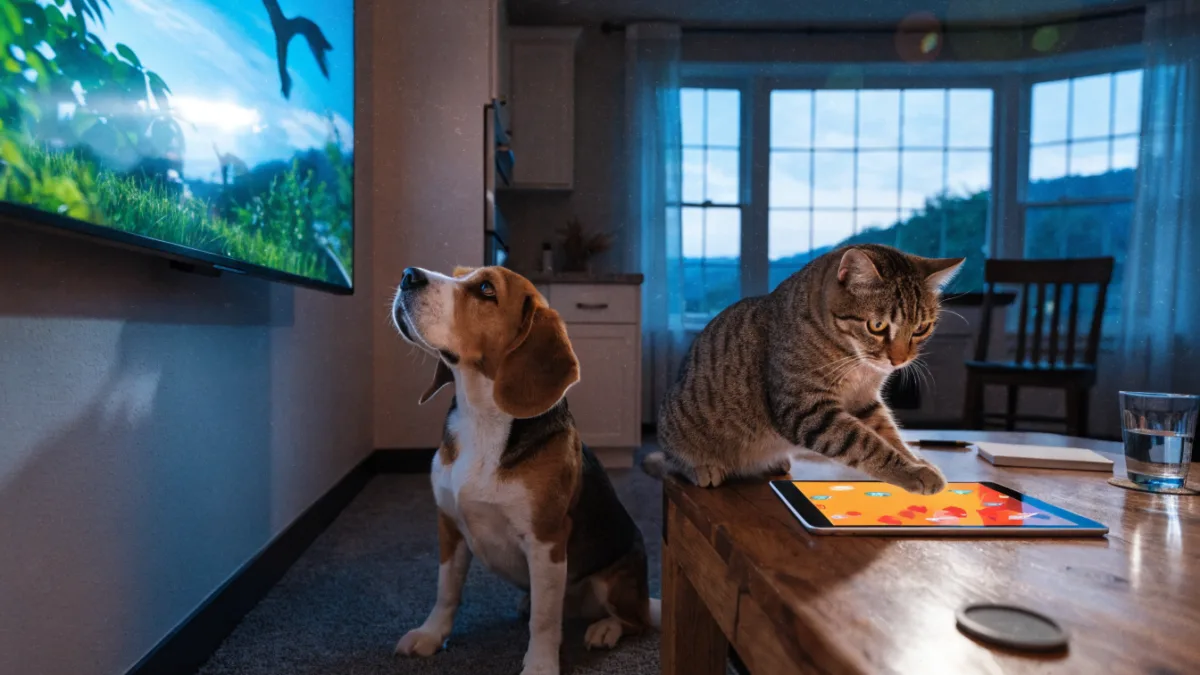
Last Tuesday, I walked into my living room to find my cat Mochi sitting on my iPad, which she had somehow unlocked with her paw. She wasn’t just sitting on it—she was actively swiping through a YouTube video of birds at a feeder, occasionally tapping the screen when a particularly tempting finch appeared. My iPad now has a permanent collection of tiny claw scratches across the protector, and Mochi has developed what I can only describe as a streaming addiction. Meanwhile, my roommate’s beagle mix, Cooper, spends his evenings locked in on Animal Planet, head tilting at every bark and growl. Watching the two of them engage with screens so differently got me thinking about what’s actually happening in those furry little heads—and why cats and dogs have such completely different relationships with our devices.
The Science of the Screen: How Pets Actually See Technology
Here’s something that blew my mind when I first learned it: your dog probably couldn’t watch television ten years ago. Not because they weren’t interested, but because they literally couldn’t see it properly.
It comes down to something called flicker fusion rate—basically, how quickly a brain processes successive images as smooth motion. Humans process visual information at about 45-60 hertz, which is why older televisions refreshing at 50-60Hz looked fine to us. But dogs process visual information at a higher rate. To a dog watching an old CRT or early flat-screen, those “smooth” images probably looked like a choppy, flickering slideshow. Imagine trying to get invested in a movie when every frame stuttered like a poorly buffered video. No wonder they ignored it.
Modern 4K televisions with high refresh rates—120Hz and above—changed everything. Finally, dogs can see fluid motion on screen, and suddenly they actually have a reason to pay attention.
Cats, on the other hand, have always been able to see movement on screens just fine. Their visual processing is highly tuned to detect motion—a survival trait from their days as ambush predators. They don’t see color as vividly as we do, but they don’t need to. A dark shape darting across a bright background? That’s all the information a cat’s brain needs to scream “CATCH IT.”
The iPad Hunter: Why Tablets Are Cat Magic
Television is a passive experience. You sit, you watch, nothing you do changes what’s on screen. But a tablet? A tablet responds.
When Mochi taps at a digital mouse darting across my iPad screen, the mouse changes direction. When she swipes, the screen scrolls. There’s cause and effect—something that touches something deep in the feline brain. It’s not just watching; it’s doing. And for an animal hardwired to stalk, chase, and capture prey, that interactivity is intoxicating.
“Tablet games tap directly into a cat’s predatory sequence—the stalk, the chase, the pounce. The problem is that the sequence never completes. There’s no catch, no kill, no eat.”
The apps designed for cats understand this perfectly. Digital mice, bugs, and fish move erratically—just like real prey would. They hide behind objects, dart out unexpectedly, and change speed. Some cats get so engaged that they teach themselves to keep the game going. There are entire social media accounts dedicated to cats who’ve learned to swipe through videos, accidentally FaceTime their owners, or restart apps when the digital prey disappears. One cat went viral after figuring out how to keep her favorite bird video playing by tapping the screen every time it paused. That’s not random behavior—that’s a cat who’s worked out cause and effect.
But Not Every Cat Cares
Here’s where personality matters enormously. Mochi will abandon a warm lap and a full food bowl to chase digital fish. My parents’ cat, Biscuit, looked at the iPad exactly once, sniffed it dismissively, and walked away to nap in a shoebox. He’s never shown the slightest interest since.
This divide usually comes down to a few factors: age, natural prey drive, and overall environmental security. Younger cats and highly active breeds tend to be more screen-engaged. Cats who are naturally food-motivated or who have strong hunting instincts—the ones who stalk dust bunnies and attack your feet under the blankets—are prime candidates for tablet obsession. Cats who are more laid-back, older, or simply less stimulated by movement often couldn’t care less.
Neither response is wrong. It’s just personality.
The Couch Potato Pup: Why Dogs Watch TV Differently
While cats want to interact with screens, dogs tend to observe them. Cooper doesn’t try to catch the dogs he sees on Animal Planet. He watches them. He tilts his head when they bark. He occasionally glances at the door when he hears a dog whining onscreen, as if expecting a visitor.
Dogs are drawn to television for different reasons than cats. Sound plays a massive role—their hearing is far more acute than ours, and animal noises, human voices, and even certain musical cues grab their attention. But now that modern TVs actually show fluid images, visual content matters too. Dogs have been observed reacting to animals on screen, particularly other dogs, and following movement with their eyes in ways that suggest genuine engagement rather than random attention.
There’s been a whole industry springing up around this. Streaming services designed specifically for dogs offer content calibrated to canine vision and hearing—different color palettes, specific sound frequencies, and motion patterns meant to soothe or stimulate. Whether dogs actually enjoy these programs the way humans enjoy a good Netflix binge is debatable, but many owners report their dogs settling down and relaxing with the right programming on.
The Screen Time Dilemma: How Much Is Too Much?
Here’s where things get complicated, and where I have to be honest about the downsides.
Remember that incomplete hunting sequence? When a cat stalks, chases, and pounces on digital prey but never actually catches anything—never feels the satisfaction of a physical capture—some behavior experts worry that creates frustration. Not the fun kind of frustration that makes play rewarding, but the chronic kind that can lead to agitation, stress, and even aggression.
I’ve seen this with Mochi. After about fifteen minutes of intense tablet play, she starts getting twitchy. Her tail lashes. She’ll sometimes bite at the iPad or swat aggressively at things that aren’t there. It’s like she’s worked herself into a hunting frenzy with no release valve. The solution? Always follow up screen time with something physical. A treat, a real toy she can actually catch and carry around, a few minutes with a feather wand. Give that hunting sequence a satisfying ending.
When tablet time becomes a problem
Some owners report their cats becoming genuinely distressed when the tablet is taken away—vocalizing, pacing, searching for the screen. One person described their cat sitting on the closed laptop lid for hours, waiting for the birds to come back. That’s not enrichment anymore; that’s dependency.
The general consensus among behaviorists seems to be: screen time is fine as part of an enrichment routine, not the whole thing. Ten to fifteen minutes a day, followed by physical play and a reward? Great. Three hours of unsupervised tablet access while you’re at work? Probably not ideal.
And then there’s the practical concern: your screen. Cats have claws. Claws meet glass. Even with a screen protector, an enthusiastic cat can do real damage. I’ve resigned myself to replacing my iPad protector every few months, but that’s my choice and my budget. A thick, high-quality screen protector is non-negotiable if you’re going to let your cat use a tablet. Look for tempered glass rather than film—it handles the impact of a full-force pounce much better.
Why Digital Play Actually Matters
Despite the concerns, I’m genuinely glad tablet games and “Cat TV” exist. Here’s why: indoor cats need enrichment, and a lot of owners struggle to provide enough of it.
Cats who live indoors—which is safer for them and exponentially safer for local wildlife—don’t get the mental stimulation that outdoor cats do. No stalking real bugs, no climbing actual trees, no encountering new smells and sounds. Boredom in cats isn’t just sadness. It manifests as overgrooming, destructive behavior, excessive vocalization, and sometimes aggression. Mental enrichment isn’t a luxury for indoor cats; it’s a basic welfare need.
Tablet games and bird-watching videos are tools. Not the only tool, not a replacement for physical play and environmental enrichment, but a legitimate option for breaking up the monotony of indoor life. For cats in small apartments, for owners with limited mobility, for elderly cats who can’t run and jump like they used to but still want to hunt—digital play fills a real gap.
The Bottom Line on Pets and Screens
Cats and dogs engage with screens differently because they’re different animals with different instincts. Cats want to hunt—tablets let them hunt. Dogs want to observe—modern TVs finally let them see clearly enough to bother paying attention. Neither is wrong, and both can be valuable enrichment when used thoughtfully.
The key is balance. Screens shouldn’t replace physical play, real toys, or one-on-one time with you. They should supplement those things. Watch your pet’s body language. If your cat seems frustrated after tablet time, shorten the session and always follow up with something tangible. If your dog gets anxious watching certain content, switch to something calmer. And talk to your vet if you’re noticing obsessive behaviors—you know, beyond the normal feline level of demanding attention at inconvenient moments.
As for Mochi, she’s currently asleep on the iPad. Which, honestly, might be the ideal balance—hunt for a bit, nap on the hunting ground. Cats have figured out self-care in ways humans still haven’t mastered.
And if keeping our cats entertained indoors means fewer songbirds in their mouths and more digital mice on their screens? That’s a trade-off I’ll make every time. The birds win, the cats win, and my furniture stops getting used as a scratching post during the 3 AM zoomies. Mostly.