

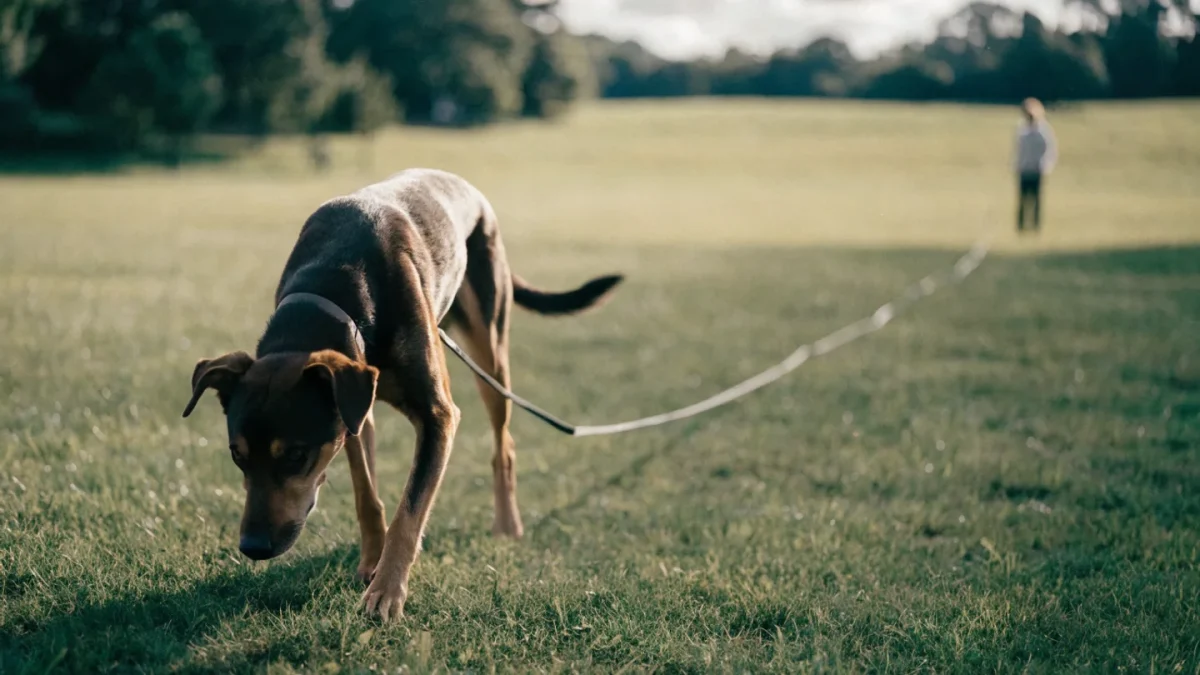
The tool that closes the gap between on-leash training and reliable off-leash behavior is a long line, and it's the one most people skip. They train behaviors at leash length, assume the dog is reliable, let them off-leash, and then watch the dog disappear.
A long line is the in-between tool that builds the reliability that makes off-leash work actually possible.
Standard Leash (4-6 Feet)
This is your everyday walking and training leash. The 4-6 foot length keeps the dog close enough for direct management while allowing natural movement.
Use for:
- Loose-leash walking training
- Basic obedience in controlled environments
- Any training where the dog is close to you
Material considerations: Nylon is common, functional, and easy to clean. Leather softens over time and is easy on hands. Biothane (plastic-coated webbing) is waterproof and extremely durable. The material matters less than having an appropriate weight for your dog's size — a massive leash on a small dog is cumbersome; a delicate leash on a large strong dog may not be safe.
Long Line (15-30 Feet)
A fixed-length rope or flat line that extends significantly farther than a standard leash. Not an extending/retractable leash — a passive line that pays out on the ground.
Use for:
- Recall training: dog learns to come when called with freedom of movement, while you maintain the ability to reel them in if needed
- Proofing behaviors in distraction-heavy environments before the dog is ready for off-leash
- Outdoor sniff walks where you want to give significant freedom without losing the dog
- Any training situation that requires freedom of movement beyond standard leash range
Key differences from extending leash:
An extending leash actively pays out and retracts. It teaches dogs that pulling creates more leash — the opposite of loose-leash training. A long line lies on the ground and doesn't actively manage the dog. It's a safety net, not a control tool.
Material and setup:
Biothane is the most practical for long lines — lightweight, doesn't tangle easily, easy to clean. Cotton rope works but can be heavy when wet and tangles more. Avoid very thin lines (cutting hazard, painful if it runs through your hands quickly) — 3/4 inch width minimum.
Attach to a back-clip harness rather than a collar for long-line work; if the dog hits the end of the line at speed, harness distribution is safer than neck impact.
Short Tab Lead (8-12 Inches)
A very short leash attached to a collar or harness that gives you a grip point without a full-length leash dragging. Useful during transitions from leash to off-leash work.
Use for:
- Indoor management when you need a quick handle on the dog
- Transitional stage from full leash to off-leash when you want a quick grab point available
- Any situation where a full leash would be in the way but you want a physical handle option
Slip Lead
A looped lead that forms a temporary collar when slipped over the dog's head. Common in handling contexts (vet offices, kennels).
Use for:
- Quick temporary management
- Transfer situations (from car to veterinary office, for example)
- Not recommended as a regular training or walking tool — positioning matters for safe use, and misuse can cause neck strain
What Not to Use for Training
Extending/retractable leashes: Teach pulling for length, create unpredictable leash behavior, remove handler responsiveness. Not recommended for training contexts.
Chain leashes: Heavy, noisy, difficult to hold comfortably, no training benefit over nylon or biothane.
The right line is the one that's appropriate for what you're teaching. Most trainers cycle between a standard 6-foot leash and a long line depending on the behavior and environment they're working in.