

Picture a frantic owner rushing into a clinic with a shivering, mud-covered Beagle named Buster. Buster had bolted during a thunderstorm the night before, slipping right out of his collar. Fortunately, a good Samaritan found him wandering a busy intersection and brought him to a local animal shelter. The shelter staff scanned him, found a tiny microchip, and within hours, Buster was back in the arms of his weeping owner. Stories like Buster’s are exactly why microchipping is worth championing. Statistics show that one in three family pets will become lost at some point during their lifetime. While collars and ID tags are a great first line of defense, they aren’t foolproof. Microchipping offers a permanent, unalterable layer of security that can mean the difference between a joyful reunion and a lifetime of heartbreak.
The Limitations of Traditional ID and How Microchips Work
I always recommend that pets wear a collar with up-to-date physical identification tags. They are highly visible, allowing anyone who finds your pet to simply call the number on the tag. However, collars can easily slip off, break, or—worst-case scenario—be intentionally removed by someone with bad intentions. This is where a microchip becomes invaluable.
A microchip is a permanent form of identification that stays with your pet for life. But before we go further, let me clear up the most common misconception I hear in the exam room: a microchip is not a GPS tracker. I’ve had countless clients ask me to “ping” their dog’s chip to find their location, and I completely understand why they’d want that!
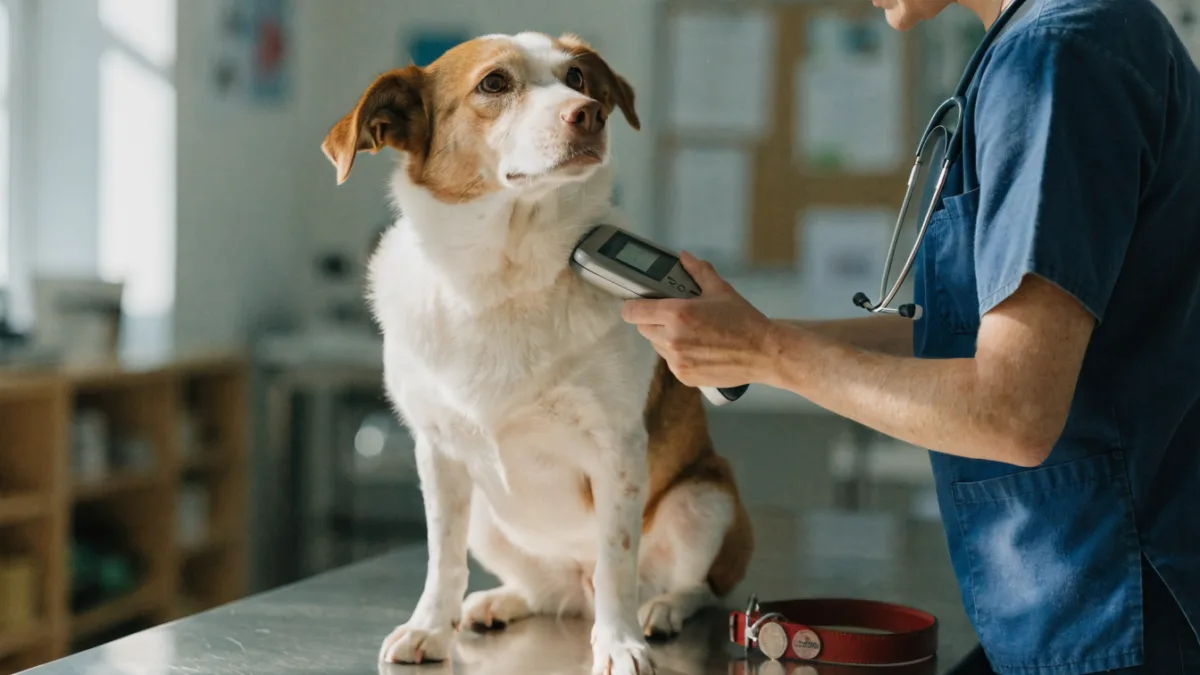
Instead of active satellite tracking, a microchip is a radio-frequency identification (RFID) transponder. It’s about the size of a grain of rice and is injected just beneath the skin, usually between the shoulder blades. It doesn’t have a battery or an internal power source. It only activates when a special scanner is passed over it. The scanner sends out a low-frequency radio wave that briefly powers the chip, allowing it to transmit a unique 15-digit identification number back to the scanner’s screen. That number is the key to finding you, but only if the key is placed in the right lock.
The Lifelong Commitment to the Registry
Getting your pet chipped is only step one. I often see a “set it and forget it” mentality when it comes to pet identification, and it’s a major debate in the veterinary community. Owners assume that once the chip is injected, their job is done. Unfortunately, a microchip is only as good as the information linked to it. If you don’t register that unique chip ID into a database with your current contact information, the chip is effectively useless.
I remember treating a sweet, middle-aged Golden Retriever named Daisy who was brought in as a stray. She had a beautiful, healthy coat and clearly was someone’s beloved pet. We scanned her and found a chip. We cheered, thinking the mystery was solved. But when we looked up the number in the registry, the owner’s phone number was disconnected, and the address was from three apartments ago. We tried the emergency contact listed, but they hadn’t spoken to the owner in years. It was absolutely heartbreaking. Had Daisy’s owner simply spent five minutes updating her profile online, she could have gone home that same afternoon.
When you move, get a new phone number, or change emergency contacts, you must update your information in the microchip registry. It requires a lifelong commitment to keeping your phone number, address, and emergency contacts current.
Finding the Right Registry and Using Universal Lookups
Years ago, there was a real concern about “brand-specific” scanners. If a shelter had one brand of scanner and your pet had a different brand of chip, it might not be detected. Today, universal scanners are the industry standard, meaning nearly any vet clinic or animal shelter in the country can read your pet’s chip, regardless of who manufactured it.
To make things even easier, the American Animal Hospital Association (AAHA) developed a universal microchip lookup tool. Vets and shelter workers can type your pet’s chip number into this single search engine, and it will instantly tell them which specific registry company holds your contact information. From there, the registry contacts you directly to let you know your pet has been found.
The Reunification Math: Why Microchips Matter
If you ever wonder whether microchipping is worth the minor pinch of the needle, let’s look at the evidence-based numbers. The statistics surrounding reunification are staggering.
- Dogs: Microchipped dogs have a 52% return-to-owner rate. This means they are more than 2.5 times more likely to be reunited with their families than non-microchipped dogs.
- Cats: Microchipped cats have a 38% return-to-owner rate, making them a staggering 20 times more likely to go back home.
The contrast for cats is especially striking. Without a microchip, the return-to-owner rate for felines plummets to a dismal 2%. Cats are notorious for slipping out of collars, and when they end up in a shelter, they are highly stressed and often hide, making it difficult for staff to match them to missing pet posters. For an indoor-only cat that accidentally dashes out the door, a microchip is often their only ticket home.
Modernizing the Chip: Smart Registries and Global Trends
Microchipping isn’t a static technology; the way we use the data is constantly evolving. Modern microchip registries are moving far beyond basic spreadsheets of names and phone numbers. Many newer database apps allow you to upload clear photos of your pet, store their digital medical records, and even instantly broadcast “lost pet” alerts to local shelters, rescue groups, and veterinarians in your immediate area the very second your pet goes missing.
We are also seeing a global shift in how governments view this technology. Recognizing the immense value of permanent identification, several countries and local municipalities have introduced or passed legislation making microchipping legally mandatory for all dogs, and sometimes cats. Countries like the UK, France, and parts of Australia now require mandatory microchipping to help curb stray populations and reduce the burden on animal shelters. While laws vary widely depending on where you live, the underlying scientific consensus remains the same: permanent identification saves lives.
Addressing the Health and Safety Debate
I completely understand the impulse to question whether implanting a foreign object under your pet’s skin is safe. It’s a valid concern, and it comes up often. Occasionally, there is public debate regarding the safety of microchips, specifically fears about cancer forming at the injection site.
Veterinary associations worldwide widely agree that the benefits of microchipping vastly outweigh the incredibly rare risk of adverse medical reactions. The microchips are encapsulated in biocompatible glass, meaning the body largely ignores them. The risk of a sarcoma or tumor forming at the injection site is exceedingly rare, especially when compared to the incredibly high risk—one in three—of your pet going missing. The chip is engineered to last for the entire lifespan of your pet, offering you immense peace of mind regardless of unexpected situations like natural disasters, accidentally escaped gates, or panicked bolting from loud noises like fireworks.
Always discuss any medical procedure with your own veterinarian. No article can give specific dosage advice or medical directives for an animal nobody has examined — but your personal vet can easily assess your pet’s health and safely administer a microchip during a routine wellness exam.
The Ultimate Takeaway
While we often focus on wild habitats and conservation in the broader study of animal science, our domestic companion animals rely entirely on us for their survival and safety. Pet overpopulation is a crisis, and millions of unidentifiable animals are euthanized in shelters every year simply because their families couldn’t be located. By committing to microchipping—and strictly maintaining that registry information—you are doing more than just protecting your friend; you are actively helping to reduce the burden on shelters and rescues.
Check your pet’s chip today. Log into your registry, verify your phone number, and make sure the emergency contact is a trusted friend or family member who will answer the phone when you can’t. That tiny grain of glass beneath the skin is your lifelong promise to them: no matter what happens, I will always bring you home.