

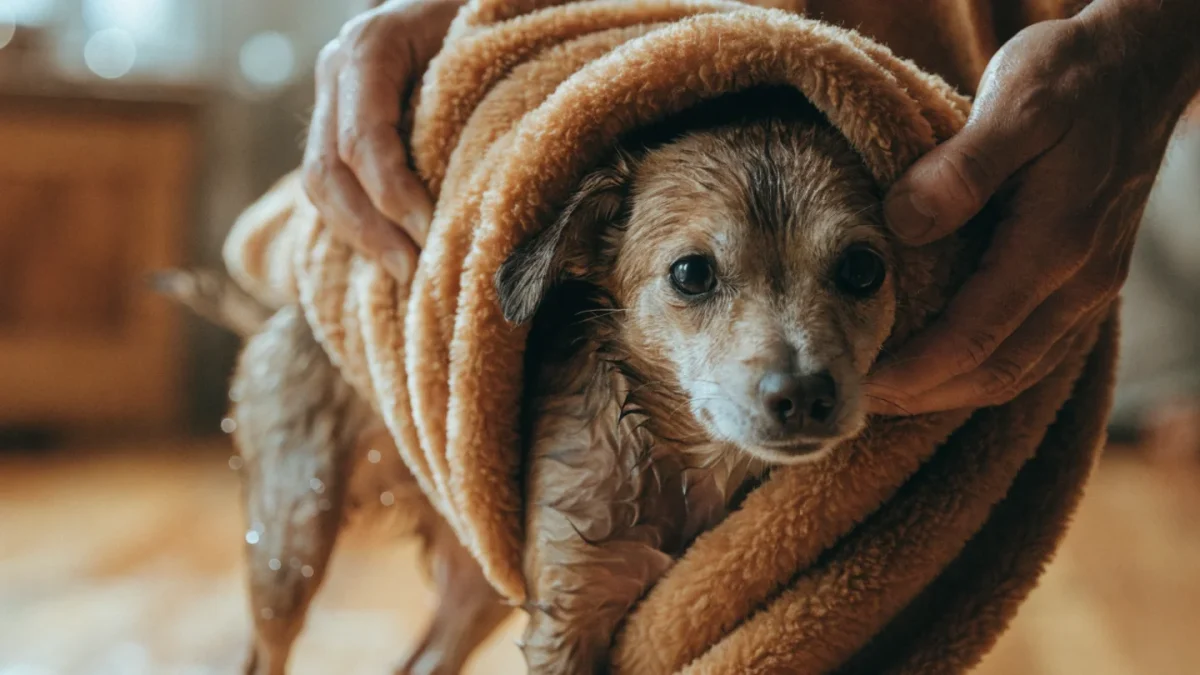
A January night, maybe three years ago. A couple came in carrying their Beagle, Max, wrapped in a beach towel. They'd left him outside "for just a few minutes" while they unloaded groceries — except they'd gotten distracted, and "a few minutes" turned into closer to forty-five in 15°F temperatures with a strong north wind. Max was barely responsive. His temperature was 92°F.
What struck me was that Max's owners were completely blindsided. He was a healthy adult dog with a normal coat. They thought dogs were tougher than that. And honestly, that assumption — that dogs and cats are built for cold — puts pets in danger every winter.
Hypothermia is not just "being really cold." It's a physiological collapse. And the window between "this dog needs help" and "this dog might die" is shorter than most people realize.
What Hypothermia Actually Is
Normal body temperature for dogs is 101-102.5°F. For cats, slightly higher — 100.4-102.5°F. Hypothermia begins when core temperature drops below 99°F in dogs and below 99°F in cats.
The body's response to cold follows a predictable sequence. First, peripheral blood vessels constrict — blood is pulled away from the skin and extremities and redirected to core organs to keep them warm. This is why hypothermic animals often have pale or white gums and feel cold to the touch even when their core is still relatively okay. Then shivering kicks in — the body literally burns energy to generate heat through muscle movement.
If exposure continues, those compensatory mechanisms start to fail. Shivering stops (the body has used up its glucose stores, or it's just too overwhelmed). Heart rate slows. The kidneys and liver begin to dysfunction. At severe hypothermia, the heart becomes arrhythmic and vulnerable to arrest.
The thing about this progression is that it can happen surprisingly fast in small animals, in wet animals, and in wind. Wetness destroys insulating capacity — a wet coat becomes almost worthless. Wind strips away the thin layer of warm air next to the skin. A wet cat in 35°F temperatures with a breeze is in serious danger within an hour.
The Three Stages: What You're Looking For
Mild Hypothermia (99-90°F)
This is the stage where you can easily miss what's happening.
- Shivering — often vigorous and continuous
- Muscle stiffness or awkward gait
- Lethargy, slowed responses
- Ears and extremities cold to touch
- Animal may still be alert and responsive
Shivering is a good sign in the sense that it means the body is still actively fighting. But don't mistake "still fighting" for "fine." Get the animal inside and warm immediately.
Moderate Hypothermia (82-90°F)
- Shivering may stop — this is actually worse, not better
- Obvious muscle rigidity
- Pale, gray, or bluish gums
- Heart rate notably slower than normal
- Stumbling, incoordination, difficulty standing
- Dull, glassy eyes
- Reduced or absent response to stimulation
When shivering stops in a cold animal, something has gone wrong. The body has either exhausted its heat-generating capacity or core temperature has dropped low enough that the shivering mechanism itself has shut down. Either way, you need a vet.
Severe Hypothermia (below 82°F)
- Unconscious or barely responsive
- No voluntary movement
- Heart rate very slow or irregular
- Breathing very slow, shallow, or absent
- Fixed, dilated pupils
- Muscle completely rigid
This is a cardiac emergency. Without active warming via warmed IV fluids, body cavity lavage, and intensive monitoring, severe hypothermia is fatal.
First Aid: What to Do Before the Vet
I want to be very clear about what "first aid" for hypothermia means and doesn't mean. First aid buys you time. It does not replace veterinary care. If your pet is moderately or severely hypothermic, you are doing first aid while getting to the vet — not instead of it.
Step 1: Move the animal inside immediately.
Get them out of the cold. Out of wind. Off frozen ground. Into a warm (not hot) space.
Step 2: Remove wet material.
Wet fur, wet bedding, wet clothing — anything wet needs to come off. Wet insulation isn't insulation.
Step 3: Wrap in dry, warm blankets.
Use body-temperature or slightly warmer blankets if possible — not blankets from a dryer on high heat, which can burn. Wrap the body, not just the extremities. The goal is to prevent further heat loss while the animal generates their own heat, and to provide some gentle external warmth.
Step 4: Use chemical heat packs or warm water bottles wrapped in towels.
Never apply heating pads, heat lamps, or hot water bottles directly to the skin. These can cause burns before the animal's impaired circulation can register pain. Wrap heat sources in at least one layer of towel. Place against the groin and armpits — areas where blood vessels are close to the surface.
Step 5: Offer warm fluids if the animal is conscious and swallowing.
Warm (not hot) broth, warm water. Only if they're awake enough to swallow safely.
Step 6: Get to a vet.
Warming a moderately or severely hypothermic animal requires warmed IV fluids to warm from the inside. This cannot be done at home. Also, hypothermia often accompanies other injuries or conditions — a dog who fell through ice may have inhaled water, have lacerations, or be in shock.
What NOT to Do
Do not rub or massage the limbs vigorously. Cold extremities have poor circulation, and sudden movement can drive cold blood from the periphery into the core, dropping temperature further — a phenomenon called "afterdrop."
Do not apply direct heat — heating pads on the skin, heat lamps, hair dryers close to the body. Burns develop frighteningly fast on hypothermic patients who can't feel pain normally.
Do not give alcohol. I know this is an old folk remedy. It's wrong. Alcohol causes peripheral vasodilation, which feels warm but actually speeds heat loss and drops core temperature further.
Do not assume the animal is stable because they seem improved. Animals can appear to rally and then deteriorate rapidly.
Rewarming: The Vet's Approach
When a hypothermic patient comes into my clinic, we're doing several things simultaneously that you simply can't do at home.
Warmed IV fluids go in fast. This warms the blood from the inside, which is far more effective than external warming alone. We'll run fluids at 37°C — blood temperature.
We take continuous temperature readings, because rewarming too fast creates its own problems (rewarming shock, electrolyte shifts).
We monitor cardiac rhythm. Cold hearts are arrhythmic hearts. A dog coming up from 86°F may have abnormal heart beats during rewarming that need to be watched and sometimes treated.
We check for secondary problems: aspiration pneumonia if they were in water, electrolyte abnormalities, AKI from decreased kidney perfusion.
Mild hypothermia can often be managed with passive external rewarming and monitoring at the hospital. Moderate to severe hypothermia typically requires active core rewarming. Survival rates for severe hypothermia are guarded but not hopeless — Max survived, came in at 92°F, went home the next evening. But he needed an overnight in the hospital.
Which Pets Are Most Vulnerable
All pets can develop hypothermia. But some are at much higher risk:
Small breeds and small dogs — More surface area relative to body mass, less insulation, faster heat loss.
Short-coated breeds — Greyhounds, Whippets, Chihuahuas, Boxers, Dobermans. Essentially no subcutaneous fat or coat insulation.
Puppies and kittens — Immature thermoregulation. A very young puppy can become hypothermic at room temperature if separated from their mother.
Senior pets — Reduced circulation, often lower muscle mass (less heat generation), and frequently underlying conditions.
Sick or debilitated animals — Any illness that affects circulation, metabolism, or muscle function increases hypothermia risk.
Wet animals — Regardless of coat type, a soaking wet animal loses heat profoundly faster than a dry one.
Cats outdoors in winter — Particularly feral or stray cats who can't come inside. Stray cats found unresponsive in winter should be brought in immediately and not assumed dead — cats have survived hypothermia with body temperatures well below what would kill a human.
Preventing Hypothermia: The Actual Checklist
- Know your pet's cold tolerance — don't guess based on breed stereotypes
- Limit outdoor exposure when temperatures drop below their safe threshold
- Keep walks shorter and more frequent rather than long in cold weather
- Provide adequate shelter for any dog kept outside (insulated, elevated, windproof, dry bedding)
- Dry wet pets immediately after baths, swimming, or coming in from rain/snow
- Don't leave pets in cold cars — the interior cools rapidly
- Check on older and smaller pets more frequently in cold weather
- Know where your nearest emergency vet is before winter starts
FAQ
My dog was shivering after a walk but seems fine now — should I still worry?
If shivering resolved after warming up and your dog is acting completely normally, they likely experienced cold discomfort rather than true hypothermia. Monitor for the rest of the day. If any lethargy, weakness, or continued stiffness develops, call your vet.
Can cats get hypothermia indoors?
In very cold houses or if a cat gets very wet, yes — though uncommon. Kittens, elderly cats, and sick cats are most vulnerable. Any cat showing lethargy or stiffness in a cold environment should be warmed and examined.
How do I tell if a pet is dead or just severely hypothermic?
You often can't, and neither can I with certainty on first look. "Looks dead" in a cold animal is not good enough. Severely hypothermic animals can have hearts beating so slowly they're barely detectable, and may have respiratory rates below what's visible. Assume they're alive and treat accordingly until a vet has assessed them.
Can I use a heating pad on my hypothermic pet?
Only with several layers of cloth between the heating pad and the skin, and only on the lowest setting. Direct contact with a heating pad — or any heat source — on a hypothermic animal routinely causes burns.
What temperature is dangerous for dogs to be left outside?
Below 32°F is risky for most dogs. Below 20°F is dangerous for nearly all dogs. But individual factors — breed, age, coat, health status, wind, wetness — matter as much as the number on the thermometer. When in doubt, bring them in.